
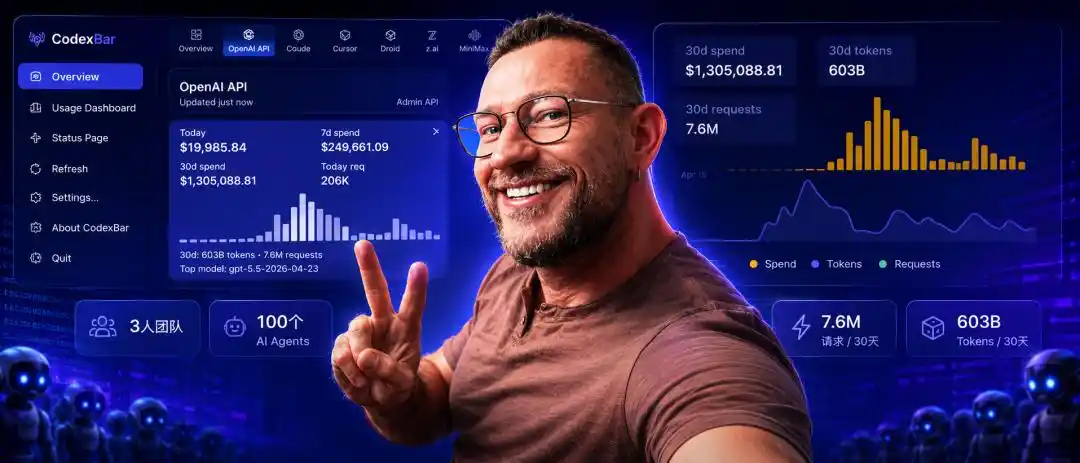
The screenshot posted on X on Friday showed a number most developers will never see on their own dashboards: $1,305,088.81 in OpenAI spending over 30 days.
The bill covered 603 billion tokens across 7.6 million requests, generated by roughly 100 instances of OpenAI’s Codex coding agent. The people behind it: a three-person team. OpenAI covered the tab.
Peter Steinberger, the Austrian developer who created the open-source automation project OpenClaw and now works at OpenAI, posted the figure and framed the experiment as a research question: if tokens were no longer the binding constraint, what would software development look like? The disclosure, reported by 36Kr and shared widely across developer channels, is the most concrete public data point yet on what autonomous AI coding costs when run without budget limits.
The agents are not simply generating code. Steinberger has described an autonomous development pipeline in which roughly 100 Codex instances run continuously against the OpenClaw codebase, an open-source project for controlling smart-home and desktop automation that has become one of the more visible examples of agent-driven engineering.
The fleet handles work that would ordinarily occupy a mid-sized engineering organization: reviewing pull requests, scanning commits for security vulnerabilities, deduplicating GitHub issues, writing fixes for reported bugs, monitoring benchmark results, and posting regression alerts to the project’s Discord server. In some cases, the agents open pull requests directly after listening to recorded meetings. The three human members supervise the fleet and set direction rather than executing tasks hands-on.
The spending figure reflects Codex’s “Fast Mode” pricing, which consumes credits at a significantly higher rate than standard execution. Steinberger has been transparent about that detail, noting that with fast mode disabled, the cost falls below the fully loaded expense of a single senior engineer while producing considerably more output.
The bill matters because it puts a real number on the gap between what developers pay for AI coding tools and what the underlying inference actually costs. OpenAI estimates that Codex costs between $100 and $200 per developer per month on average, with wide variance depending on model choice and automation intensity. Steinberger’s month sits at the extreme end of that variance: roughly 100 agents running around the clock at unthrottled speed. The $1.3 million figure is what the work cost to run at full tilt, not what a typical buyer would pay for comparable output — a distinction Steinberger himself has emphasized.
The subsidy math is the uncomfortable part for the industry. AI coding tools are competing aggressively on price right now. Codex, Claude Code, and Cursor all sell subscriptions far below the raw API cost of the compute they consume, subsidizing inference to attract developers. OpenAI shifted Codex to token-based billing in April, a signal that the subsidy model may not last indefinitely. Steinberger’s month shows exactly how wide the gap between subscription revenue and actual inference cost can get when agents run continuously — and OpenAI absorbed the bill itself, treating the spend as a research and engineering investment.
For enterprises planning agentic development teams, the number is a useful calibration point. Most planning today is done from vendor projections and estimates. Steinberger’s disclosure provides a measured data point: 100 agents running for 30 days on a large codebase cost between $300,000 and $1.3 million per month depending on execution speed, before optimization.
The experiment points at a structural question that the industry is only beginning to confront. Software development has historically been priced around human labor: headcount, salaries, and the speed at which engineers produce working code. If AI agents can do the work of a mid-sized team at a token cost that is falling every quarter, the unit economics of building software change — and so does the value of the people who direct the agents rather than write the code.
That is the scenario Steinberger’s team is testing. Three humans, a hundred agents, and a workflow in which the humans review, direct, and make judgment calls while the agents execute. The reaction across developer communities has been split between excitement at what the setup can produce and unease about what it implies for engineering employment. If a three-person team backed by a token budget can sustain the output of a much larger organization, the question becomes what the optimal size of a software company actually is.
The answer is not yet clear. Token costs at the scale of $1.3 million a month remain prohibitive for most companies, and the quality of agent output still requires human oversight. But the direction of travel is visible: the cost of inference is falling, the capability of agents is rising, and the bottleneck is shifting from writing code to managing the system that writes it.
One detail in Steinberger’s post drew particular attention: the bill was paid by OpenAI. That choice makes the experiment possible — no startup team could fund a $1.3 million month on its own — and it also makes the figure hard to replicate elsewhere. A team paying its own way would run agents slower, spend less, and measure success differently, several developers noted in response to the post.
Steinberger’s $1.3 million month is a single data point, but it is a valuable one. It quantifies what continuous, unthrottled agentic development actually costs, exposes the subsidy embedded in every AI coding subscription, and demonstrates that a three-person team can operate a development pipeline of a scale previously associated with a mid-sized engineering organization. The experiment’s real question — what happens to software development when tokens become cheap — will be answered by falling prices in the coming quarters. The bill posted on Friday is the baseline against which that change will be measured.



