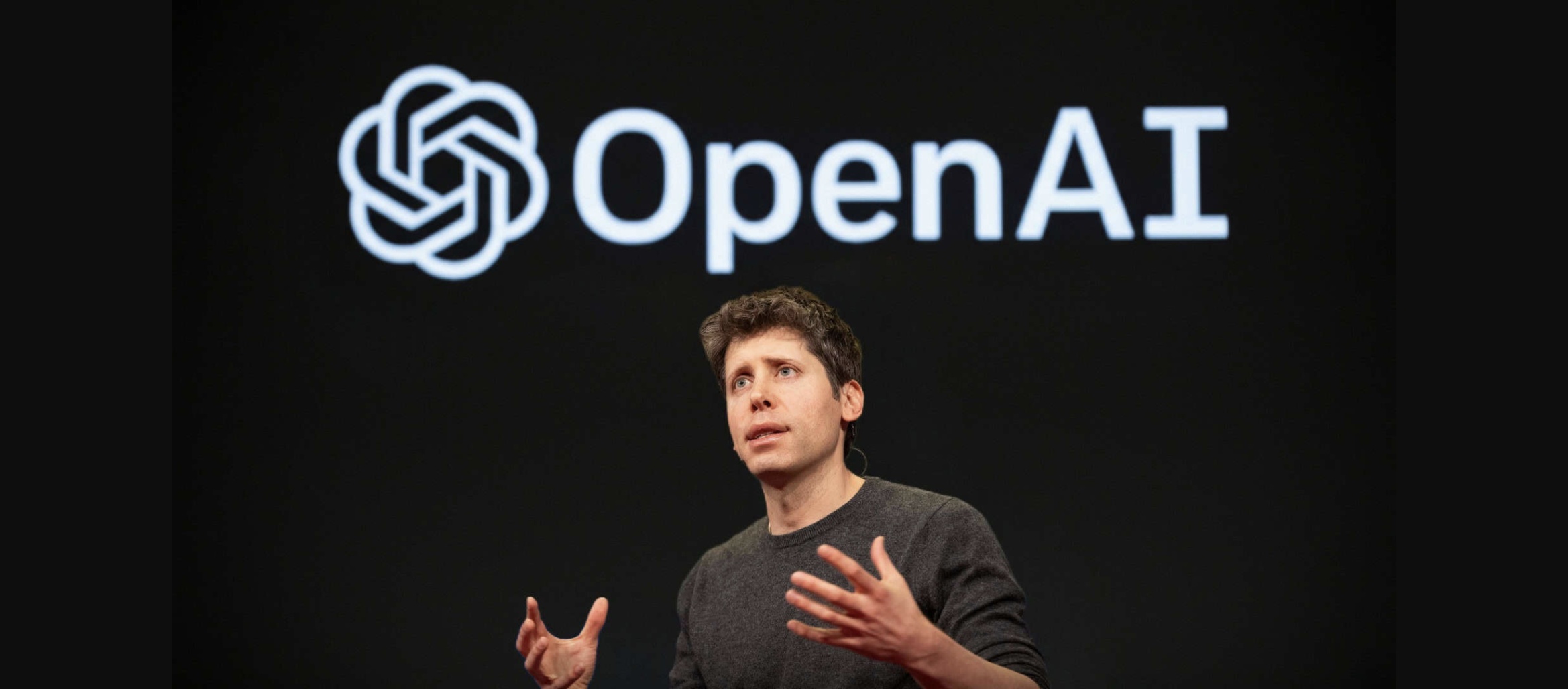
In 2023, Sam Altman told audiences that “jobs are definitely going to go away” as AI improved. By 2025, he was warning that entire categories of white-collar work, especially entry-level roles, were at risk from systems that could write, code, research and handle administrative tasks. This week, the OpenAI chief executive said he was wrong.
In an interview with TIME published this week, Altman said the AI-driven “jobs apocalypse” he had long warned about probably will not happen. “We’ve been roughly right on technological predictions and pretty wrong on the social and economic implications,” he said. “I’m delighted to be wrong about that.”
The reversal is striking, coming from the executive whose warnings helped drive a global debate about AI and employment. OpenAI’s ChatGPT, released in late 2022, made the automation threat feel immediate, and Altman’s pronouncements gave the concern a chief executive’s voice. Now the same voice is telling workers, and the markets, that the worst-case scenario did not arrive.
What changed, according to the interview and the data around it, is reality. Employment for workers in AI-exposed occupations has stayed relatively stable since ChatGPT’s launch, and the feared surge in unemployment never materialized. Instead, economists have documented a productivity effect: AI makes workers faster at existing tasks, which tends to raise demand for their labor rather than eliminate it.
Economists call the pattern the Jevons paradox, after the 19th-century observation that more efficient coal engines increased coal consumption rather than reducing it. The same logic appears to apply to AI: customer service teams handle more inquiries, radiologists analyze more scans, and programmers ship more software, each using the same headcount.
Altman’s warnings were never casual. In essays and on stages from Davos to congressional hearings, he described AI as a force that would remake the labor market as profoundly as the industrial revolution, and he pressed policymakers to build safety nets before the disruption arrived. Those warnings helped make him the most influential voice in the AI jobs debate, and they made this week’s reversal a notable event in itself.
What he now says changed, in part, because the technology changed more slowly than the rhetoric. The AI systems of 2026 are more capable than the ones of 2023, but they remain tools that require human oversight, especially for consequential work. Companies that experimented with replacing workers found that the systems needed supervision, and that the most productive arrangements paired humans with machines rather than substituting one for the other.
Altman’s own experience appears to have shaped his thinking. OpenAI has been hiring aggressively even as it builds systems capable of doing knowledge work. The Financial Times has reported that the company plans to grow from about 4,500 employees to roughly 8,000 by the end of this year, hardly the behavior of a company expecting AI to eliminate most jobs.
The timing of the reversal is sensitive. OpenAI is under intensifying regulatory scrutiny, with lawmakers in the U.S. and Europe examining everything from data practices to market power, and Altman’s earlier warnings have been cited by critics who argue AI poses systemic risks. A softer jobs message helps the company present itself as a creator of economic opportunity rather than a destroyer of livelihoods.
The reversal also highlights a split inside the AI industry. Anthropic chief executive Dario Amodei warned in January that AI could eliminate half of entry-level white-collar positions within five years and push unemployment toward 20%. The two executives now occupy opposite ends of the jobs debate, even as their companies race to similar valuations.
Altman did not abandon all caution. He still argues that AI will transform work, that some jobs will disappear, and that society needs new mechanisms, including his proposal for “universal basic compute,” a guaranteed allocation of AI capability for every citizen, to distribute the gains. The change is in emphasis: from disruption to continuity, from catastrophe to transition.
The reaction to the reversal has been mixed. Researchers who study AI and labor welcomed the acknowledgment but cautioned against overcorrection: the absence of an apocalypse so far does not guarantee one will not arrive as agents become more reliable. Regulators, for their part, have shown little interest in softening their scrutiny of OpenAI over a change in tone, and several state and federal inquiries remain open.
Altman, asked what he would tell workers who spent the past three years preparing for disruption, said the preparation was not wasted. The skills people built, working with AI rather than against it, are the skills the economy now values, he said. The technology is changing work, he argued; it just is not ending it.
Labor economists who have studied the first three years of the AI era say the data supports Altman’s new position more than his old one, with caveats. “The displacement is real but narrow so far, concentrated in writing, coding and customer support,” one economist said. “The broad apocalypse has not happened, and the tools are not yet good enough to make it happen quickly.”
The interview lands as both OpenAI and Anthropic move closer to public markets, with IPO speculation swirling around valuations near a trillion dollars. A chief executive warning of mass unemployment would be an awkward backdrop for a stock offering; a chief executive celebrating that the warnings were wrong is a better story for investors.
For workers, the practical takeaway is more measured. The jobs apocalypse may not arrive on schedule, but the labor market is being reshaped in real time, and the skills that AI amplifies are worth more than the skills it replaces. Altman’s message, in effect, is that the future will be negotiated, not decreed, and that the negotiators will include the people who were told to fear the machines.