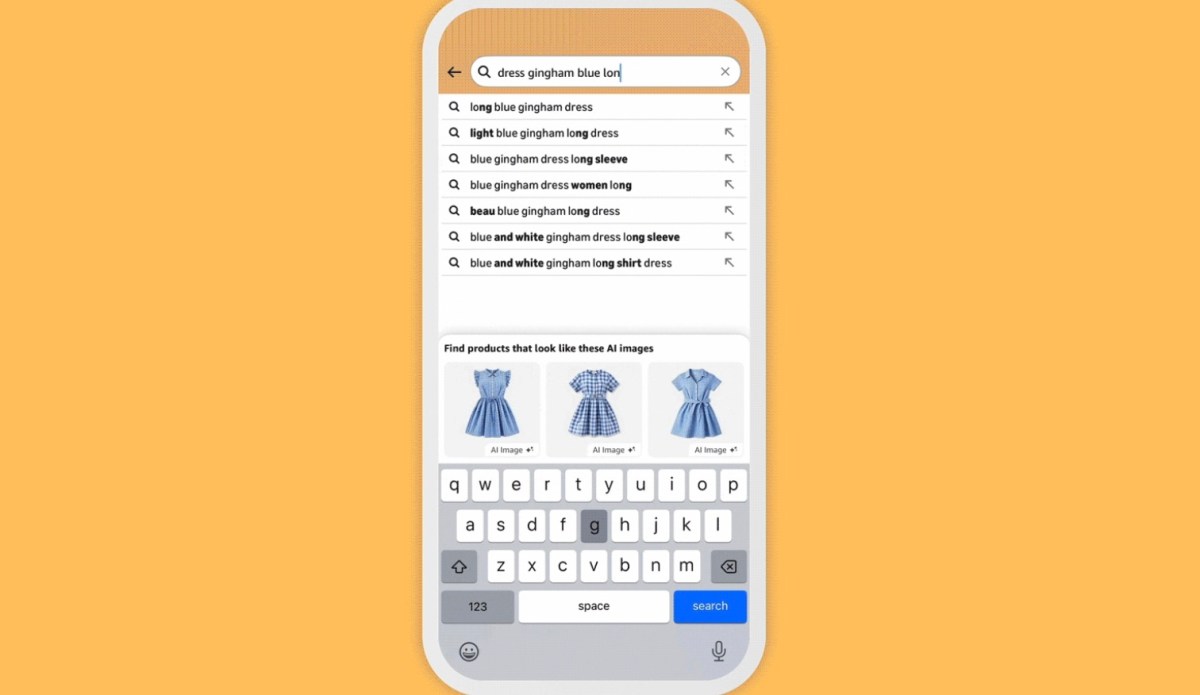
Some of the products appearing in Amazon’s search results do not exist. The retailer has begun displaying AI-generated images for certain items, and in tests by The Verge, searches for specific products produced polished photographs of merchandise that Amazon’s own listings confirmed was never made. The feature has touched off a debate about how far e-commerce companies should go with generative AI.
The images appear in the search carousels and recommendation blocks that customers scroll through before clicking into a listing. In The Verge’s tests, searching for particular products returned photo-realistic shots of items the site itself had no inventory for, the report said. The images were indistinguishable at a glance from real photography, the publication said, with the only clue being that the products themselves were nowhere to be found.
Amazon confirmed that it is testing AI-generated imagery in search, describing the feature as an experiment to help customers visualize products. The company said the images are labeled in ways that make clear they are generated, though the labels are easy to miss in a mobile layout, according to shoppers who encountered them. Amazon said it is monitoring the feature for quality and accuracy.
The practice raises a question regulators and consumer advocates have begun to ask about the AI economy: what happens when the content in a shopping experience is fictional? A photograph of a product that does not exist is not false advertising in the traditional sense, because no sale is made and no money changes hands. But it changes the character of the shopping environment, blurring the line between what is real and what is illustrative.
There are legitimate uses. Retailers have long used stylized images and renders for products that are photographed before final production, and AI can generate images for items in development or for variations that have not been manufactured. Amazon itself could use the technology to show colors, configurations or settings that photographers never captured. The problem, critics say, is when customers cannot tell the difference.
The practical risk is disappointment and distrust. A shopper who saves an image of a product, only to discover the item does not exist, has a worse experience than one who saw nothing at all. Over time, repeated encounters with fictional products could corrode the trust that makes marketplaces work. Amazon’s own sellers have complained that AI imagery gives an unfair advantage to listings with better-looking pictures, whether or not the products match.
The feature also sits on a legal boundary. Product images are governed by rules about deception, and regulators in several countries have been scrutinizing AI-generated content in advertising. If an AI image leads a shopper to believe a product exists when it does not, that could be treated as a misleading practice, even if no purchase occurs. Amazon has not said how it would handle a case where a customer relies on a fictional image to make a decision.
The broader issue is the pace of AI adoption in commerce. Amazon has been among the most aggressive companies in deploying generative AI, using it to write product descriptions, summarize reviews and now create images. Each deployment saves labor costs and speeds up catalog growth, and each one also adds a layer of machine-generated content that customers and regulators must learn to interpret.
The company’s own test results are mixed, according to people familiar with the data. Some AI images improve click-through rates, those people said, while others generate confusion and complaints, and Amazon is weighing the two effects. The company’s history suggests it will keep the feature if the metrics favor it, adjusting the labels and the placement to minimize harm.
The technology behind the feature is straightforward. Amazon’s models take the text and attributes of a listing and generate a photograph-style image that matches, filling in the product details the way a studio photographer might set up a shot. The company has used AI for years to clean up backgrounds and improve lighting; the new step is generating the entire image from scratch, including products that no photographer has ever seen.
Sellers have mixed feelings. Some welcome the feature, since professional product photography is expensive and AI images can make small listings look polished. Others worry that generated images will be held to a different standard than real ones, and that sellers who invest in genuine photography will be at a disadvantage. Amazon has said sellers can opt out and that the feature is designed to help, not replace, but the rollout has raised the same question that follows every AI deployment: who is responsible when the machine gets it wrong?
The regulatory conversation is still forming. Agencies in the United States and Europe have begun to look at AI-generated content in commerce, and the question of labeling is central: when does an image need to be marked as synthetic, and who enforces it? Amazon’s experiment, running at massive scale in front of hundreds of millions of shoppers, is effectively a live test of the rules before the rules exist, and the outcome will influence how regulators write them.
For shoppers, the practical advice is the same as it has always been: read the listing, check the reviews and look at what actually ships. For the industry, the experiment is a preview of a coming conflict. Every marketplace, every retailer and every platform is deciding how much AI-generated content its customers can tolerate, and Amazon, with its scale, is running the test for all of them.