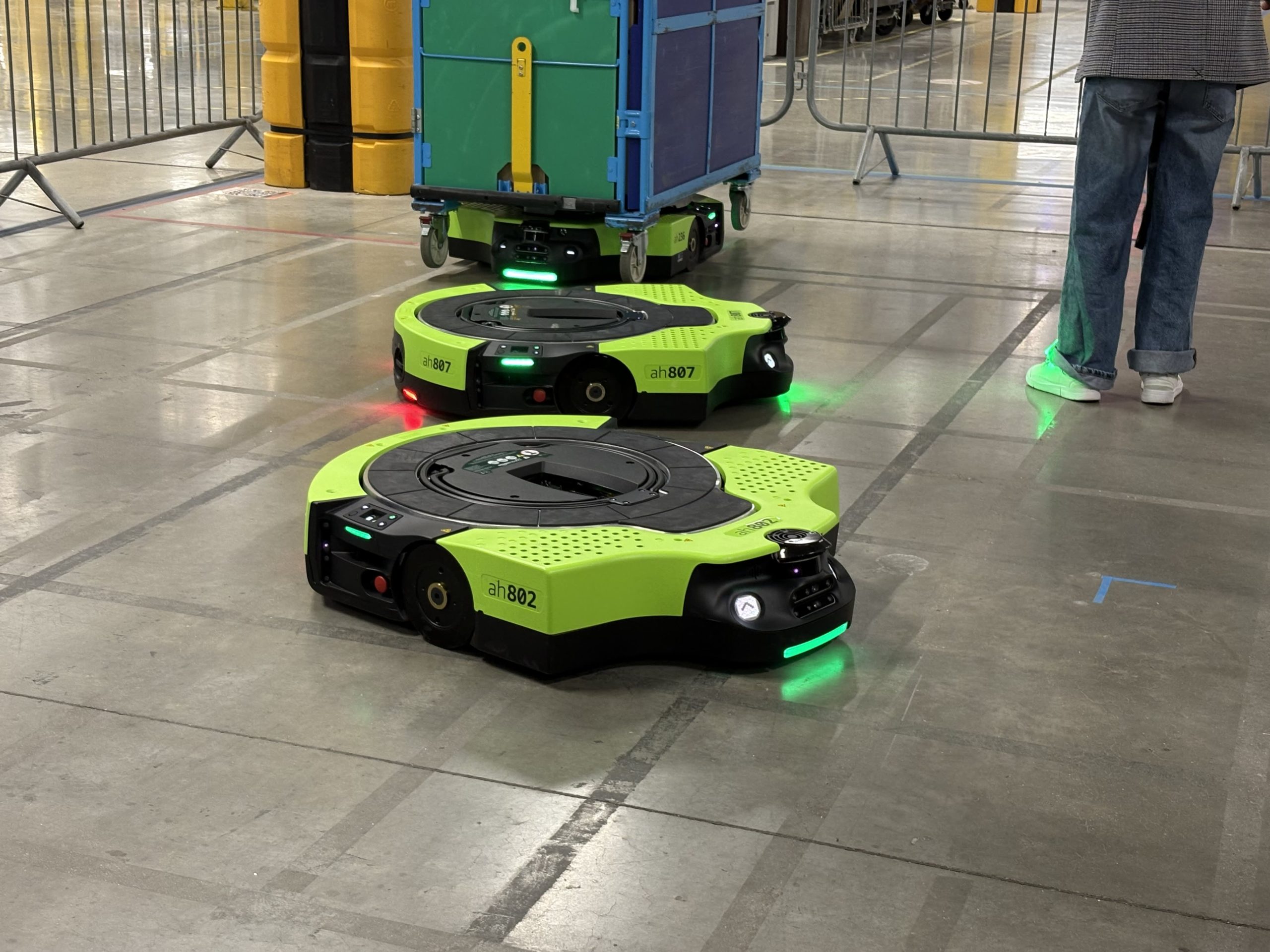
The instruction came in plain English, and the machine obeyed. Amazon has unveiled the next generation of its Proteus warehouse robots, which respond to natural-language commands, alongside a new robot called Vulcan with tactile sensing and a box-handling system called STARK, CNBC reported.
The three products address the same problem from different angles. Proteus moves carts and containers through fulfillment centers, and the natural-language interface lets workers direct it without specialized training or handheld terminals. Vulcan is Amazon’s first robot with touch sensitivity, allowing it to grip and handle items with the care that fragile goods require. STARK automates the handling of boxes at the edges of the system, the part of a warehouse where most of the labor has traditionally concentrated.
The launch comes at a striking moment in Amazon’s own history. The company has cut more than 30,000 corporate jobs in recent quarters while redirecting the freed-up money into AI and robotics, a pattern CNBC described as layoffs plus reinvestment. The math is explicit: labor savings fund the machines, and the machines reduce the need for future hiring in the roles they take over.
Amazon’s robotics ambitions are not new. The company bought Kiva Systems in 2012 for about $775 million and spent the next decade converting that acquisition into the largest fleet of warehouse robots in the world, with hundreds of thousands of machines moving shelves, sorting parcels and carrying goods across its network. What has changed is the sophistication: the new generation understands speech, senses pressure and coordinates with human workers rather than simply avoiding them.
The natural-language interface matters more than it sounds. Warehouses run on dense, noisy, fast-moving processes, and the workers who manage them rarely have time to learn complex control systems. A robot that responds to plain commands lowers the barrier to adoption and lets a single supervisor direct a fleet. It also gives Amazon a training advantage, since workers already know how to speak.
The tactile sensing in Vulcan addresses a harder problem. Much of what a warehouse handles is fragile or irregular, including glass, produce and oddly shaped parcels, and robots have historically struggled with items that do not fit a standard box. A gripper with touch sensors can feel its way around a product the way a human hand does, which is the difference between robots that handle a narrow slice of the work and robots that handle most of it.
The competitive stakes are rising. Warehouse automation has become one of the most active corners of the robotics industry, with startups and established players racing to build machines that can match human dexterity at human-comparable cost. Amazon’s scale gives it an unusual position: it can develop robots, test them in its own warehouses and deploy them across hundreds of sites without waiting for a single customer to sign.
The financial logic is straightforward. Fulfillment labor is one of Amazon’s largest costs, and every task a robot performs instead of a worker is a saving that compounds across the network. The company’s earnings calls have repeatedly framed automation as a margin story as much as an innovation story, and the new hardware is built to that argument. Amazon has said the point is not to shrink the workforce but to grow the business without growing the head count proportionally.
The human dimension is the sensitive one. Amazon has been criticized for the conditions in its warehouses and for the pace of its automation, and the 30,000-plus corporate cuts have sharpened the questions. Company executives say the robots will work alongside people, taking over the tasks that are hardest on the body, rather than replacing the workforce wholesale. Labor groups note that the direction of travel is unambiguous, whatever the language around it.
The broader context is an industry that has made automation central to its economics. Rivals such as Walmart have invested in their own robotic fleets, startups have moved into the gap, and the technology has improved faster than the regulatory debate around it. Amazon’s latest hardware keeps it at the front of that pack, at least for now.
The announcement also deepens Amazon’s push into AI-enabled hardware more broadly, from its robotics line to the chips it designs for its cloud. The company has argued that the same technologies, trained on the same models, will reshape both its warehouses and its data centers, and the new robots are the clearest example of that convergence so far.
For Amazon, the bet is that a warehouse staffed by robots and a thin layer of human supervision will be cheaper, safer and faster than the one it runs today, and that the savings arrive before competitors build their own fleets. The new robots are the clearest statement yet of what that bet looks like in hardware, and the natural-language interface is the part that hints at where the next decade of fulfillment work is heading.