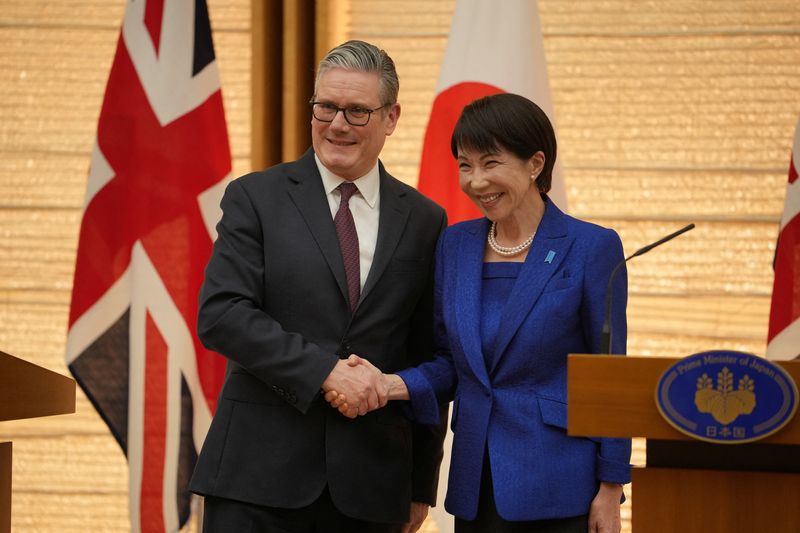
The signing table was set in London, and the two prime ministers put their names to an agreement worth more than £18 billion, or about $24 billion, covering artificial-intelligence research, semiconductor supply chains and quantum computing. British officials called it the largest bilateral technology deal the country has signed since leaving the European Union.
The pact is broad in its ambition and specific in its machinery. The two governments committed to joint AI research programs, with scientists and funding moving across both countries. They agreed to coordinate on semiconductor supply, a recognition that chip fabrication is now a matter of national security as much as commerce. And they pledged to work together on quantum computing, the field that promises to break current encryption and speed up a class of calculations that classical computers cannot manage. Each of the three areas is one where neither country can go it alone, and both governments said as much in their statements.
The agreement also confirmed continued work on GCAP, the Global Combat Air Programme, the next-generation fighter jet being developed by Britain, Japan and Italy. The program, which aims for a new fighter in the 2030s with industrial partners including BAE Systems in Britain and Mitsubishi Heavy Industries in Japan, is one of the most ambitious military-industrial collaborations in Europe and Asia, and it has become the anchor of the broader defense relationship between London and Tokyo. Pairing a fighter program with civilian technology cooperation is a deliberate choice: the two governments want the relationship to span the military and commercial worlds.
For Britain, the deal is part of a post-Brexit pivot. With the European Union no longer the default partner for big technology projects, London has been building bilateral ties with like-minded governments, and Japan has been near the top of the list. The two countries already share a view of the global technology order that puts supply-chain security ahead of pure cost, and they have both been tightening restrictions on the transfer of advanced technology to China. The agreement gives that shared posture a financial structure, and it builds on a security relationship that deepened after the two governments signed a broad defense accord in 2023.
For Japan, the pact supports a national project of its own: rebuilding a semiconductor industry that once dominated the world and now imports most of its advanced chips. Tokyo has poured public money into domestic fabrication, including the Rapidus venture in Hokkaido, and it sees British research strengths, in chip design and in the materials science that underpins fabrication, as complementary to its own manufacturing ambitions. The quantum collaboration, likewise, pairs Japan’s hardware work with British expertise in algorithms and software.
The numbers, large as they are, may undersell the deal’s significance. Government spending on AI and quantum is dwarfed by private investment in the same fields, and £18 billion spread over years will not by itself reshape either economy. What the agreement buys is coordination: joint standards, shared access to research, and a framework for companies in both countries to treat each other as trusted partners. In a technology world where access is being rationed by government, that framework has a value beyond the headline figure.
The deal also reflects a wider pattern in global technology policy. As the United States and China compete over chips, AI and advanced manufacturing, middle powers have been forming their own arrangements, and the British-Japanese agreement is one of the largest examples. The two countries sit on opposite edges of the same strategic map: Britain anchors Europe’s Atlantic flank while Japan anchors Asia’s Pacific one, and both are building technology relationships that do not run through Washington. Both are also willing to spend public money to keep the option of independent capability alive. Whether those bets pay off will take a decade to know; the spending is happening now. As the United States and China compete over chips, AI and advanced manufacturing, middle powers have been forming their own arrangements, and the British-Japanese agreement is one of the largest examples. Both countries are trying to secure access to technology without depending entirely on Washington, and both are willing to spend public money to keep the option of independent capability alive. Whether those bets pay off will take a decade to know; the spending is happening now.
Officials from both sides said they expect the partnership to grow, with the first joint AI research calls opening before the end of the year. The two prime ministers, in their joint statement, described the agreement as the foundation for a broader economic relationship, and they pointed to the fighter program as proof that the cooperation is built to last.
The timing is also deliberate. Both governments face elections and budgets in the next few years, and a technology pact with a headline number and a defense project attached is the kind of agreement that survives changes in leadership. Whether the promise survives contact with procurement reality is another matter; big bilateral programs have a history of cost overruns and schedule slips. But the direction is clear: Britain and Japan are building the infrastructure of a technology alliance, and they have put money behind it.