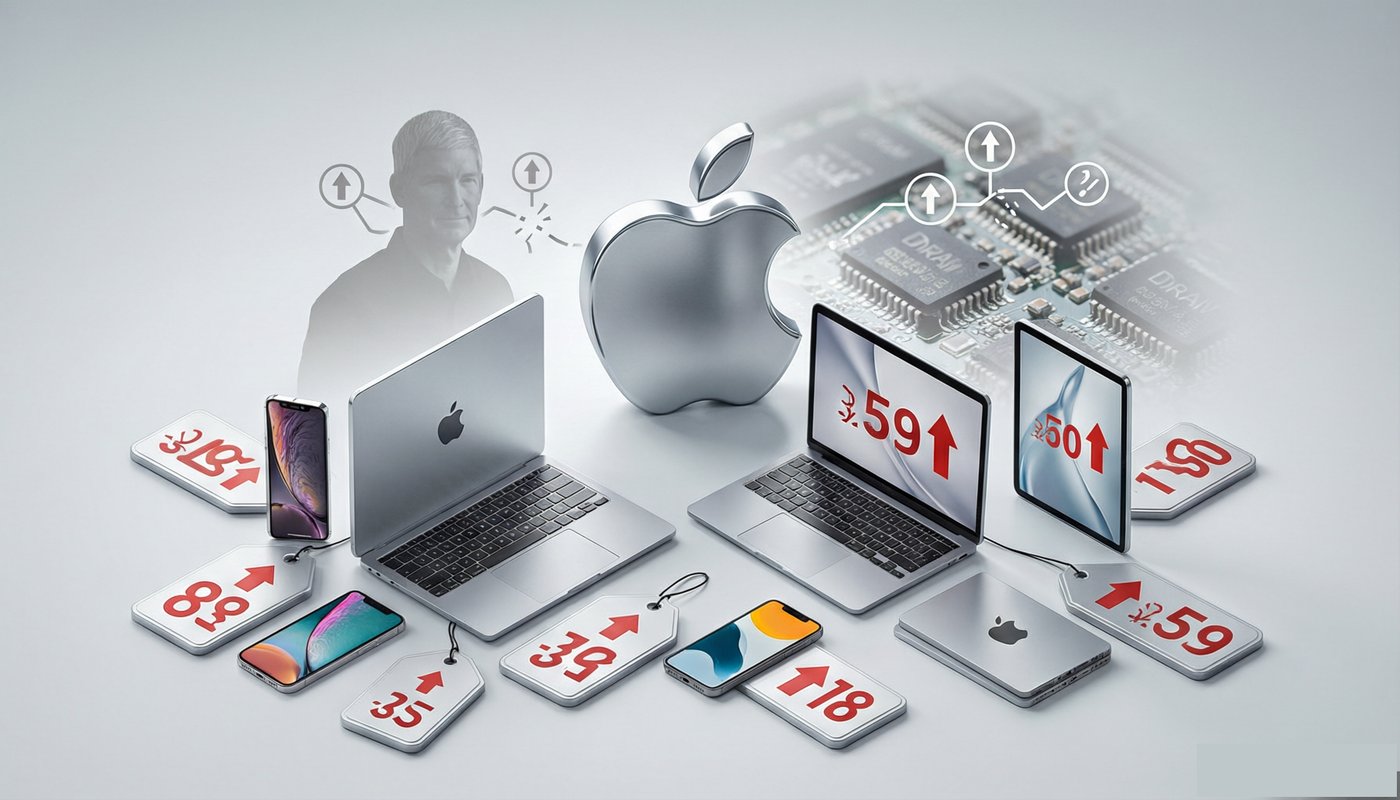
CUPERTINO — Tim Cook did not soften the message. In an interview with ABC News, the Apple chief executive said a global shortage of DRAM and NAND flash memory has driven up component costs and that price increases across Apple products are unavoidable. “We can’t absorb it all,” he said, according to a transcript of the interview.
The remarks ended months of speculation about whether the memory supercycle would reach consumers. MacRumors and 9to5Mac, which track Apple’s product plans closely, confirmed that the increases will sweep across the iPhone, Mac and iPad lines, with the first adjusted prices expected at the next product events. Apple typically keeps pricing stable between generations, and the decision to raise prices mid-cycle reflects how unusual the current supply situation has become.
The memory industry has been tightening since last year, when manufacturers cut capacity after a brutal downcycle and then watched AI demand arrive faster than anyone expected. Data centers absorbed record volumes of high-bandwidth memory for AI accelerators, and the same fabs that make that memory also produce the DRAM that goes into phones and laptops. When AI demand crowded out commodity production, prices for standard memory began climbing, and the increases have now reached the biggest consumer of memory in the world.
The timing has a bitter irony for the industry. Days before Cook’s interview, SK Hynix, the world’s largest maker of high-bandwidth memory, surpassed Samsung Electronics to become South Korea’s most valuable company, a crown it won precisely because of the AI-driven memory boom. On the day Cook spoke, SK Hynix’s shares plunged 12% as the global technology selloff swept through Seoul. The company that profits most from the shortage lost a fifth of its value on the same news cycle that confirmed the shortage is real.
Apple’s position in the memory market complicates its options. The company is one of the largest buyers of DRAM and NAND in the world, and its procurement team has historically negotiated favorable terms by committing to multi-year volumes. But suppliers have little spare capacity to offer at any price, analysts said, and the strongest negotiating position in the current market belongs to the makers, not the buyers.
The price increases will test Apple’s pricing power at a delicate moment. The iPhone remains the company’s most important product, and consumers have shown sensitivity to price in mature markets where upgrade cycles have lengthened. Apple’s premium positioning has protected it from the discounting that hits other phone makers, but raising prices on the full lineup at once is a move the company has rarely attempted outside a currency crisis.
For the broader industry, Apple’s announcement is a signal. If the world’s most powerful buyer of memory is accepting higher prices, smaller device makers have no choice but to follow, analysts said. PC makers and Android phone manufacturers have already begun raising prices or trimming memory content in new models, and the pass-through to consumers is likely to accelerate in the second half of the year.
The memory makers’ calculus is straightforward. After years of punishing losses, the industry consolidated and disciplined capacity, and the AI boom turned scarcity into windfall profits. Suppliers have told customers that demand from data centers will absorb their output for the foreseeable future, and that consumer electronics will have to pay market prices for what remains. That stance, more than any single price increase, is what has changed for Apple and its customers.
There is a scenario in which the pressure eases. Memory prices have spiked before, and each cycle eventually brought new capacity online within 18 to 24 months. Manufacturers are already shifting more wafer capacity to commodity DRAM, and SK Hynix said it is reallocating resources to meet demand in the general memory market. If supply catches up, prices could normalize by next year, and Apple’s mid-cycle increases would be remembered as a temporary adjustment.
The increases will not hit every product equally, according to people familiar with Apple’s plans. Devices with the most memory content, such as the MacBook Pro and the iPad Pro, are expected to see the largest adjustments, while entry-level models may absorb part of the cost through thinner margins. Apple has also been buying memory in bulk ahead of the price increases, a practice it has used in past shortages, and the company’s inventories could cushion the impact for the first wave of products. The longer the shortage lasts, the less effective that hedging becomes, and suppliers have told customers to expect elevated prices through next year at least.
The situation has begun to resemble the memory shortage of 2017-2018, when DRAM prices doubled and device makers passed the costs to consumers. That cycle ended when suppliers added capacity and prices collapsed, and the current cycle has a different shape: the capacity is being added, but a large share of it is going to high-bandwidth memory for AI rather than to the commodity DRAM that phones and computers use. That structural shift, more than any single quarter of demand, is what has convinced suppliers that prices will stay high, and it is what makes Apple’s mid-cycle increase look less like a temporary adjustment and more like a permanent change in the cost structure of consumer electronics.
Until then, the costs are real and arriving at once. Cook’s interview confirmed what suppliers had been signaling for months, and the message to consumers is straightforward: the machines that run the AI boom and the phones in people’s pockets are competing for the same scarce memory, and for now, memory wins.