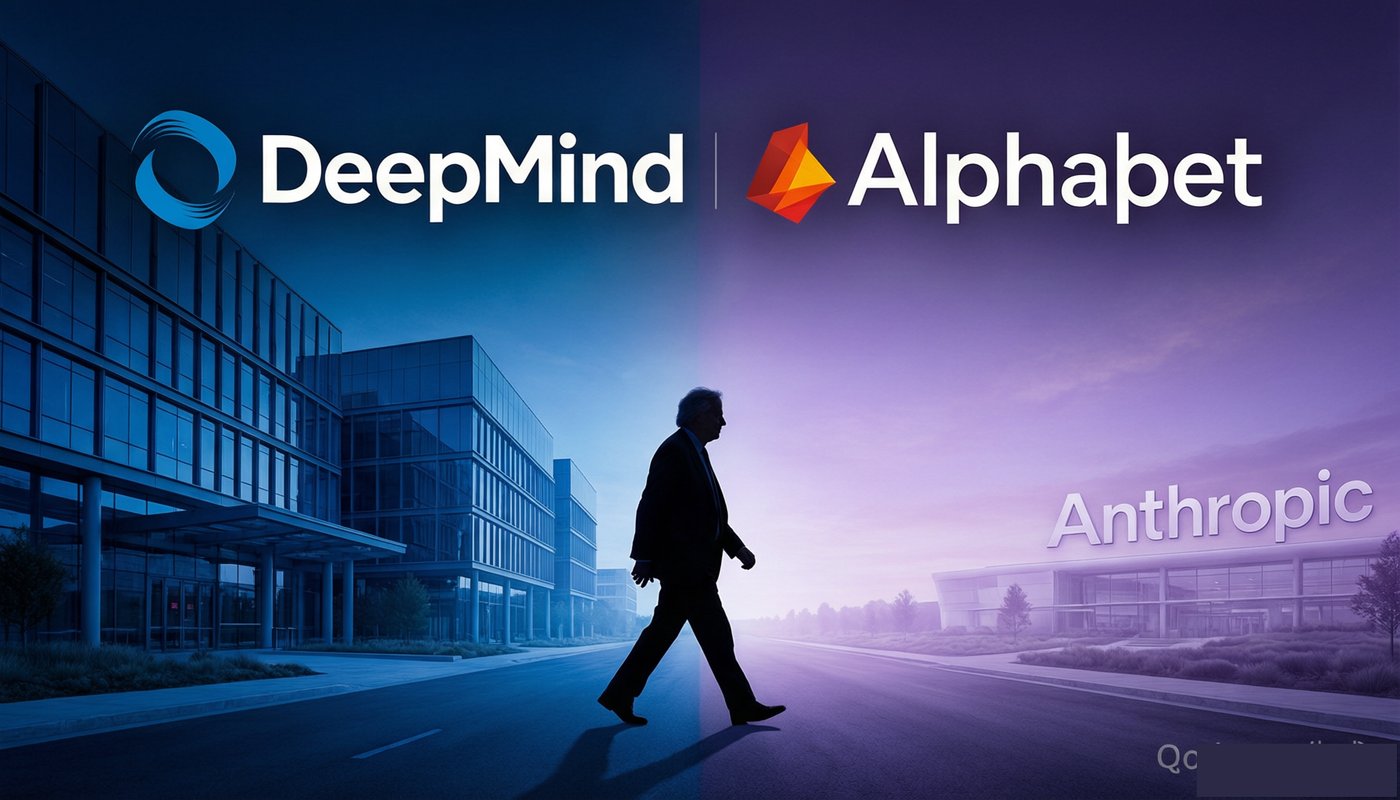
LONDON — John Jumper won the Nobel Prize in Chemistry in 2023 for AlphaFold, the system that predicted the three-dimensional shape of proteins and reshaped biology. Now he is leaving Google’s DeepMind for Anthropic, according to people familiar with the matter, in the highest-profile departure yet from the laboratory that built Google’s most celebrated AI research.
The news landed as Alphabet shares fell for a second consecutive day, extending a decline of more than 6% that erased more than $100 billion in market value. The stock had already been under pressure from concerns about the pace of Google’s AI product launches; the loss of a Nobel laureate gave investors a concrete reason to worry about the science that feeds those products.
Noam Shazeer, one of the co-authors of the 2017 paper “Attention Is All You Need” that introduced the Transformer architecture underpinning modern AI, is joining OpenAI, according to people familiar with the matter. Shazeer returned to Google in 2024 after selling his chatbot startup Character.AI back to the company; his second exit took days to become common knowledge on the engineering forums where Google’s rank-and-file researchers gather.
MLQ.ai, a research firm that tracks AI talent movements, counts at least seven senior DeepMind researchers who have left for OpenAI or Anthropic so far this year. Earlier departures included specialists in robotics and foundation models, the large neural networks that power everything from search summaries to autonomous systems. The Jumper move is different in kind: he is the first sitting Nobel laureate to walk out of the lab.
DeepMind, founded in London in 2010 and acquired by Google in 2014, built its reputation on AlphaFold, AlphaGo and a string of results that established Google as the leading publisher of AI research. That reputation fed the market’s willingness to pay a premium for Alphabet shares, analysts said, because it promised that the search giant would remain at the frontier even as OpenAI and Anthropic dominated headlines.
The defections have turned that promise into a question. Anthropic and OpenAI have both built aggressive recruiting machines, offering founders-level compensation, equity that has appreciated rapidly, and the chance to work on models with fewer corporate constraints. A person close to DeepMind said the lab has responded with retention packages for senior researchers, but acknowledged that matching offers from well-funded rivals has become more expensive each quarter.
Alphabet’s financial position complicates the story. The company remains one of the most profitable in technology, with a search franchise that generates tens of billions in quarterly profit, and its Gemini models have closed much of the quality gap with rivals, analysts said. Yet the talent exodus raises a subtler question: whether a company that grew rich on search can hold the researchers who will define the next generation of products.
Investors have begun treating AI talent as a balance-sheet item. “The models are only as good as the people who build them,” said one portfolio manager who owns Alphabet shares. “Every departure is a markdown on the research franchise, even if the current earnings look fine.”
For Anthropic, the hire bolsters a scientific bench that already includes veterans of OpenAI and DeepMind. Jumper’s expertise in computational biology could help the company extend Claude beyond language into science-oriented applications, a person familiar with the company’s plans said. Anthropic declined to comment on individual hires.
For Google, the question is whether the exits slow the pipeline of new models. DeepMind remains one of the world’s largest AI research organizations, and Alphabet has said it will invest more in compute and research this year than ever before. But the departures have a compounding effect: each senior exit makes the next retention negotiation harder, and makes recruiting outside talent more difficult.
The market’s verdict came quickly. Alphabet’s two-day slide was the sharpest reaction to a talent story in years, and analysts said further moves by senior researchers could trigger another leg down. Google’s response, executives signaled, will be measured in checkbooks: higher pay, more compute allocations for researchers, and a clearer path from research to product.
The departure is personal in ways that matter to the people who track AI talent. Jumper joined DeepMind in 2017, when the lab was already the most decorated in the field, and his work on AlphaFold won the Nobel along with Demis Hassabis, DeepMind’s co-founder and chief executive. The system transformed biology and made Jumper a name known far beyond machine learning. His move to Anthropic suggests he wants to apply his methods to a different set of problems, according to people familiar with his thinking. The loss to Google is therefore not just a matter of head count; it is the departure of the researcher most associated with the idea that DeepMind’s AI could reshape the sciences.
The broader picture is one of a widening gap between where Google’s best researchers sit and where the industry’s momentum has moved. OpenAI’s release of ChatGPT in 2022 forced Google to reorganize its AI efforts, and the company’s response, the Gemini line of models, has improved steadily. But the talent flows have gone the other direction: the most visible researchers in the field now work at OpenAI and Anthropic, and their products define what the public thinks of as AI. Alphabet’s management has said it is willing to spend whatever it takes to retain its best people, and the company’s balance sheet can support that promise. Whether money is enough to hold researchers who believe the most interesting work is happening elsewhere is the question the coming months will answer.
Whether that is enough will be tested in the coming months. The Nobel medal on Jumper’s shelf now hangs in a different building, and the team that built AlphaFold is smaller by one of its anchors.