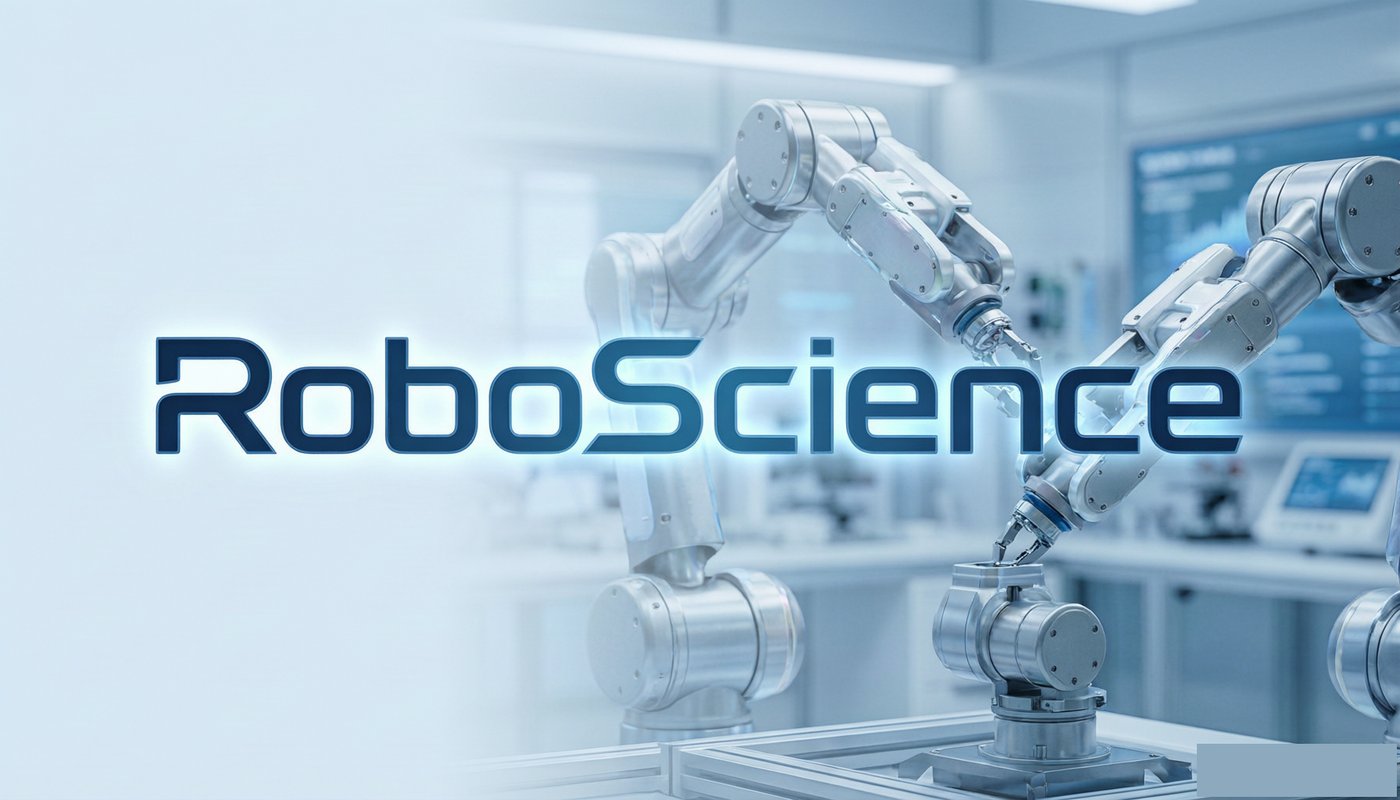
The video lasts less than a minute. Two black robotic arms on a tabletop lift a silk tie, loop it around the collar of a dress shirt, and work the knot tight with the unhurried patience of a man late for a wedding. Screened at a product event on June 24, the clip was RoboScience’s way of showing what its new general-purpose model can do: see an object, plan around it, and act on it.
RoboScience, a Shenzhen startup founded in December 2024, on June 24 released Visics, a general embodied AI model built on what the company calls a VLOA architecture — Vision, Language, Object, Action. The design is object-centric. Instead of treating vision and language as separate modules bolted onto a robot, the model organizes its understanding around the physical things a machine touches, then turns that understanding into motion. The company says the architecture lets a single pipeline perceive an object, reason about it in words, and execute a manipulation task without hand-coded steps in between.
The founders carry unusually long AI pedigrees. Tian Ye, a former technology lead for Apple’s AI platform and a graduate of Stanford’s AI Lab master’s program, co-founded the company with Shao Lin, an assistant professor at the National University of Singapore who earned his PhD at Stanford’s AI Lab. Both spent years watching robots stumble over tasks that language models handle in an instant: folding a towel, sorting a bin of parts, ladling food. Text is cheap for a machine to produce; physical action is not. RoboScience’s stated focus is the interface between robots and the physical world, spanning robot bodies, end effectors, and multimodal physical simulation — the software that lets a model rehearse an action before a robot attempts it.
The tie was a deliberate choice of prop. A tie is thin, flexible, and prone to tangling — the kind of deformable object that defeats robots trained on rigid, predictable shapes. Knotting one requires the machine to track a moving, folding surface and to sequence a series of grasps that would each ruin the job if mistimed. Earlier this month, Xu Huazhe, founder of the robotics startup PoKe, showed a robot preparing mapo tofu, a dish whose slippery cubes and shimmering oil test both vision and dexterity. Chinese robotics labs have begun using such demonstrations as public proof of progress, in the way autonomous-driving companies once competed on disengagement-free miles.
The timing is no accident. Shenzhen has become a hive of embodied-AI startups, drawn by supply chains that can turn a design into working hardware in weeks and by local government programs that subsidize industrial automation. Global players are crowding the same territory: Tesla is developing its Optimus humanoid, Figure has raised billions for general-purpose robots, and a wave of Chinese humanoid makers has emerged from the country’s drone and EV supply base. RoboScience, by contrast, has stayed deliberately quiet, publishing research and demos rather than consumer prototypes.
Analysts said the demo says more about the direction of the field than about any single model. “The market is beginning to separate robotics companies by the generality of their models rather than by their hardware,” said one Shenzhen-based technology analyst. Hardware is increasingly a commodity in the region; the differentiation is in how a model generalizes from one object to another, from one kitchen to the next. The founders have said their ambition is a model that can be dropped into a new environment and learn its layout in minutes, rather than a robot tuned to a single assembly line.
The company has not said when its first commercial products will ship, nor has it disclosed financial backers. For now its public face is a sequence of videos: a tie knotted, a wok stirred, an arm reaching. The bet, shared with a growing list of peers, is that embodied AI follows the curve language models followed — that once the underlying model is good enough, applications compound quickly. A person close to the company said the next demonstrations will target kitchens and warehouses, the two settings where investors expect the first returns on embodied AI.
The company’s approach reflects a broader shift in how robots are being built. For years, industrial robotics ran on the opposite philosophy: each task hand-programmed, each gripper custom-tooled, each installation tuned by integrators over months. The embodied-AI movement treats that as a dead end. If a model can be trained on enough demonstrations — video of hands folding clothes, arms packing boxes, fingers tying knots — it should generalize the way large language models generalize across text, without bespoke engineering for every new chore. The founders of RoboScience have said publicly that they consider the model, not the machine, the company’s core asset, and that hardware design exists to serve the model’s learning loop.
For Shenzhen’s robotics corridor, the stakes are straightforward: whoever makes a robot that learns like a language model — from general data, with little hand-tuning — will set the pace of the coming wave of industrial automation. The tie video is a small artifact of that race, but it points at the prize: robots that do not just move, but understand what they are moving, and why. If the demonstrations keep coming — a tie here, a wok there — the distance between a video and a warehouse deployment will be the metric that matters, and Shenzhen’s robot builders intend to be the ones closing it.