
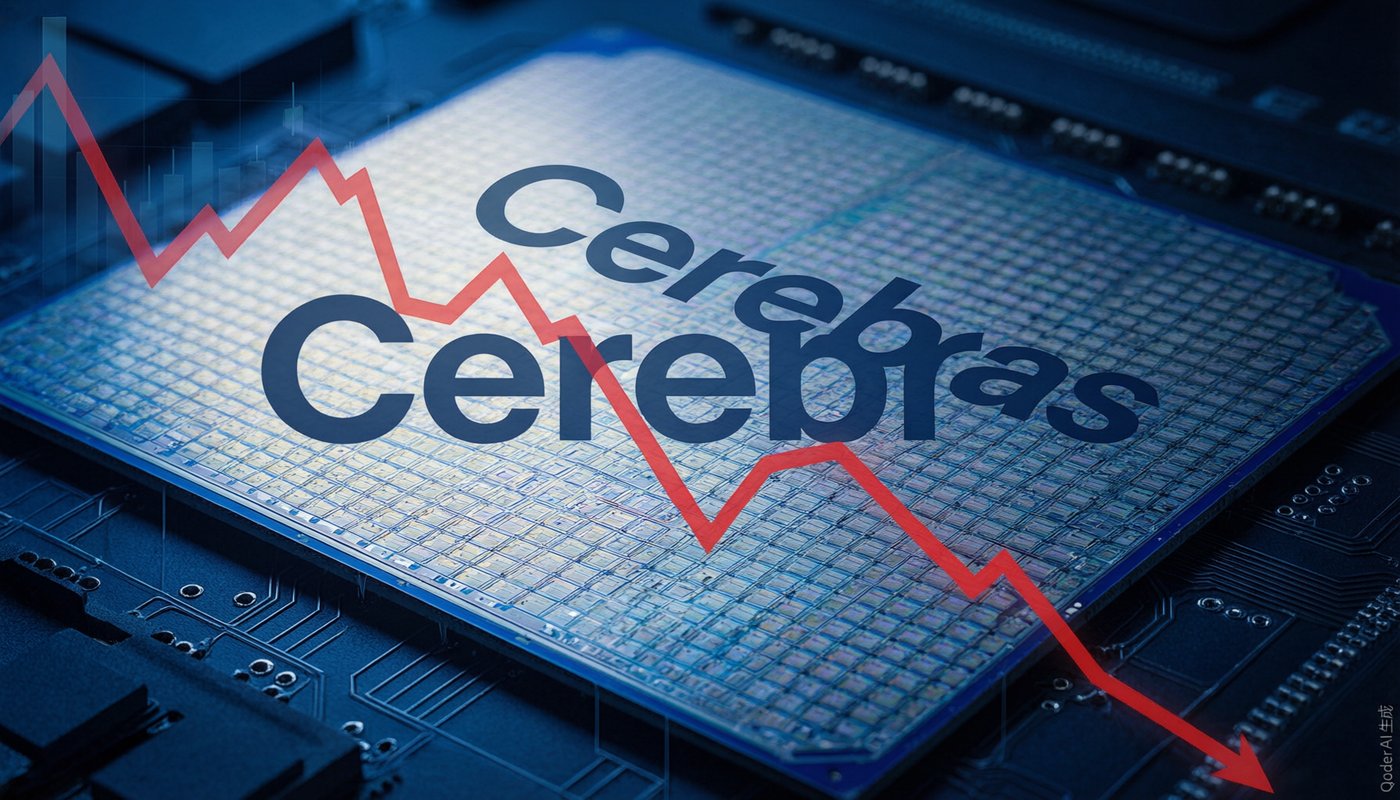
The slide began quietly and then accelerated. Cerebras Systems, the AI chip maker that went public on May 14, fell as much as 12% in intraday trading Thursday to its lowest level since its debut, before closing down 7.6%. The drop came a day after the stock fell about 14% and closed below its IPO price for the first time. Since listing, the company’s market value has nearly halved, with roughly $30 billion erased.
The immediate trigger was a financial report that failed to satisfy investors. Cerebras said its core gross margin for the quarter ended March 31 was 47%. The number beat the roughly 29.6% that analysts had forecast — itself a sign of how low expectations had fallen — but it sits far below the margins of the companies Cerebras is measured against. Nvidia’s gross margins run near 70%; Micron, the memory maker whose chips Cerebras’s systems depend on, posts margins around 85%. For a company that sells expensive machines by the rack, the comparison raised a pointed question: if Cerebras cannot price its products like Nvidia, can it ever match Nvidia’s economics?
Cerebras took an unusual path in the AI chip race. Rather than building a conventional GPU or an accelerator that emulates Nvidia’s software, the company makes a wafer-scale engine — a single silicon wafer, the size of a dinner plate, wired into one massive processor. The design eliminates the interconnects that slow communication between chips in traditional data centers, and the company has demonstrated record speeds running large language models. It has signed up sovereign AI customers in the Middle East and elsewhere, and its pitch has been that a simpler, more direct architecture can serve inference workloads that do not need Nvidia’s full generality.
The stock’s fall suggests investors are now pricing in the hard parts of that pitch. Cerebras’s wafer-scale chips are expensive to produce and require their own packaging and cooling solutions, and its customer base is concentrated: a handful of buyers account for the bulk of revenue, which is a risk when a single sovereign deal stalls. Its gross margin, while improving, reflects a hardware business that has not yet achieved the scale to drive costs down. The company has said it is building out manufacturing and software to close the gap, but the market, judging by the share price, is not willing to pay for that promise in advance.
The fall from grace has been steep by any measure. Cerebras priced its initial public offering at a moment of peak enthusiasm for AI hardware, and the shares surged on their first day of trading, giving the company a market value that briefly rivaled far larger chip makers. The subsequent slide has erased that first-day premium and more. Much of the damage came in the past two sessions: the 14% drop Wednesday took the stock below its IPO price, and Thursday’s decline extended the move, leaving investors who bought in the first weeks of trading nursing losses of 40% or more.
Thursday’s session also had the texture of a stock finding its floor the hard way. The 12% intraday drop took the shares through a series of technical support levels, and trading volume was heavy, suggesting funds that had bought the IPO story were exiting rather than averaging down. One person close to the company said management believes the selloff is overdone and that customer conversations remain strong. Analysts said the stock may need to prove the margin story over several quarters before it stabilizes.
The broader context is an AI chip market that has turned unforgiving. Investors have become less willing to fund challengers to Nvidia on the strength of technology alone; they want evidence of profitable scale. That shift has hit companies across the sector, from custom-chip designers to memory suppliers, and it has made the IPO class of 2026 a test of patience. Cerebras’s wafer-scale architecture is the most distinctive bet in the group, which cuts both ways: it gives the company a story no one else can tell, and it gives investors a risk no one else can benchmark.
For now, the company’s defenders point to the underlying demand. AI inference workloads are growing faster than training workloads, and Cerebras’s design is optimized for the speed of answering questions rather than the speed of learning patterns. If inference becomes the dominant cost of the AI industry, the wafer-scale machine could become a mainstream option rather than a niche one. The market’s verdict Thursday suggested that day has not arrived, and that a 47% gross margin is not yet the number that changes minds.
The next few quarters will decide whether Cerebras’s slide is a correction or a re-rating. The company reports earnings again in the coming months, and investors will be watching the same two numbers they watched this time: revenue growth and gross margin. If both move in the right direction, the stock has room to recover from a halving that many on the Street consider excessive. If the margin picture stalls, the market has already shown what it thinks.



