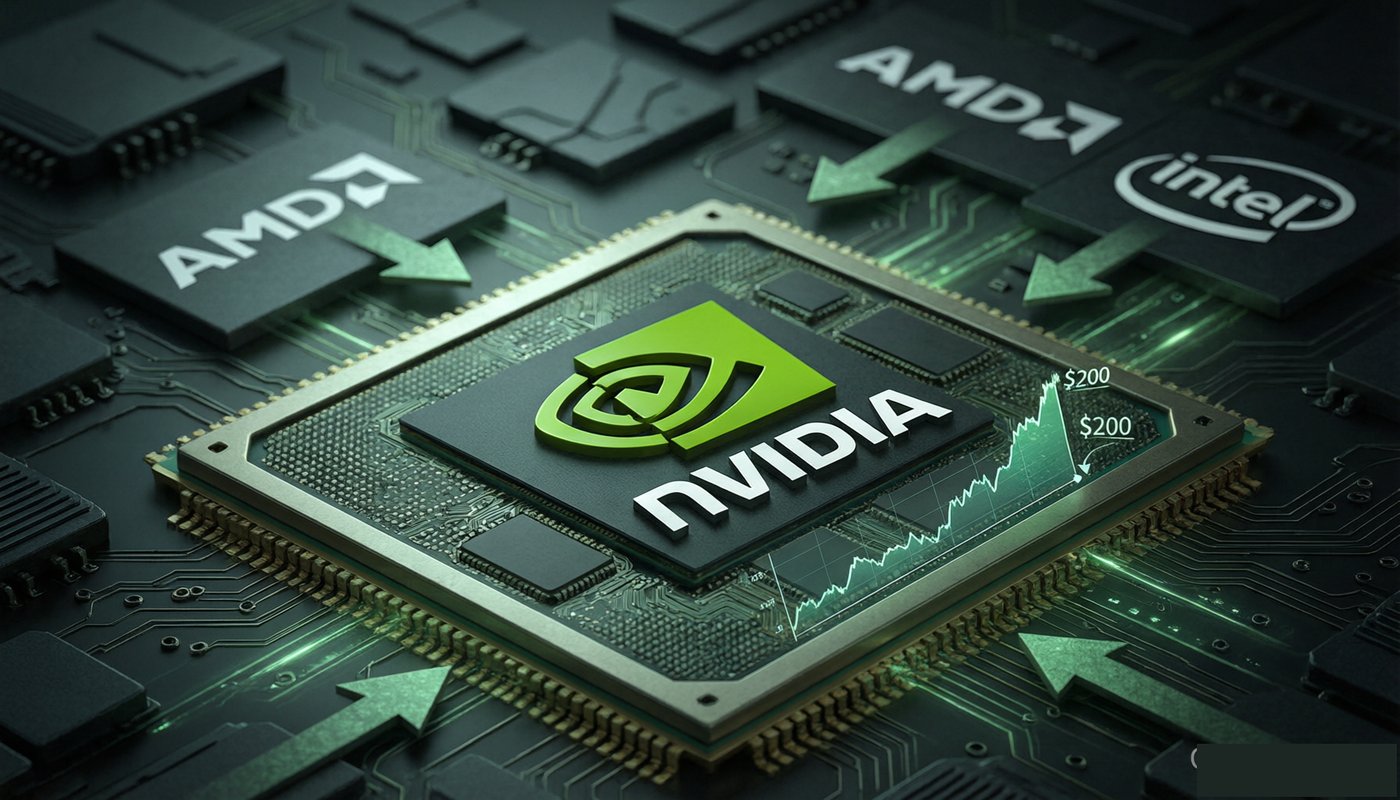
Nvidia’s stock has fallen below the $200 mark, according to a Barron’s report from earlier this week, as investors weigh a competitive picture that has grown more crowded than at any point in the AI chip boom. The decline reflects a shift in sentiment toward the company that became the biggest beneficiary of the AI buildout: analysts point to AMD’s accelerating product cadence, Intel’s renewed push into accelerators, and the rise of custom chips — including the Jalapeño processor OpenAI unveiled this week with Broadcom — as forces that are finally testing Nvidia’s dominance.
The stock’s slide is notable because Nvidia’s fundamentals have rarely looked stronger. The company continues to report record revenue, its data-center business still sells every chip it can make, and its software ecosystem, CUDA, remains the default way to program AI hardware. The question investors are asking is not whether Nvidia’s business is good today, but whether its near-monopoly pricing power survives the arrival of credible alternatives — and whether the valuation premium built on that pricing power has room to fall.
The competitive math has changed in a specific way. For years, the threat to Nvidia came from rivals trying to build better chips, and none succeeded at scale. The newer threat is different: customers designing their own chips for their own workloads. Amazon, Google, Microsoft, Meta, and now OpenAI have all committed to custom silicon, and while none of these programs has displaced Nvidia, together they are carving out the workloads that Nvidia once took for granted — inference at scale, where cost per query matters more than peak performance. Each custom chip announcement chips away at the assumption that every AI dollar flows through Nvidia.
AMD has been the most aggressive challenger in the merchant market. Its MI-series accelerators have won design wins at major cloud providers, its software stack has matured, and its server CPU franchise gives it a foothold in every data center where Nvidia sells. Intel, after a painful stretch, has re-entered the accelerator race with renewed investment and a manufacturing base that rivals can use. Neither has matched Nvidia’s performance per watt in every workload, but both have made the market believe that choice is possible — and choice, in the chip industry, is the enemy of premium pricing.
Nvidia’s chief executive, Jensen Huang, has dismissed some of the threats in characteristically direct terms. He has said that data centers built around smuggled, black-market chips — a reference to the gray market that emerged around export restrictions — are a dead end, arguing that legitimate, supported hardware is the only durable foundation for AI infrastructure. The remark was aimed at the shadow supply chain, but analysts noted it carries a broader message: Nvidia believes its total platform — chips, networking, software, support — will keep winning against cheaper or more flexible alternatives, because the cost of an AI system’s failure dwarfs the savings on its components.
The market has become harder to convince. Nvidia’s valuation, which at its peak implied years of uninterrupted growth at monopoly margins, has been repriced as the custom-chip wave has become impossible to ignore. The stock’s move below $200, a level that once seemed like a floor, is as much about multiples as about earnings: investors are applying a lower price-to-earnings ratio to the same growth, because they are assigning a higher probability to a future in which Nvidia shares the AI market with several capable competitors.
The $200 level has taken on meaning beyond the round number. Nvidia shares spent most of the AI boom trading far above it, and institutional investors came to treat the level as a marker of the market’s confidence in the company’s trajectory. Breaking below it has triggered technical selling — funds that use moving averages and price levels to manage risk have trimmed positions — and it has changed the tone of the debate among the analysts who follow the company. What was once a question of how high the stock could go has become a question of where it finds a floor.
The company’s next earnings report will be the key test. Analysts expect Nvidia to deliver another quarter of strong growth, and the company’s guidance for the following quarter will show whether demand from the largest cloud providers remains as voracious as it has been. The more important signals will be qualitative: how Nvidia describes the competitive response, how it prices its next-generation products, and whether it acknowledges the custom-chip wave as a structural shift rather than a passing fashion.
For investors, the slide below $200 is a decision point. The bulls say the fears are overstated — that custom chips have been coming for years and Nvidia’s share of AI compute has only grown, and that the company’s software ecosystem gives it a moat no rival has breached. The bears say the market is finally pricing in the obvious: that the most profitable company of the AI era is now competing with its own largest customers, and that the era of 90% market share and 70% margins is closer to its end than its beginning. Both sides agree on one thing — the next year will determine which is right.