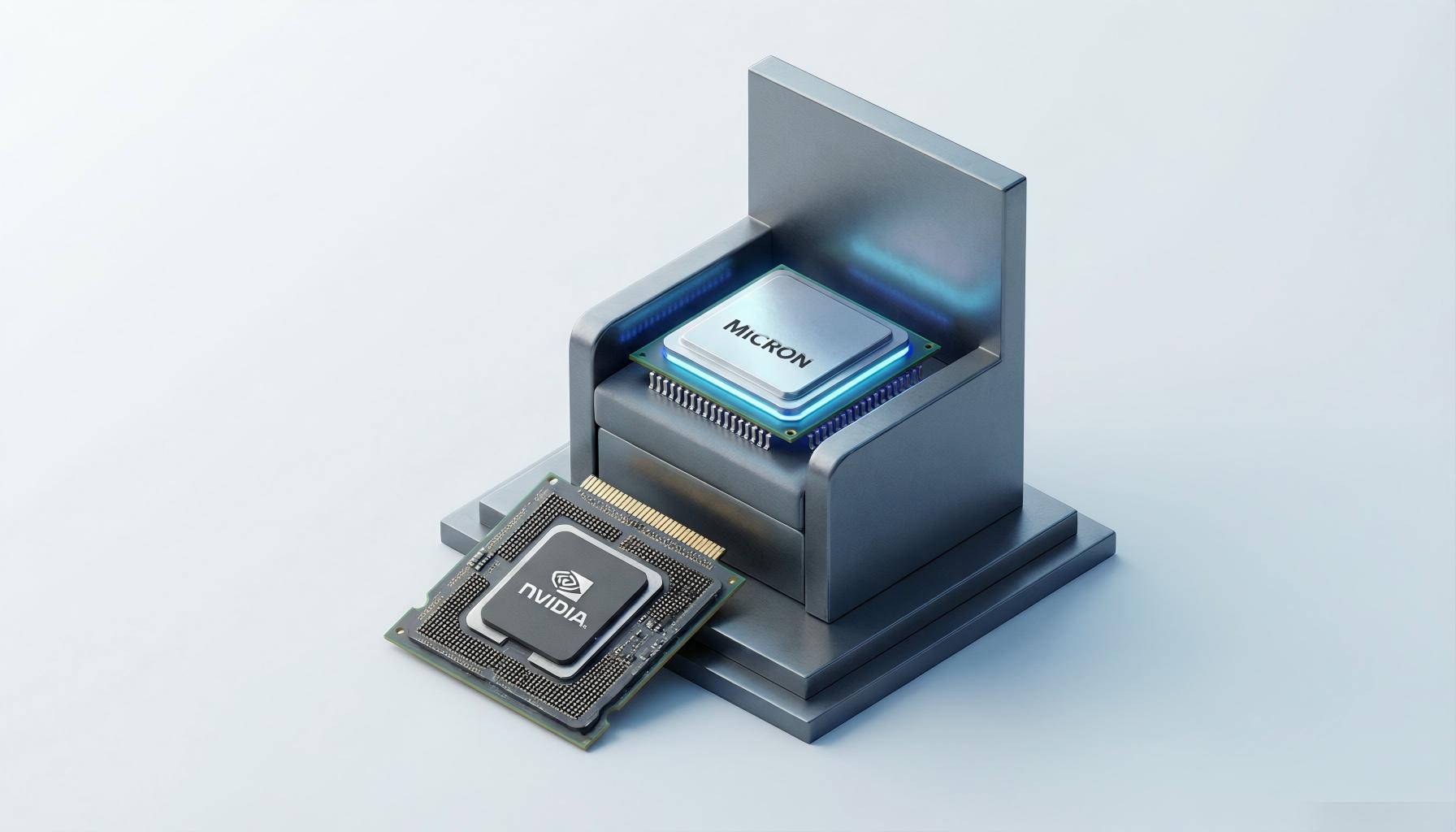
Barron’s called it the “new Nvidia.” In a deep-dive analysis this week, the financial weekly argued that Micron, the memory-chip maker, now occupies the position Nvidia held at the start of the AI boom: the company whose product is the industry’s critical bottleneck, and whose pricing power follows from that fact.
The argument rests on a shift in where AI systems spend their money. When large language models run — answering a query, generating a document, powering an agent — the constraint has moved from raw computing to memory access. The energy and latency consumed by moving data in and out of memory now dominate the cost of inference, according to the analysis.
Fortune added a corollary: Micron’s high-bandwidth memory, or HBM, product line could change the cost structure of AI infrastructure by 2027. HBM is the stacked memory that feeds data to AI processors, and it has become one of the most sought-after components in the industry, with supply sold out through much of the year.
The market has noticed. Micron’s market value has climbed past those of Meta and Tesla, according to Fortune, as investors reprice the company from cyclical memory vendor to structural winner in the AI buildout. The stock’s rally has been one of the strongest among chip names this year.
The “memory tax” is the phrase doing the work. Just as Nvidia’s chips commanded premium prices because compute was the scarce input, the argument goes, memory now commands a premium because inference cannot run without it. Every token a model produces requires memory access, and the cost adds up across billions of tokens a day.
The economics are visible in the numbers. Memory prices have risen sharply over the past year, and analysts said the increase reflects AI demand rather than the old cyclical pattern of supply cuts. The industry that once competed on commodity pricing is being asked to supply precision components to the richest customers in technology.
The comparison to Nvidia has limits, analysts caution. Nvidia’s dominance rests on software — the CUDA platform that locks developers into its hardware. Micron sells hardware into a market with two credible competitors: SK Hynix and Samsung, both of which are expanding HBM capacity aggressively. Pricing power in memory has a history of eroding.
The cyclical risk is real. Memory is the industry with the deepest boom-bust scars, and every up-cycle in its history has ended with oversupply and collapsing prices. The AI-driven demand wave is different in kind, supporters say — but the industry has heard that argument before, in every previous cycle.
Micron’s own positioning has improved. The company won early qualification for its HBM products with leading AI chip designers, and its next-generation HBM4 line is scheduled to ramp through 2026 and into 2027. Management has said the product roadmap gives it an edge in the transition to the faster, denser memory that next-generation AI systems will require.
The company’s finances reflect the turn. After years of losses and thin margins, Micron has returned to profitability with record gross margins, and it has committed to expanding capacity in the United States as part of the CHIPS program. The combination of government support and AI demand has transformed its outlook.
Investors who missed Nvidia are using Micron as a second chance. The stock’s valuation, while higher than its historical average, remains well below the multiples Nvidia commanded at its peak, and the narrative of a company selling picks and shovels into the AI buildout has broad appeal.
Skeptics point to the same history. Memory makers have repeatedly failed to sustain premium pricing, and the capacity expansion now underway in Korea, Taiwan and the United States could produce the surplus that ends the current boom. The question, analysts said, is not whether Micron is well run, but whether its product can stay scarce.
For the industry, the “new Nvidia” framing captures a real shift. The AI boom’s cost center is moving from compute to memory, from training to inference, and from a handful of chip designers to the suppliers that feed them. Whoever owns the bottleneck collects the tax — and this year, that is Micron.
The next twelve months will test the thesis. HBM4 qualification, pricing negotiations with hyperscalers, and the pace of capacity additions will determine whether Micron’s premium pricing holds. If the memory tax is real, the company’s valuation will look reasonable in hindsight. If it evaporates, the cycle will do what cycles do.
The comparison to Meta and Tesla is itself a statement about the market’s priorities. Those companies spent heavily on AI with returns still uncertain; Micron sells the components everyone needs to try. In the current market, the supplier of the shovel is getting the premium that used to go to the miner.