
The first hours of Amazon’s Prime Day brought the kind of numbers the company’s retail business has been waiting for. Sales on the first day of the annual shopping event ran ahead of the same period last year, according to early data tracked by industry analysts, suggesting that consumers, despite two years of inflation fatigue, were willing to spend on the discounts Amazon dangled in front of them.
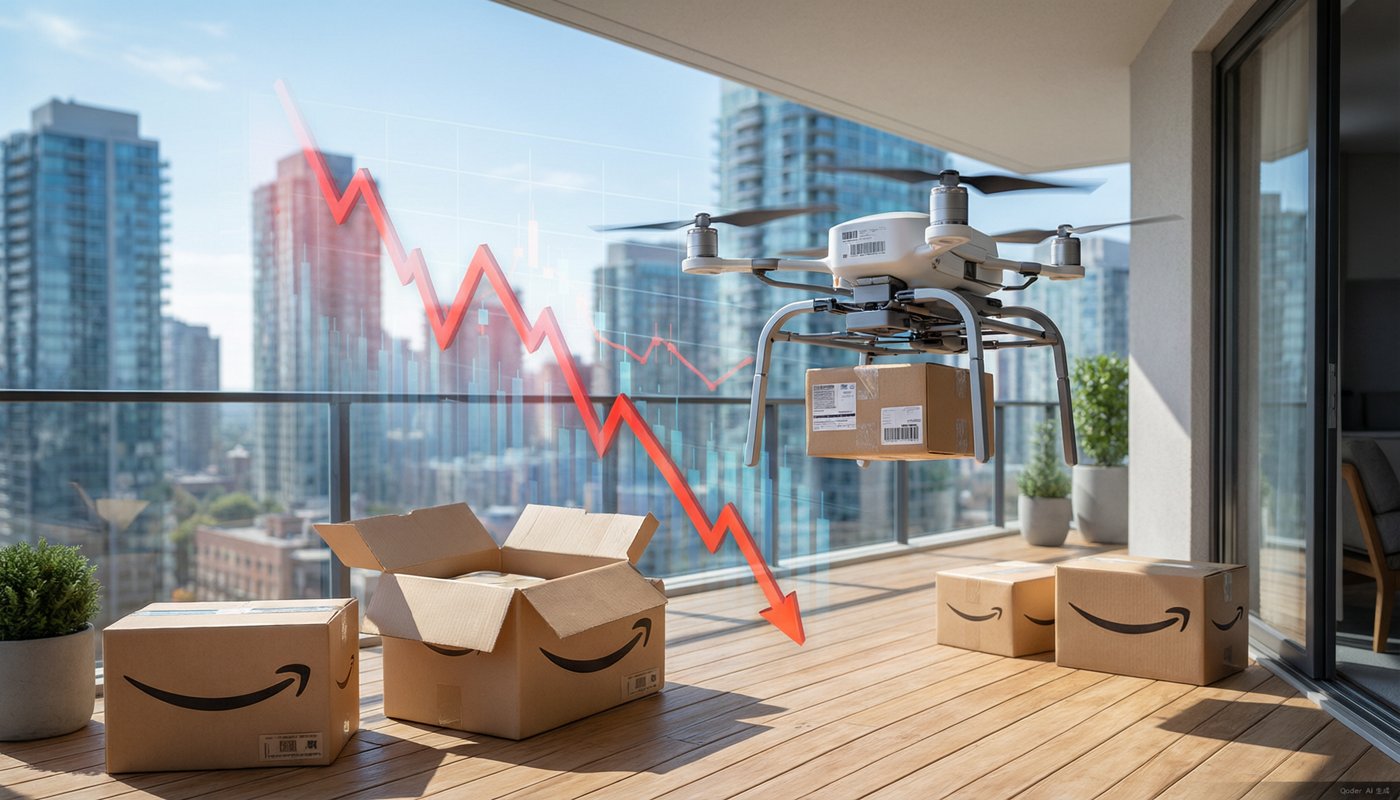
The strong start is a bright spot in a difficult year for Amazon’s stock. The shares have fallen about 13 percent from their high, as investors have rotated out of the retail-heavy part of the company and toward its cloud and AI businesses, and the market has been looking for evidence that the core commerce operation can still grow. A strong Prime Day does not move the stock much by itself, but it quiets some of the worries.
The event has also become a logistics showcase. Amazon announced that it is testing drone deliveries to apartment balconies in several cities, an expansion of its drone program that had previously focused on houses with yards. The tests are small, limited to specific buildings and specific routes, but they mark a step toward the urban delivery model that Amazon has been working toward for a decade.
The consumer resilience behind the strong first day is the surprise. Economists have been warning for months that stretched household budgets would eventually show up in discretionary spending, and Amazon’s own forecasts have reflected that caution. Instead, shoppers showed up, drawn by the scale of the discounts and the habit of the event, which has become a fixed point in the retail calendar.
Prime Day’s economics favor Amazon in ways that a normal sale does not. The event is designed to convert casual shoppers into Prime members, and to deepen the loyalty of existing members, who spend more with Amazon over the course of a year. The discounts are funded in part by the merchants who participate, and the event’s real product is data, on what sells, at what price and to whom.
The company’s drone ambitions have always run ahead of its approvals. Amazon has been working with regulators in the United States and Europe to win permission for flights beyond the operator’s line of sight, the condition that makes widespread delivery possible, and the balcony tests are designed to generate the safety data that permission requires. Each small expansion of the program is, in effect, a step in a regulatory process that has taken far longer than Amazon’s original forecasts.
The drone test is the part investors are watching most closely. Amazon has spent more than a decade and billions of dollars on delivery drones, and the program has had a troubled history, with regulatory setbacks, a crash that grounded the fleet and repeated redesigns. The balcony test is an acknowledgment that the most valuable delivery market, dense cities, is also the hardest for drones to reach.
The economics of drone delivery are still unproven. Amazon has said drones reduce delivery costs on short routes, but the company has never published the unit economics, and the fixed costs of the program, the infrastructure, the pilots, the regulatory compliance, are large. The balcony tests will produce the data Amazon needs to decide whether urban drone delivery can ever pay for itself.
The strong start to Prime Day also matters for Amazon’s relationships with its sellers. The company has been pressing merchants to cut prices and join its fulfillment network, and a record event would validate that pressure. The merchants, for their part, are watching whether the discounts they funded produced sales, and whether the traffic holds through the event’s second day.
The broader retail picture is mixed. Amazon’s results will be reported next quarter, and Prime Day is only one data point, but the event’s performance is being read as a signal about consumer confidence at a moment when the economy is sending conflicting messages. Jobs data has been solid, wages have been growing and inflation has moderated, but savings have been drawn down and credit card debt is high.
The event’s first-day strength also carries a caution for the rest of the year. Prime Day pulls demand forward, and the weeks that follow often show a corresponding dip, which means a strong event does not necessarily translate into a strong quarter. Retail analysts will be watching whether Amazon’s second-day traffic holds, and whether the event’s growth rate, which has been slowing as the event matures, has bottomed out.
For Amazon, the week is a test of two businesses at once: the retail machine that made the company, and the logistics innovation that is supposed to keep it ahead. The first-day numbers suggest the retail machine still works, and the drone tests suggest the innovation is still coming. Whether the balcony deliveries land on schedule, and whether the sales hold through the event, are the questions the market will be asking when the final tally comes in.



