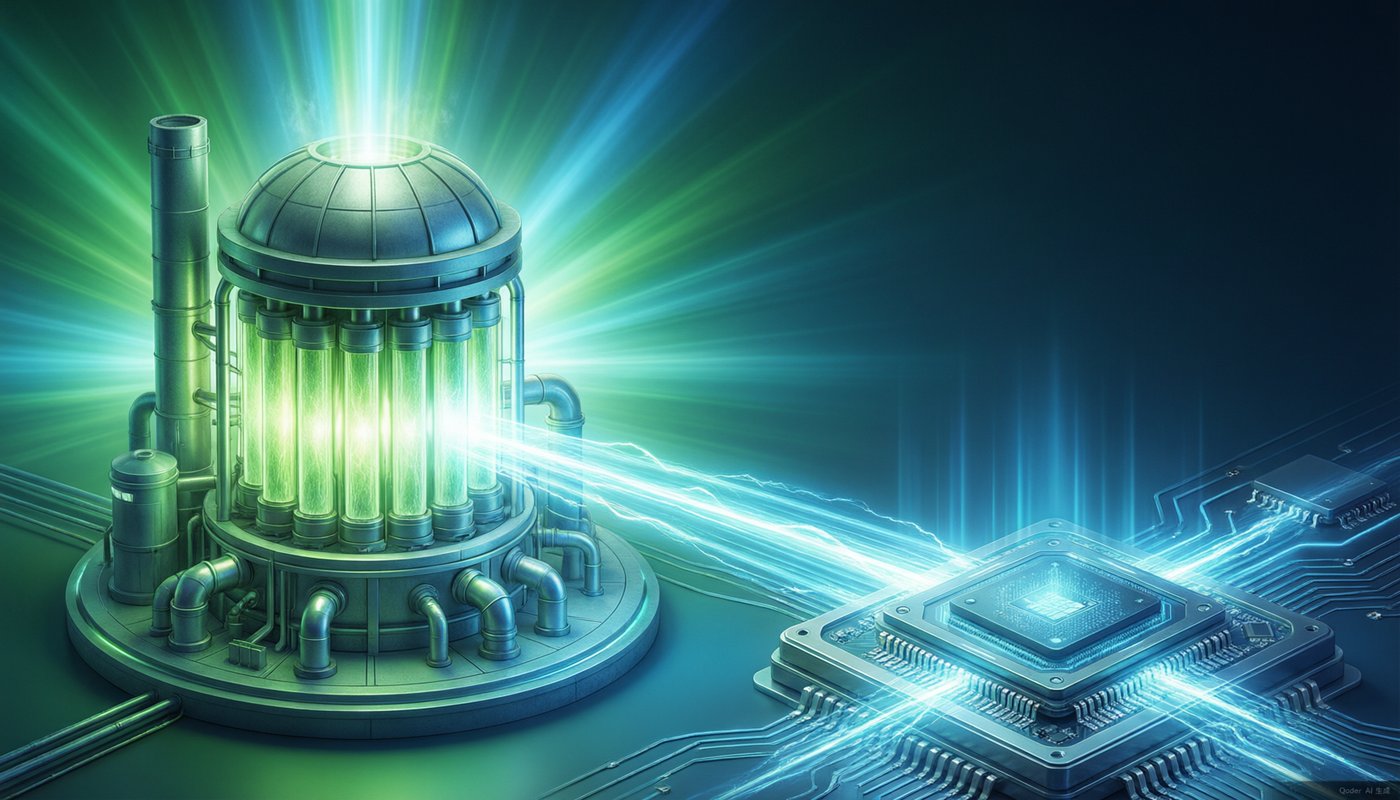
The announcement, made this week by Valar Atomic, describes a result that the nuclear and technology industries have been predicting for years: an advanced reactor powering AI computing hardware. Valar said its Ward 250 reactor has successfully supplied electricity to Nvidia’s Blackwell-architecture AI chips — the first commercial-grade application of a next-generation reactor in the United States. The achievement gives the “nuclear plus AI” story its first verifiable demonstration, and it arrives faster than most in either industry expected.
The problem the reactor addresses is the defining constraint of the AI build-out: electricity. AI data centers consume power on a scale that has strained grids, stretched utilities, and forced the industry to compete with homes and factories for energy. The companies building the largest AI systems — Microsoft, Google, Amazon, and their rivals — have all concluded that the grid alone cannot supply what they need, and all have been making bets on new sources of power. Nuclear, with its round-the-clock output and carbon-free profile, has emerged as the most serious candidate.
Valar Atomic is a small player in a field dominated by giants. The company’s Ward 250 is an advanced reactor design, one of a new generation of systems that differ from the conventional reactors that have powered the U.S. grid for decades — smaller, designed for commercial customers rather than utilities, and aimed at the specific problem of supplying industrial-scale power on demand. The successful test, in which the reactor powered Blackwell chips, is the company’s proof that its technology works in the application the market most wants.
The technology giants’ nuclear bets provide the context. Microsoft has signed agreements to restart and develop reactors; Google has backed small-reactor developers; Amazon has invested in nuclear startups. The scale of their commitments signals that the industry sees nuclear as a solution to the data-center power problem, not a sideshow. Valar’s achievement matters because it demonstrates the endpoint of those bets: a reactor, connected to AI hardware, delivering power that the hardware can use. It is the validation of a hypothesis the giants have funded but not yet proven.
The details of the demonstration are the company’s evidence. The Ward 250 powered Blackwell-architecture chips — Nvidia’s flagship AI accelerators — in what Valar described as a commercial-grade application, meaning the setup was designed for real operation rather than laboratory demonstration. The company said the reactor’s output met the requirements of the computing load, and that the system operated as designed. The specifics — the power level, the duration, the configuration — have not been fully disclosed, and the claims have not been independently verified, but the direction is clear.
The significance extends beyond the technology. The “nuclear plus AI” pairing has been the subject of intense speculation, with skeptics arguing that advanced reactors are years from commercial viability and that the industry’s interest is a form of greenwashing. Valar’s announcement challenges that skepticism with a concrete result: a reactor of a new design, operating in the United States, supplying power to the most advanced AI hardware in existence. If the result holds up to scrutiny, it changes the timeline that the industry has been assuming.
The road to scale remains long. The Ward 250 is one reactor, and the AI industry’s needs are measured in gigawatts — hundreds of reactors’ worth of capacity. The regulatory process for new reactor designs in the United States is measured in years, and the supply chain for advanced reactors barely exists. Valar’s demonstration is a proof of concept, not a solution; the company’s next steps — commercial contracts, regulatory approvals, manufacturing partnerships — will determine whether the technology scales or remains a demonstration.
The economics will be the ultimate test. Nuclear power has historically been expensive to build, and advanced reactors are meant to change that by being smaller, simpler, and factory-built. The price at which Valar can deliver power to data centers, compared with the alternatives — grid power, gas, renewables with storage — will decide whether the technology gets adopted. The data-center industry’s willingness to pay premium prices for reliable, clean power is the opening the nuclear startups need.
The broader meaning of the announcement is the arrival of a new energy era’s first evidence. The technology industry has been talking about nuclear power for AI for years, and the bets have been large; what has been missing is the demonstration that the pieces fit together. Valar has provided that demonstration, in a form that the market can see. The companies that signed the nuclear deals, the investors who funded the startups, and the utilities planning the grid will all be studying the results — and recalculating the timelines that have governed their plans. The first reactor has powered the first AI chips. The race to build the next hundred has begun.