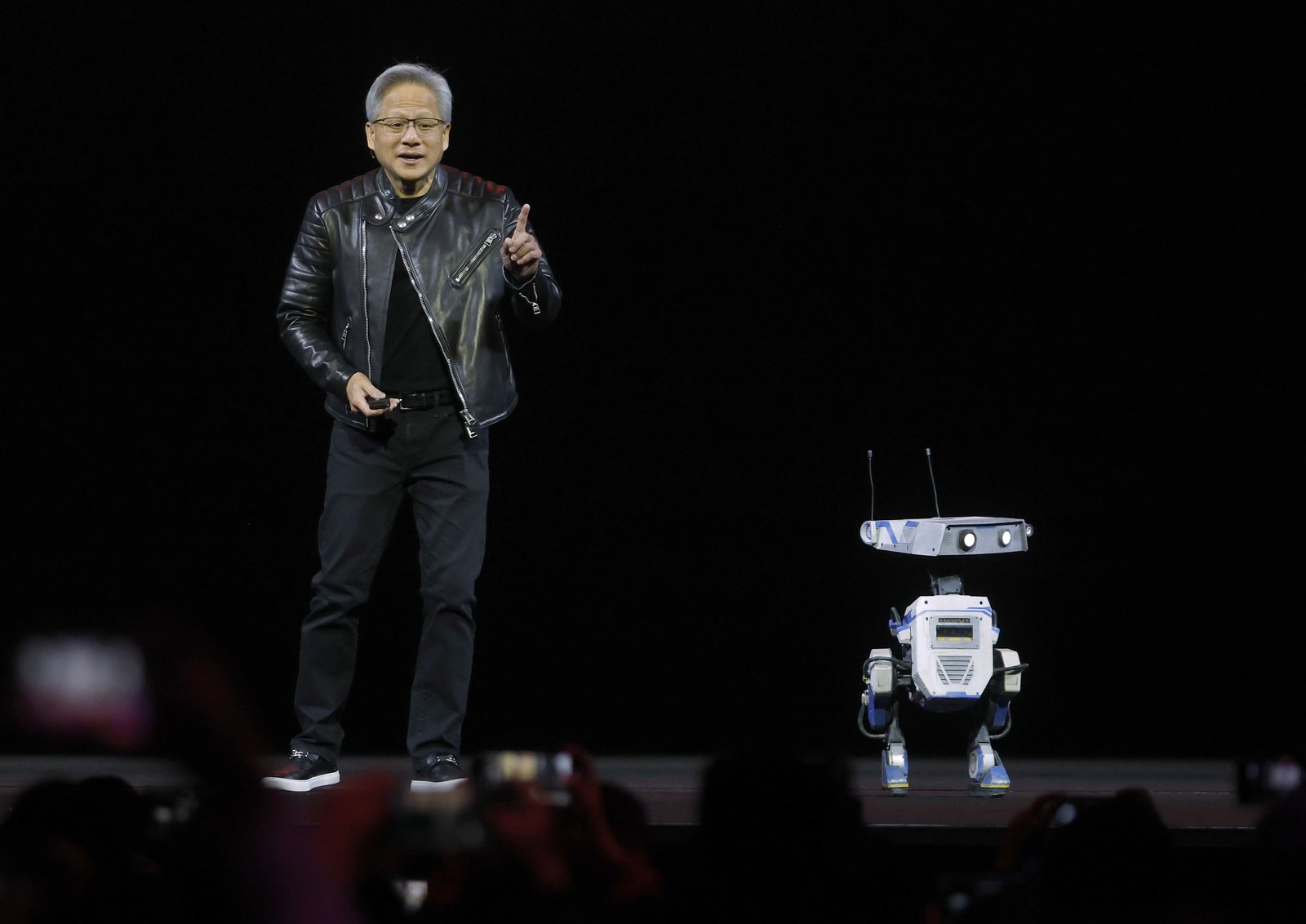
Jensen Huang walked into a Morgan Stanley roadshow in California this month with a slide deck and a list of rumors to kill. The Nvidia Corp. chief executive, joined by the chip maker’s chief financial officer and a core group of senior executives, spent the closed-door, non-deal meeting fielding four questions that have circled trading desks for weeks: whether Nvidia’s next flagship architecture would slip, whether customer-built chips were eroding demand, whether growth had peaked, and whether the company leaned too heavily on a small group of buyers. The answers, according to people familiar with the matter, were uniformly upbeat.
The most consequential exchange concerned Rubin Ultra, the company’s next-generation product line. A rumor had spread quietly through the industry that delivery would slide to 2028, a gap that would interrupt Nvidia’s product cadence and hand rivals a window in the race for artificial-intelligence computing leadership. Mr. Huang denied the report outright and said the architecture ships next year on schedule, according to people familiar with the matter. There is no delay, he told the room.
The session was one of several recent appearances by senior Nvidia executives, who have fanned out across investor events as the company tries to steady a shareholder base rattled by competing narratives. One camp sees a business whose data-center revenue still compounds at a pace few technology firms have matched. Another sees an order book that depends on a handful of hyperscale customers and a product cycle whose next act has not yet been proven in silicon.
The second item on the agenda, the rise of custom silicon, is the one analysts say worries investors most. Google, Amazon and Microsoft have each built their own AI accelerators, and every new design raises the question of how much of the total computing market Nvidia can keep. Mr. Huang’s answer, according to people at the session, was that custom chips serve narrow workloads while Nvidia’s platform handles the broadest span of model training and inference. Analysts who follow the company said the argument carries weight in the short term, because most frontier-model developers still build on Nvidia’s software stack. The longer-term erosion risk is real. One analyst put it simply: the question is not whether custom silicon grows, but whether Nvidia grows faster than the market around it.
The third concern, that growth has peaked, drew a response built on the product calendar. Executives pointed to a lineup that runs from the current generation through Rubin and Rubin Ultra, and to networking and software businesses that carry higher margins than the core GPU line. The fourth concern, customer concentration, was answered with the argument that the buyer pool is widening beyond the big cloud operators to include national AI projects, enterprise deployments and a growing set of sovereign data centers.
The outreach is also about who owns the stock. The roadshow was explicitly pitched as a chance for a broader investor base, including value-oriented funds, to hear the case that Nvidia’s valuation no longer prices in the growth still ahead. Executives argued that the multiple has compressed enough that the risk-reward has shifted, even if the share price is well below the levels of a year ago.
The timing matters. Nvidia’s next earnings report is only weeks away, and it will give investors the first hard look at whether the demand signals described at the roadshow are showing up in the income statement. For now, the company’s public numbers support its message: data-center revenue has kept climbing even as customers talk about efficiency gains, and supply of the latest chips remains tight.
The gap between what Nvidia says about demand and what its customers say about spending is the central argument of this market cycle, and the roadshow was an attempt to close it. Whether Mr. Huang’s assurances hold will show up in the capital budgets that hyperscalers finalize over the coming months. Analysts said those budgets, more than any single investor meeting, will determine whether Nvidia’s growth story extends past the current generation of chips.
For a company that has spent two years beating estimates, the risk is no longer about beating the quarter. It is about whether the market believes in the years after it. That is the context in which the Rubin Ultra denial matters most. A slip in the product calendar would have handed skeptics a concrete fact around which to build a bear case. By addressing it head-on, with the full executive team in the room, Mr. Huang was making the argument that the product engine is intact and the doubts, for now, are priced into the stock.
Whether investors accept that argument will be tested in the weeks ahead, as the next earnings date approaches and as rivals lay out their own product road maps. The roadshow bought Nvidia a hearing. The numbers will decide the rest.