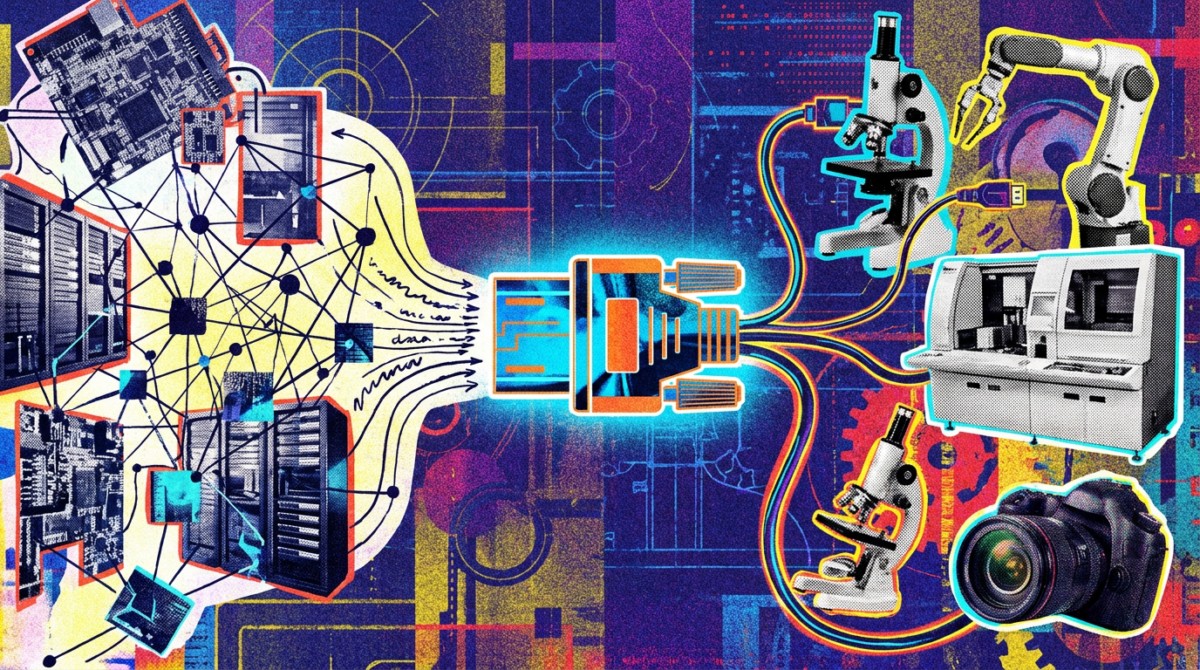
Anthropic released a research preview Aug. 27 of a proposed standard for letting AI agents operate laboratory instruments, robots and factory equipment. The Model Hardware Standard, or MHS, is designed to give software a common way to talk to physical devices, in the same way the company’s Model Context Protocol gave AI a common way to reach into software tools. Reuters, CNBC and Ars Technica all covered the announcement, an unusually wide reception for a technical specification.
The pitch is straightforward. Scientists and manufacturers would connect their equipment to Claude through a shared interface, letting the model read instrument states, run experiments and adjust production lines without custom integration for every device. Today, connecting an AI to a microscope or a robotic arm means writing bespoke code for each machine; the standard is an attempt to describe devices once so that one integration works across many of them. For a lab with ten different instruments or a factory floor with a hundred, the difference between custom work and a common standard is the difference between a project and a product.
For Anthropic, the move is a first step away from its software roots. The company has built its business on models that process text, code and images, and its customers mostly use them inside applications. MHS is its most concrete move toward physical AI, the effort to give models a body in the real world. Anthropic has said it sees robotics and scientific automation as natural extensions of its work, and the standard is an opening bid for the protocols those systems will use.
The timing is no accident. OpenAI has been working on its own robotics and physical-world initiatives, and the two companies are racing to define how AI and machines will interact. In software, whoever controls the protocol often controls the ecosystem, because developers build to the interface that most other developers are using. The same logic now extends to hardware: the company whose interface becomes the default for connecting devices to models holds a claim on the next decade of automation.
MHS is a research preview, not a finished product. Anthropic said it is publishing the spec to gather feedback from researchers and manufacturers, and the details will change as real users stress-test it. The company wants input from equipment makers and scientists before finalizing the standard, and it is inviting the same kind of community process that turned MCP from an Anthropic project into an industry-wide convention adopted even by its competitors.
The practical applications are closer than they sound. Labs already use robotic liquid handlers, automated microscopes and networked sensors, and a standard that lets an AI operate them could speed up drug discovery and materials research by running experiments around the clock. Factories are full of programmable machines that still require humans to translate between control systems, and the same standard could let a model adjust a production line when a parameter drifts, catching problems faster than a shift supervisor.
Regulators will eventually weigh in. Physical AI raises safety questions that software never did: a model controlling a robot or a reactor can cause physical harm, and the standards for verification and fail-safes are still being written. Anthropic, which has built its brand on safety research, is positioning MHS as a way to make physical AI safer by design, with predictable interfaces, auditable controls and clear boundaries between what a model may do and what it may not.
The contest between the two companies is not just technical. Anthropic’s MCP already became an industry standard for tool use, adopted across the major model providers, and MHS is an attempt to repeat that trick with hardware. OpenAI, for its part, has pushed its own interfaces and robotics work, and neither company shows signs of ceding the field. The winner of this particular race will not be decided by a single announcement, but by which standard the equipment makers, the scientists and the factories actually adopt in the years ahead.
The standard also opens a commercial question for Anthropic. A specification that lets any model control any device also lets any model maker compete in the physical world, and a standard that Anthropic controls is a way to keep Claude central to the systems that adopt it. The company has been careful to frame MHS as an open effort, but the strategic logic is the same one that governs all standards: the sponsor sets the terms, and the ecosystem builds on top.
The scientific community has reason to pay attention. Automated laboratories are becoming standard equipment in drug discovery and materials science, and the labs that figure out how to let AI run their instruments will move faster than those that do not. Anthropic is betting that the labs and factories that adopt MHS early will be the ones that shape how the standard evolves, and that the first-movers will pull the rest of the industry along. Whether that happens depends on execution, but the direction is set: AI is moving out of the screen, and the companies that define how it touches the physical world will write the rules for everyone else.