
The stock fell 4.6 percent Thursday, wiping out about $253 billion in market value in a single session. The trigger was not the earnings themselves, which beat expectations, but what executives said about the road ahead. Nvidia reported second-quarter revenue of $96.2 billion on Aug. 26, roughly double a year earlier, and guided the next fiscal year up about 70 percent. Investors sold anyway, their attention fixed on gross margins as the company moves from one chip generation to the next.
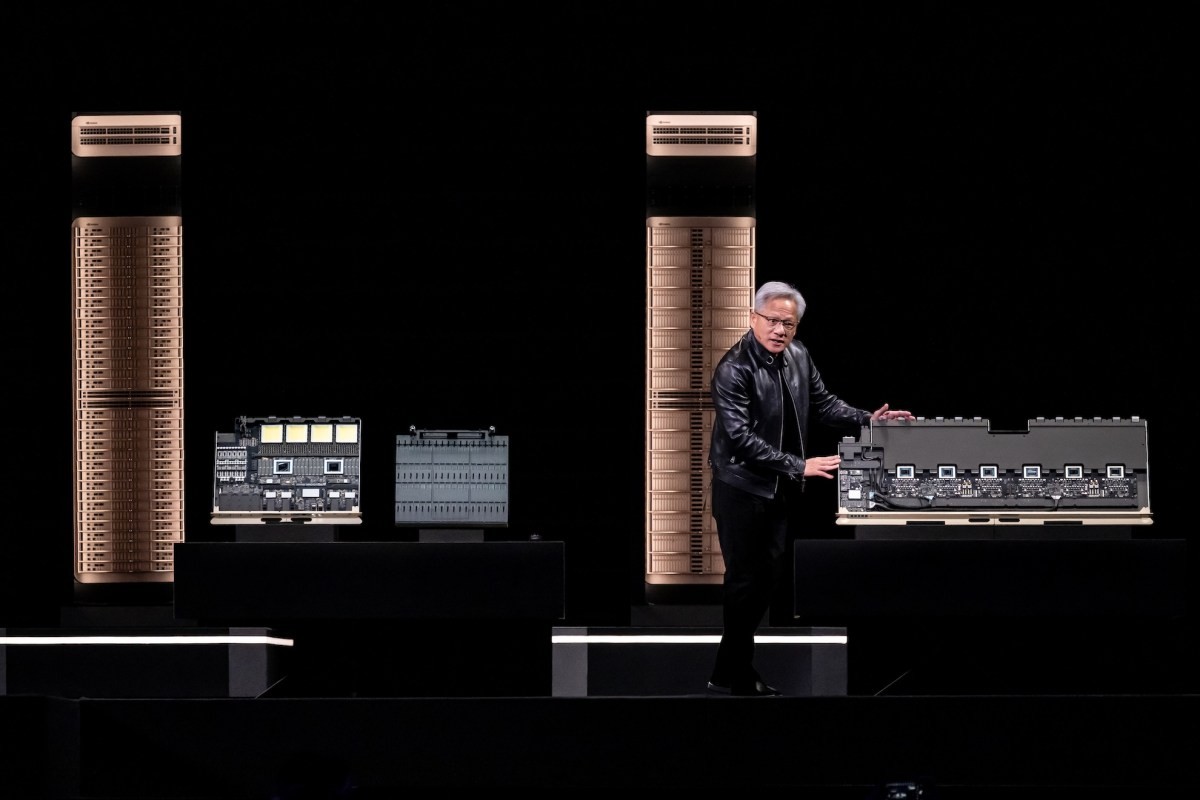
The concern is the transition from Blackwell to Rubin, the architecture Nvidia plans to ship in volume next. Generational shifts have historically squeezed margins as Nvidia discounts older inventory and absorbs the cost of ramping new manufacturing. This time the company is also selling complete systems, racks that bundle its Vera CPUs, inference accelerators and storage networking, rather than individual chips. Full-system shipments raise the average selling price, but they change the cost structure, and Wall Street is still modeling what that does to profitability.
Analysts split into two camps. One group argues the selloff is overdone. They point to the guidance, which implies another year of breakneck growth, and say that valuations built on the 2028 numbers still look conservative; several raised their price targets after the report. The other group warns that the AI trade is entering a repricing phase, in which investors demand proof that massive capital spending converts into durable profits for customers, not just revenue for Nvidia.
TechCrunch’s analysis the same day framed the moat differently. Nvidia’s advantage, the argument runs, is no longer just the GPU. The Vera Rubin generation packages the Vera CPU, inference accelerators and storage networking into complete rack-scale systems, pushing data centers from stacking chips to orchestrating entire machines. System-level optimization, Nvidia says, can deliver up to three times the performance of earlier approaches. If that holds, the company is selling less a chip and more an operating system for the data center, a position competitors have struggled to attack.
The margin question is really a question about the pace of technology. Every new architecture requires new manufacturing processes, new packaging and new supply agreements, and each step carries costs that must be absorbed before volume production drives them down. Nvidia has managed this cycle repeatedly, but the stakes grow each time because the absolute numbers are larger. A few points of margin on a business that doubled to $96 billion in a quarter is tens of billions of dollars.
What the market does with the answer matters beyond Nvidia. The company has become a proxy for the entire AI trade. When its shares move, so do the suppliers, customers and rivals that ride the same wave, from Taiwan Semiconductor and Broadcom to the cloud providers that buy its chips. A repricing of Nvidia is, in effect, a repricing of the sector, and Thursday’s move rippled through chip stocks before the close.
The selloff also reflects a shift in how investors are reading the AI buildout. For two years, the trade was simple: more demand, more chips, more revenue. The questions now are subtler. Whether customers like Microsoft, Meta and the cloud providers can earn a return on the infrastructure they are buying will determine how long the spending boom lasts, and Nvidia’s margin is the most visible meter of that tension. When the company warns that a transition will cost a few points of profitability, the market hears the broader question underneath: who ultimately pays for all this computing.
Nvidia’s chief executive, Jensen Huang, has said demand for the newest chips still outstrips supply, and the company’s guidance suggests customers see no slowdown in their own spending. The selloff shows how quickly sentiment can turn when a growth story meets a cost story. Investors are no longer asking only whether AI computing grows; they are asking at what margin, and who pays for the transition.
For Nvidia, the stakes of getting the Rubin transition right are unusually high. The company’s valuation has come to embody the entire industry’s expectations, and each quarter it must clear a higher bar just to hold its stock steady. Thursday’s drop was a reminder of that arithmetic, though it left Nvidia’s shares still far above their levels of a year ago, and few analysts are predicting the run is over. The debate is now about the terms of the next leg, not whether it happens.
Nvidia’s challenge is to make the Rubin transition look orderly: guide margins through the dip, keep supply ahead of demand, and show that whole-system sales produce enough profit to justify the complexity. If the company threads that needle, Thursday’s selloff will be remembered as a pause in a longer run. If the transition drags, the repricing camp gets its evidence. Either way, the next two quarters will tell investors which story is true.



