
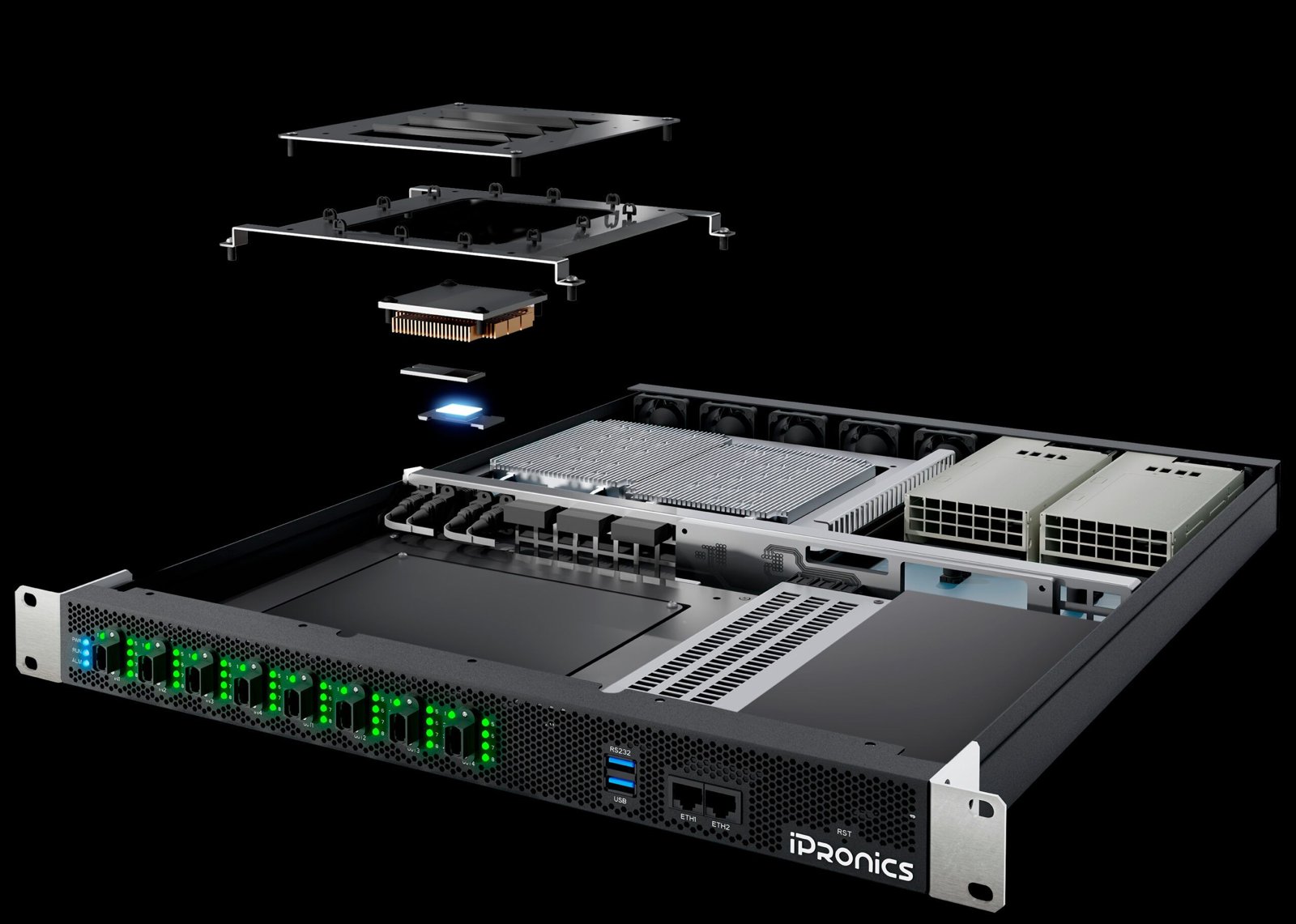
iPronics, a Spanish startup that builds optical switches for AI data centers, said Tuesday it raised $125 million in a Series B round led by Maverick Silicon and Light Street Capital, with NVIDIA among the participants. Reuters reported the financing, which brings the company’s total funding to $177 million.
The company traces its roots to the Polytechnic University of Valencia, where it was founded in 2019, and it has been shipping products for about a year. Its products are aimed at the networks that connect the tens of thousands of accelerators inside AI clusters, a market growing faster than the switches that serve it can be built.
The technology is optical circuit switching, the same approach Google has used to rewire the fiber connections in its AI supercomputers, according to the company. Where conventional gear steers light with banks of tiny tilting mirrors known as MEMS, iPronics routes signals with silicon photonics and no moving parts.
The design goal is size. iPronics says its approach can shrink optical switching equipment by roughly 20 times, small enough to fit inside a standard server rack, and can reconfigure a network in milliseconds as workloads claim and release capacity.
The need comes from how AI clusters work. Training jobs move data between specific groups of chips, and the pattern changes every time a job starts, ends or is rescheduled. Switches that steer light mechanically take time and space to do that; switches that do it on a chip can keep up with the pace of the work.
The economics change with scale. In a small cluster the wiring can stay static; in a large one, jobs of different shapes share the same machines, and the ability to rewire on demand determines how fully the hardware is used. Operators that can reconfigure their networks in milliseconds can pack more work into the same accelerators.
As accelerator supply has loosened, attention has shifted to everything around the chips: the power feeding them, the cooling that keeps them from throttling, and the network tying them together. Interconnect, once an afterthought of cluster design, has become a deciding factor in how much of a cluster’s theoretical speed is actually usable, engineers say.
NVIDIA’s interest fits that pattern. The company sells its own networking hardware alongside its accelerators, from NVLink for chip-to-chip links to InfiniBand and Ethernet for cluster fabrics, and it has invested across the photonics field as it designs clusters that link ever larger numbers of processors.
Optical switching is one of several interconnect bets NVIDIA has made as it designs systems that link its accelerators in ever larger numbers. The company’s own product line spans the layers between chips, and investments in startups such as iPronics give it a view of approaches that may one day sit inside the clusters its chips power.
Google’s experience is the proof point for the category. Its optical circuit switching deployments showed that reconfiguring a network rather than overbuilding it could make a large cluster more flexible, and suppliers have since raced to offer similar capability to operators that design their own systems and those that buy off the shelf.
Most of the largest AI operators still treat optical switching as custom engineering, building their own gear or buying from a handful of suppliers. iPronics’s pitch is that the technology has matured enough to sell as a standard product, and that the rest of the industry will adopt it the way it adopted other data-center networking standards.
iPronics is part of a broader wave of silicon-photonics startups betting that light will replace electricity for more of the connections inside a data center, including the shortest ones between chips. The wager is that optics, long confined to the cables between buildings and racks, will move into the machines themselves.
The photonics wave is also a manufacturing story. Silicon photonics rides on the same fabrication processes used for computer chips, which means optical components can be produced at scale in chip fabs rather than assembled by hand. That alignment with the semiconductor industry is what makes shrinking a switch by roughly 20 times plausible.
The size of the round, with two specialist funds leading and NVIDIA participating, shows how much money is chasing the parts of AI infrastructure that sit between the processors. Investors have watched accelerator spending balloon and are looking for the next constraint in the system to back.
iPronics faces established optical vendors moving into circuit switching and well-funded photonics startups chasing adjacent pieces of the interconnect problem. Its bet is that an all-solid-state design, small enough for a standard rack, will win over operators that want optical flexibility without the footprint and moving parts of mirror-based systems.
Shipping matters in this market. Operators will not design a cluster around a switch that exists only in a laboratory, and iPronics’s year of shipments gives it evidence that its product works while later entrants are still qualifying designs. The round will fund the production capacity that turns that evidence into a business.
For NVIDIA, the investment is an option on a future where the switch is a chip and a cluster can be rewired in milliseconds. For the industry, iPronics is betting that the boxes of mirrors that wire today’s AI supercomputers will come to look like the mechanical ancestors of something much smaller.



