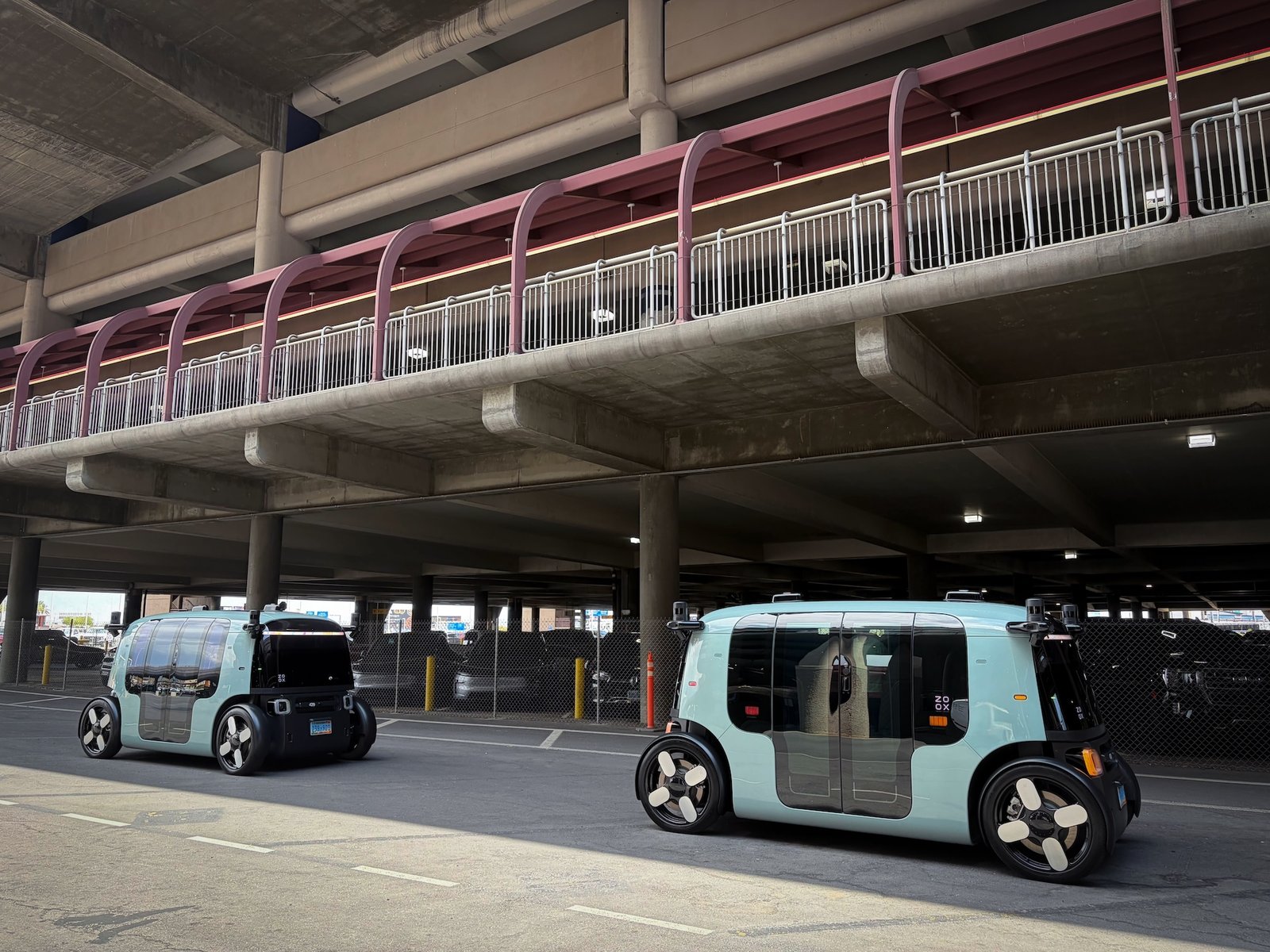
A traveler landing at Harry Reid International Airport now has an option that did not exist three weeks ago: a driverless car waiting near baggage claim. Zoox, the autonomous-driving company owned by Amazon, said Thursday that its commercial robotaxi service has expanded to the airport, where passengers can board for trips to and from the terminal. It is the only robotaxi operator allowed to pick up riders at the Las Vegas airport.
The airport is where the company’s advantage shows up in its most concrete form. Ride-hailing apps can drop passengers at the terminal doors, but their pickup points sit on the upper levels of the parking structure, a five-to-ten-minute walk with luggage in hand. Zoox picks up at the curb, where arriving passengers already are. In the competition to win the airport trip, the distance between those two spots is the whole game.
The trip itself is the most valuable kind of ride in the industry. Airport runs are longer than the average fare, predictable in their routes and concentrated at the times when demand is highest, and the passengers who take them are the same customers ride-hailing companies prize most. Las Vegas adds a further twist: much of the airport’s traffic is headed to hotels on the Strip, a corridor of dense, slow-moving streets where a robotaxi can demonstrate its skills in full view of tourists.
The launch ends a long wait for Zoox. The company spent more than a decade designing a vehicle that looks like nothing else on the road: four passengers face each other in a cabin with no steering wheel and no pedals, wrapped in sensors that cover every approach. Amazon acquired the company in 2020 for more than $1 billion, betting that a purpose-built robotaxi would eventually outperform the retrofitted sedans its rivals were testing.
The vehicle finally won a federal safety exemption in August, clearing the way for paid rides, which began Aug. 10 on the Las Vegas Strip. Since then the company has announced plans to test in San Diego and Houston and published a detailed safety framework, and the airport expansion follows within weeks. For a business that spent years moving in millimeters, the pace of the past month has been striking.
Zoox’s timing is deliberate, and it is also temporary. Last month Nevada issued commercial robotaxi permits to Tesla, Uber and Waymo, meaning the company’s exclusivity at the airport will not last. Clark County, which contains both the Strip and the airport, could allow up to 8,000 robotaxis on its roads over the next 12 months, according to local officials, turning southern Nevada into the most crowded testing ground for autonomous ride-hailing in the country.
The airport is where Zoox intends to build a moat before that crowd arrives. Airport concessions are controlled by the county, and access to the curb is a license that competitors will have to negotiate separately. Airlines, hotels and the airport authority all track how passengers move between the terminal and the city, and a robotaxi operator that demonstrates reliable airport service can lock in the geography before the permit queue grows.
The company argues its design gives it an edge in that race. A vehicle with no driver can hold its place in a queue without wages ticking, wait out a delayed flight without surge pricing, and carry four passengers who face each other rather than a single rider in the back seat. Zoox says the cabin was built for dense urban conditions from the start, not adapted from a passenger car, and that its safety record on the Strip since Aug. 10 justifies the expansion.
Airports are controlled territory. Harry Reid and airports like it charge ride-hailing companies for every pickup and drop-off, and they decide which operators may use the curb at all, so Zoox’s presence implies an agreement with Clark County that competitors will now want to match. The county has shown itself willing to let several fleets run at once; whether it will extend the same curb access to the newcomers is one of the open questions in the coming expansion.
Analysts who follow autonomous vehicles read the airport move as the first test of a broader strategy: win the trips that are easiest to automate and most profitable to serve, then expand outward. Airports fit that description better than almost any destination, with fixed routes, predictable demand and passengers who are paying for convenience rather than shopping for the cheapest fare. If the model works in Las Vegas, the same playbook can be exported to the dozens of airports where Zoox has said it eventually wants to operate.
For now, the change for travelers is small: the ride from baggage claim to a Strip hotel is a few miles, and the fare is comparable to a conventional car. For the ride-hailing industry, the significance is larger. The curb at the arrivals level has been the one place where drivers still matter more than software; a robotaxi that meets passengers at the door has quietly moved that boundary too. The race that begins at the Las Vegas airport curb is considerably longer than the ride itself.