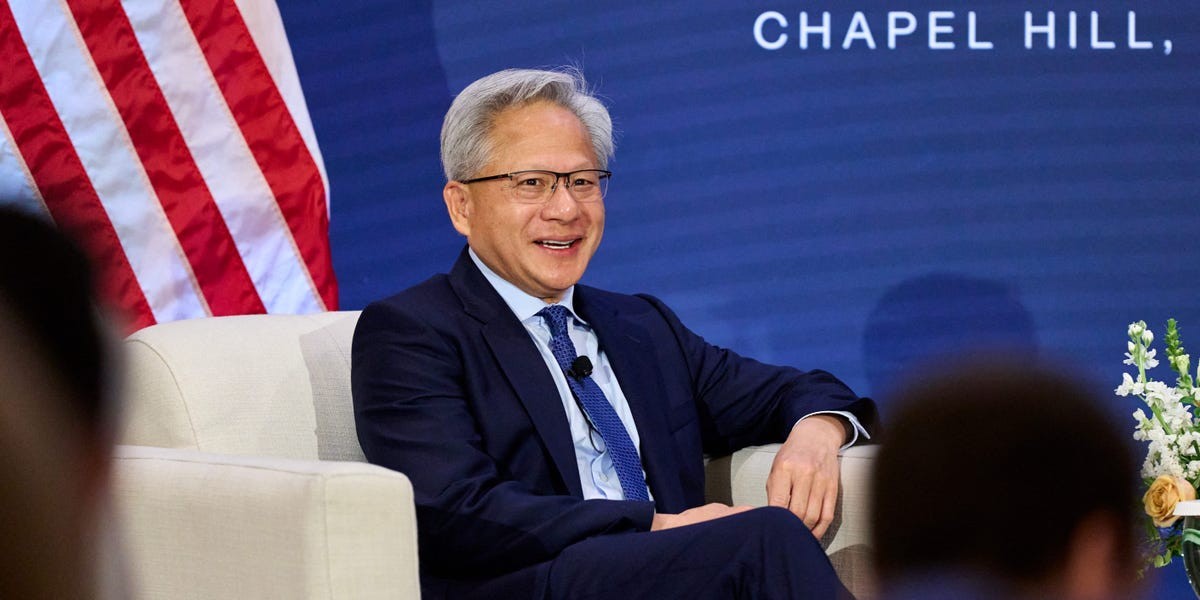
The post went up on Sunday, and the AI industry spent the rest of the day arguing about it. Jensen Huang, the chief executive of Nvidia, wrote on X that artificial general intelligence had arrived. “From ChatGPT to o1 to Astra in 4 years. AGI has arrived. Congratulations @OpenAI team,” he said, adding that 400,000 graphics processors were coming online. The message congratulated OpenAI on the release of GPT-6 Astra. It also, not incidentally, promoted the company that made the chips Astra was trained on.
Nvidia has rarely been shy about its enthusiasm for the models that run on its hardware, and Astra is a case in point. OpenAI has described Nvidia as the foundation of its infrastructure, and the two companies have grown together as the AI boom unfolded: Nvidia supplies the processors, OpenAI supplies the software that makes developers want them. A chief executive calling a customer’s product the arrival of AGI is, among other things, an advertisement for the entire ecosystem.
The four-year arc Huang drew has a specific shape. ChatGPT introduced the world to conversational AI at the end of 2022; o1, OpenAI’s reasoning model, arrived in 2024 and showed that models could think before answering; Astra, released this month, added the ability to act, operating computers and pursuing tasks on its own. For Huang, the progression from talking to thinking to doing is the definition of general intelligence arriving in compressed time.
The 400,000 GPUs in his message were a claim about capacity as much as congratulations. Nvidia’s newest chips are in demand beyond what the company can supply, and every frontier lab is fighting for allocation. A public statement that hundreds of thousands of processors are coming online reassures the market that supply is catching up with the orders that have kept Nvidia’s factories and its stock price at records.
The post also exposed a divide inside OpenAI itself over the word Huang used so freely. Greg Brockman, OpenAI’s president, told the company’s Astra launch event on Thursday that the industry was entering what he called the AGI era. Sam Altman, the chief executive, has been more careful: on a podcast he called AGI “poorly defined,” an almost irrelevant marketing term that he said obscured the real, gradual progress of the technology.
The split is more than semantics. Brockman’s job is to rally developers and partners around OpenAI’s products, and the language of arrival suits that work. Altman’s job is to manage expectations that have repeatedly outrun reality, and a word that invites comparisons to science fiction is a liability when a model falls short of its billing. The two men have long played these roles, the evangelist and the realist, and the Astra cycle has pushed the gap between them into public view.
Huang faces no such constraint. Nvidia sells to everyone in the AI industry, and its revenue does not depend on whether any single lab delivers on the most grandiose definition of AGI. Declaring the technology’s arrival costs the chipmaker nothing and flatters its customers; the same post that celebrated OpenAI also positions Nvidia as the supplier that made the achievement possible.
The commercial backdrop makes the enthusiasm easy to understand. Nvidia reported revenue of $96.2 billion for its August quarter, with data-center sales of $89 billion, figures that would have seemed impossible when ChatGPT launched. Each new model generation, whatever its actual capabilities, triggers another round of orders for training clusters and the inference capacity to serve the resulting products. For the chipmaker, every lab’s big reveal is a sales event.
The reaction inside the industry was predictably mixed. Researchers who have spent years arguing that AGI is a distant goal objected to the confidence of Huang’s declaration, while those who believe the field is approaching genuine general intelligence welcomed an endorsement from the industry’s most powerful executive. The argument is unlikely to be settled by a post on X, but the fact that the chief executive of the world’s most valuable chip company chose to take a side is itself a piece of news.
For investors, the episode carries a practical meaning. Huang’s post ties Nvidia’s fortunes to OpenAI’s product cycle at a moment when both companies face questions about sustainability: whether the demand for AI compute can keep pace with the capacity being built, and whether models like Astra will generate the revenue to justify their enormous training bills. The two companies rise and fall together, and the chipmaker’s cheerleading is also an expression of self-interest.
The coming weeks will test whether the AGI label survives contact with the product. Astra’s rollout is only beginning, its benchmark scores are impressive but incomplete, and the capabilities that would make Huang’s declaration stick, models that work reliably across the full range of human intellectual work, remain a work in progress. What is already clear is the direction of the argument: the man selling the shovels has declared the gold rush over, which in his business is the surest sign that the digging has only begun.