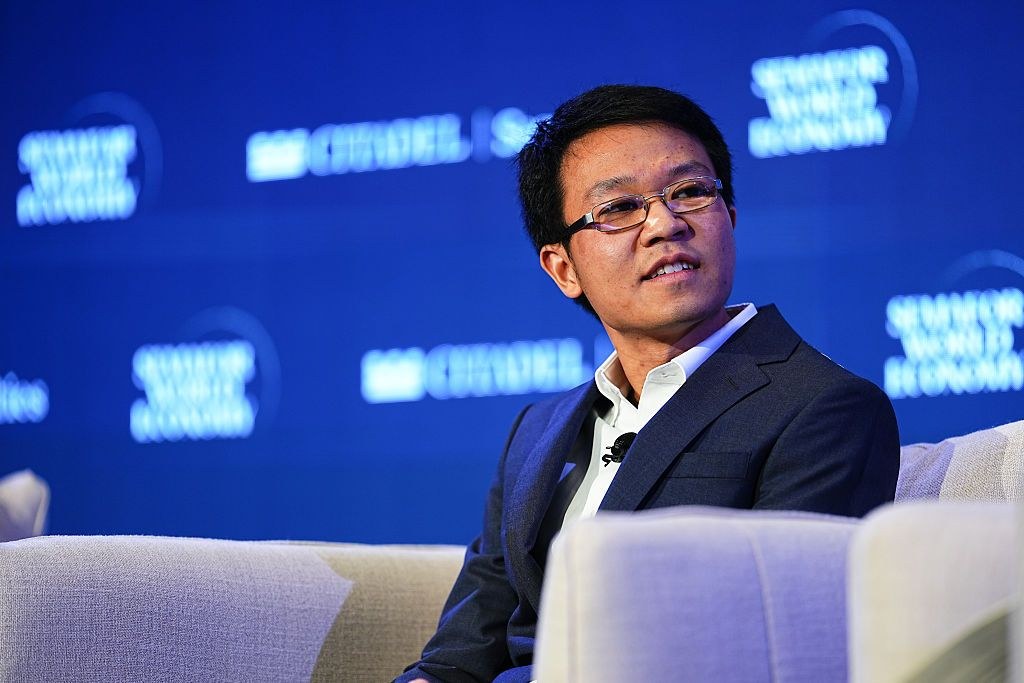
Scott Wu built his company on a simple claim: a software engineer that never stops. On September 8, Cognition AI said it had raised $2 billion in a Series E round that values the company at $48 billion, roughly double the $26 billion investors assigned it in May. The round was led by new investors Andreessen Horowitz and Accel, with participation from existing backers Founders Fund, General Catalyst, and Avenir.
The more striking number is the revenue curve. Cognition said its annualized revenue has climbed from $492 million at the time of its last round in May to nearly $900 million, a pace that few enterprise software companies have matched so early in their lives. The company’s product, Devin, is an autonomous coding agent that plans and executes multi-step software tasks, and its customer list now runs from the U.S. Army, Navy, and NASA to ServiceNow, Infosys, and Goldman Sachs.
The government adoption is the part of the list that stands out. Defense and intelligence agencies have been some of the fastest buyers of coding agents, which shrink the gap between a requirement and working software. NASA’s use of Devin points the same direction: organizations with hard deadlines and too few engineers will pay for a tool that writes code around the clock.
Cognition’s founding story helps explain the interest. Wu, who co-founded the company in 2023, came to coding agents from competitive programming, and Devin, launched in early 2024, made its name by behaving like a junior engineer rather than an autocomplete tool. The distinction, between a model that suggests code and an agent that completes a task, is the line the entire industry is now trying to cross.
Devin’s design reflects that shift. Where a code-completion tool responds to a prompt with a snippet, an agent like Devin takes a task, breaks it into steps, writes and runs code in an isolated environment, and returns a result. The distinction sounds small, but it changes the unit of work a customer is buying, from a suggestion to a finished task, and it is what lets the product command prices closer to an engineer’s time than to a subscription.
The market is crowded, and that is part of the bet. GitHub Copilot from Microsoft, Cursor from Anysphere, and coding agents from OpenAI and Anthropic all chase the same developer budgets. The jump from $26 billion to $48 billion in four months suggests investors are wagering not that Devin wins the category outright, but that the category is large enough to support several big companies at once.
The financial math is aggressive by historical standards. At $48 billion, Cognition is valued at roughly 50 times its current annualized revenue, a multiple that assumes growth continues near its present pace for years. Andreessen Horowitz and Accel, which sat out the earlier rounds, are paying that price to get in now rather than later, a measure of how quickly the category is consolidating value.
Serving autonomous agents is not cheap. A session that runs for minutes or hours, spinning up environments and calling models repeatedly, costs far more than a single autocomplete. Cognition has said little about profitability, but the revenue growth suggests customers find the economics acceptable, and Goldman Sachs on the list signals that even cautious buyers have moved past experimentation.
The timing of the round matches a broader corporate shift. A year ago, many large buyers were running pilots; now they are moving agents into production and into budget lines. Cognition’s customer list, with its mix of defense, government science, and financial firms, reflects where the spending is landing first: wherever the cost of a human engineer’s hour is highest and the volume of routine code is largest.
For the wider software industry, the round is a data point in a larger shift. If coding agents can reliably absorb even a fraction of routine engineering work, the economics of building software change, and the companies that own the agents capture a share of what used to be headcount. The $2 billion is a wager on how fast that fraction grows, and on Cognition’s ability to stay ahead of rivals funded just as well.
The competitive risk is real and growing. Microsoft can bundle Copilot into its existing contracts, and OpenAI can distribute its agents through the most-used models in the world. Cognition’s defense is focus: a single product, built from the ground up around one task. Whether that focus beats distribution is the question the next several quarters will begin to answer.
What the market will watch next is whether the revenue keeps compounding. May’s $492 million became September’s $900 million; the slope, not the level, is the argument for the valuation. For now, the round closes with Cognition as the fastest-rising company in the fastest-moving part of AI, and with a long list of skeptics waiting to see if the curve bends.