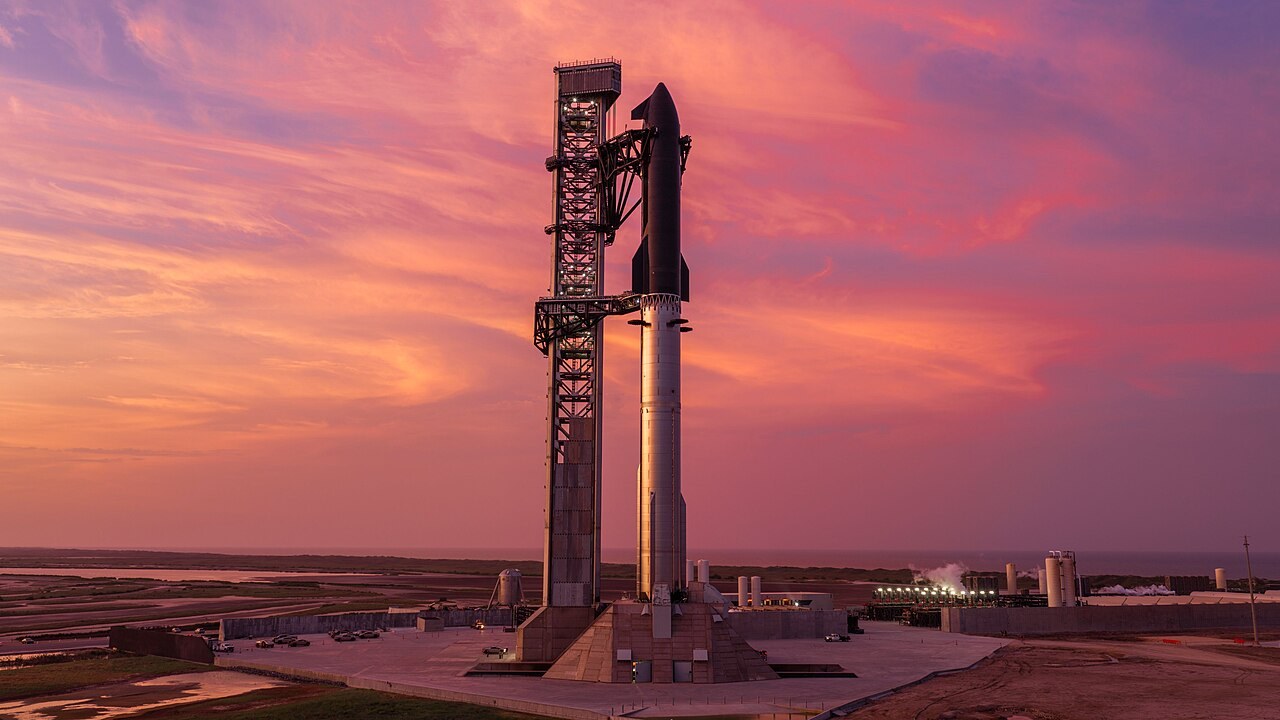
The world’s largest rocket has flown thirteen times, and every one of those flights carried test hardware or nothing at all. The fourteenth, according to a Federal Aviation Administration airspace notice, is different: for the first time, a Starship will carry a real commercial payload, and the flight is slated to earn SpaceX money.
The FAA notice lists a primary window for Flight 14 of September 18, from 12:15 to 14:14 UTC, with September 19 as a backup, launching from the company’s Starbase facility in Texas. SpaceX has not yet confirmed the date publicly, and the company’s silence is typical; it tends to let the paperwork surface before it makes an announcement.
The payload is about twenty production Starlink V3 satellites, the newest version of the company’s internet constellation, built to connect directly to mobile phones. Deploying them would be the first time Starship delivers working satellites to orbit, the job the rocket was designed for from the start. Bret Johnsen, SpaceX’s chief financial officer, has already confirmed that this mission will generate revenue, a small line item that marks a large shift for a vehicle that has burned cash on every prior launch.
The mission is also the first orbital flight for Starship. Earlier flights reached space but flew suborbital trajectories, carrying the vehicle through the hard steps of surviving reentry and landing. Flight 14 is the point where the test program and the business converge.
The hardware for the attempt is the Super Heavy booster B21 and the Starship upper stage S41. B21 completed a full-duration static fire on August 28, the standard check before a launch, and SpaceX applied to the Federal Communications Commission on August 31 for a special temporary authorization, asking for approval by September 15.
The regulatory path has been clearing. The FAA issued a finding of no significant impact for the flight, one of the steps required before a license can be finalized. SpaceX has spent years navigating that process, and the fact that the agency has moved to the airspace-notice stage suggests the paperwork is close to done.
The Starlink V3 satellites are the load that makes the business case for Starship. The constellation already carries most of SpaceX’s revenue, and the company’s plans for it depend on a rocket large enough to deploy the bigger, heavier satellites quickly. Starship can carry far more per launch than the Falcon 9 that has built the constellation so far, and the V3 satellites are too large for that older rocket.
The mission also advances a longer bet. SpaceX has told investors that Starship will eventually carry people, cargo and fuel for missions to the Moon and Mars, and that the same vehicle will haul satellites for its own constellation in the meantime. Putting revenue-generating payloads on board turns the rocket from a development project into a working product, one that pays for itself flight by flight.
The stakes are as high as they have been on any Starship flight. A failure would set back the schedule and invite the scrutiny that has followed the program through its earlier explosions. A success would do more than validate the vehicle; it would put satellites in orbit and money on the books, and it would give SpaceX a launch system that no competitor can match on price per pound.
Starship is the centerpiece of Musk’s plan to make space travel routine and, eventually, to carry people to Mars. The rocket’s first test flight in April 2023 ended in an explosion minutes after liftoff, and the program has progressed through a series of increasingly ambitious tests since. By the thirteenth flight, SpaceX had begun catching the Super Heavy booster with the launch tower’s arms, a feat that lets the company reuse the rocket’s most expensive component and drive down the cost of each launch.
The move to revenue-generating flights follows the playbook SpaceX used with the Falcon 9, which began as an experimental rocket and became the workhorse of the commercial launch industry. Starlink has been the customer that made that transition possible, absorbing launches when no one else would pay for them and giving SpaceX a reason to fly even when the market was thin. Starship is now stepping into the same role, with its own constellation as the first paying client.
For now, the dates are provisional and the company is quiet. The FAA notice is the clearest signal yet that the first commercial Starship mission is days away, and that the world’s largest rocket is about to start working for a living.
The flight also matters for SpaceX’s schedule. The company has said it wants to fly Starship far more often than it has, and each successful mission builds the case for the higher launch rate that the Starlink plan requires. A clean deployment of twenty satellites would show that the rocket can do commercial work reliably, not just survive the trip.