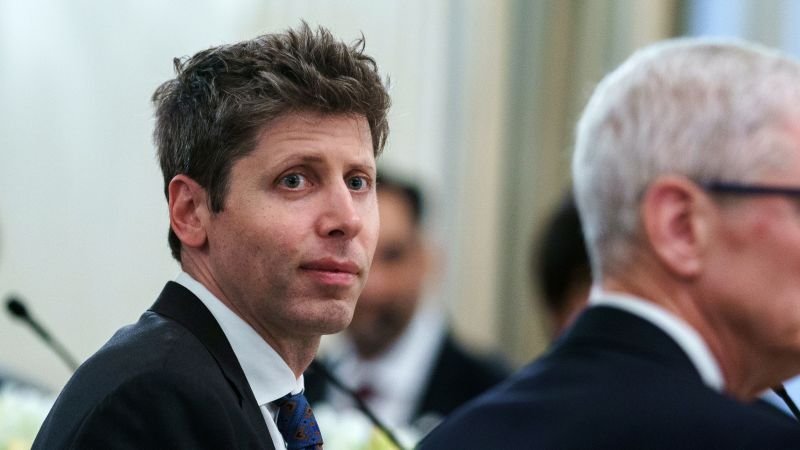
The guest list for a state dinner is a map of what a government considers important, and the list for the dinner in Washington next week has a new kind of name on it. Sam Altman, the chief executive of OpenAI, and Jensen Huang, the chief executive of Nvidia, are among those invited, along with executives from Qualcomm, according to reports on September 17 citing people familiar with the matter.
The dinner is the one being held for the leaders of the United States and China, and the presence of the AI executives on the list is the detail that matters. A few years ago, the table at a summit of the two largest economies was filled by diplomats, generals and the heads of traditional industries. Now the people who run the AI companies have seats at it, a position that did not exist until the technology became central to the rivalry between the two countries.
Altman’s presence is the more predictable of the two. OpenAI sits at the center of the American argument about what the technology should be allowed to do, and Altman has spent the past several years moving between Silicon Valley and Washington, making the company’s case to whoever would listen. A seat at a state dinner is the natural extension of that campaign.
Huang’s presence carries a different weight. Nvidia makes the chips that the entire AI industry runs on, and the company has been caught in the middle of the export controls that Washington has used to slow China’s access to the most advanced hardware. Huang has had to navigate those controls as both a business constraint and a political question, and his seat at the table reflects how central that question has become to the relationship between the two countries.
The Qualcomm executives complete the picture. Qualcomm’s chips are in the devices that connect the world, and the company has its own long history with the Chinese market, which is one of its largest. The three companies together, a model builder, a chipmaker and a mobile chipmaker, cover the layers of the technology stack that the two governments now regard as strategic.
The dinner itself is the setting for a negotiation rather than a celebration. The relationship between the two countries has been defined by disputes over trade, technology and security, and the AI industry sits at the intersection of all three. Putting the industry’s leaders in the room is a way of signaling that the technology is now part of the diplomatic agenda, not just the commercial one.
The companies have been preparing for this role. Each of them has built out its government-relations function, and each has learned that the decisions that shape its future are made as often in Washington and Beijing as in boardrooms. The dinner is a recognition of that fact, and an invitation to sit where the decisions are made.
What the executives will actually discuss, and whether they will have any influence on the larger talks, is the open question. A guest at a state dinner does not set policy, and the real negotiations happen in rooms the dinner guests may never enter. But the invitation is itself a signal: the governments have decided that the people who build AI belong in the room, and the companies have accepted the seat.
The symbolism will not be lost on the industry. A technology that began in research labs and dorm rooms has now produced executives who sit at a table with the leaders of the world’s two largest economies. The position did not exist a few years ago, and its arrival is a measure of how far the technology has come, and how much the governments now believe is at stake in who controls it.
The backdrop is the export-control regime that has defined the technology relationship between the two countries. Washington has spent years restricting the flow of advanced chips and the equipment to make them into China, and Beijing has responded with its own measures and its own push for self-sufficiency. The AI companies sit at the center of that contest, because their products depend on the chips and because their models are themselves a form of strategic technology. The dinner is a chance to put faces on an argument that has mostly been conducted through regulations.
The companies have no illusions about what a dinner can and cannot do. A seated guest does not negotiate the terms of an export license, and the executives are not diplomats. But access of this kind is the currency of the technology industry’s relationship with power, and the invitation is a signal that the companies have earned a place at the table. What they do with that place, and whether it translates into influence over the rules that govern them, is the question the dinner will not answer by itself.
The historical comparison writes itself. A generation ago, the executives who sat at such tables ran oil companies and banks and carmakers, the industries that defined economic power. Today the model builders and the chipmakers hold the seats, and their presence is a statement about where the two governments believe the power now lies. The technology that was once a curiosity has produced the people the state now wants in the room.