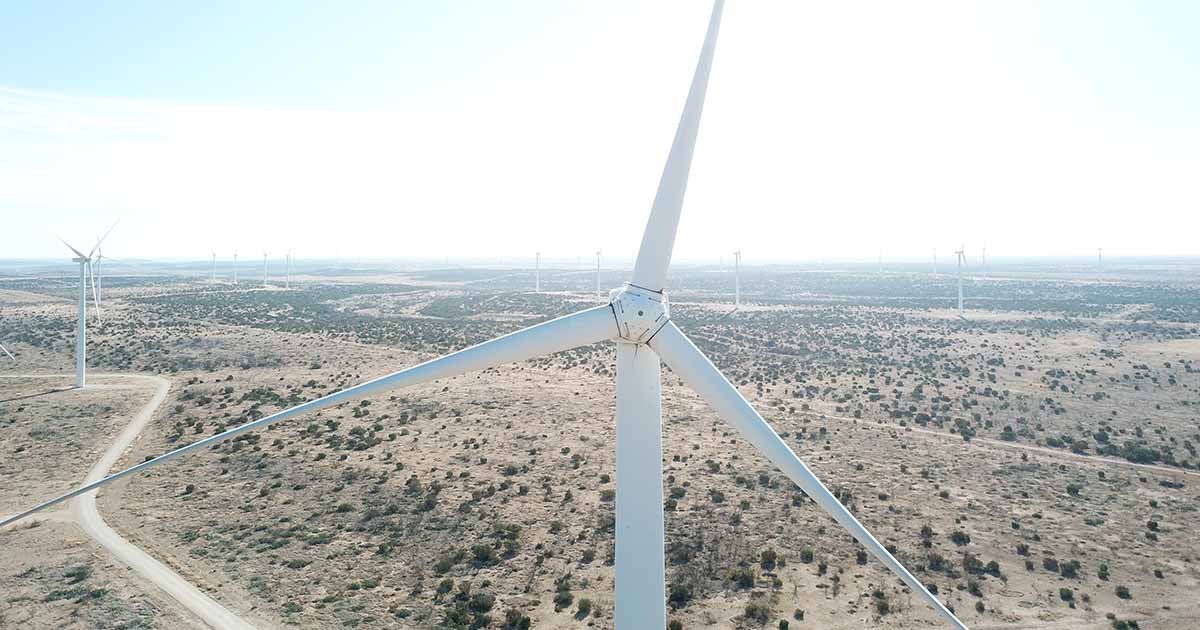
A German energy company and a cloud giant tied themselves together over Texas wind. RWE announced on September 17 that it had signed a virtual power purchase agreement with Oracle covering 433 megawatts of electricity, enough to run a substantial data center, with the power coming from RWE’s Panther Creek I, II, and III wind projects in the state.
A virtual power purchase agreement is a financial contract rather than a physical one. Oracle agrees to pay a fixed price for the output of the wind farms, and RWE sells that electricity into the Texas grid at market rates. The difference between the two prices is settled between the parties. What Oracle buys is a hedge on power costs and a claim on the renewable attributes of the generation, a structure that has become the standard tool for companies trying to match their energy use to carbon-free supply.
The 433 megawatts add to a growing Texas position for Oracle. The company said its related investments now correspond to more than 1.7 gigawatts of generation capacity in the state, a portfolio that will support both the Texas grid and Oracle’s data center operations there. The cloud provider has been one of the most aggressive buyers of power in the state, where its AI data centers are concentrated.
The deal serves two purposes at once. It locks in a stable price for a portion of Oracle’s electricity, insulating the company from the volatility of the Texas market, and it moves Oracle toward a public commitment to match all of its AI data center electricity use with carbon-free power by 2035. The 100 percent matching goal, stated by Oracle, is among the more ambitious in the industry.
RWE is among the largest developers of renewable power in the United States, and Texas is its biggest market. The company operates a large fleet of wind and solar projects across the state, and the Panther Creek wind farms are established assets with a track record of production. Selling their output through a long-term contract with a single large buyer converts variable merchant revenue into a predictable income stream.
The pairing of a renewable developer and a data center operator reflects a broader shift in the industry. AI data centers consume power at a scale that has begun to strain grids, and the companies building them have turned to renewables both to secure supply and to answer criticism about the environmental cost of their growth. A wind farm can be permitted and built faster than a gas plant, and it carries no fuel cost once running.
For Oracle, the Texas concentration is strategic. The state has cheap power, a deregulated market, and a business-friendly posture toward large industrial customers, all of which have made it a magnet for data centers. Oracle has built a substantial cloud footprint there and continues to add capacity, which in turn requires more power than the state’s existing generation can comfortably supply without new projects.
The virtual structure means the wind power does not flow directly to Oracle’s facilities. The electrons enter the same Texas grid as everything else, and Oracle draws from that grid like any other customer. The environmental benefit is measured at the portfolio level, in the accounting that matches Oracle’s consumption to the renewable output it has contracted for, rather than at any particular server rack.
Neither company disclosed the price or the term of the agreement, and the financial details were not part of the announcement. What the deal establishes is a continuing relationship between one of Europe’s largest power producers and one of America’s most power-hungry technology companies, each betting that the other’s growth will continue on the same upward curve.
Texas’s power market is the setting for all of this. The state’s grid, operated by ERCOT, is deregulated and largely isolated from the rest of the country, and its prices swing more sharply than almost any other U.S. market. For a data center operator, that volatility is a cost to be managed, and long-term power contracts are the standard tool for managing it.
Oracle’s data center buildout in Texas has been among the most aggressive in the industry. The company has positioned itself as a home for AI workloads, and those workloads consume electricity at a rate that has made power, rather than land or servers, the binding constraint on growth. Securing generation is now as much a part of building a data center as pouring concrete.
The renewable matching commitment is the third layer of the deal. Matching a data center’s electricity use with carbon-free power on an annual basis is an accounting exercise as much as a physical one, and the virtual structure of the agreement is what makes it possible. Oracle’s 2035 goal is a promise to close that accounting loop completely, and each contract like the RWE deal moves the company a step toward it.
The agreement is one of several Oracle has announced as it expands its power portfolio in Texas, and the company has signaled that more will follow. The arithmetic is simple: every new data center raises Oracle’s demand, and every new wind or solar contract raises the supply it has committed to. The 2035 goal gives the whole program a deadline.