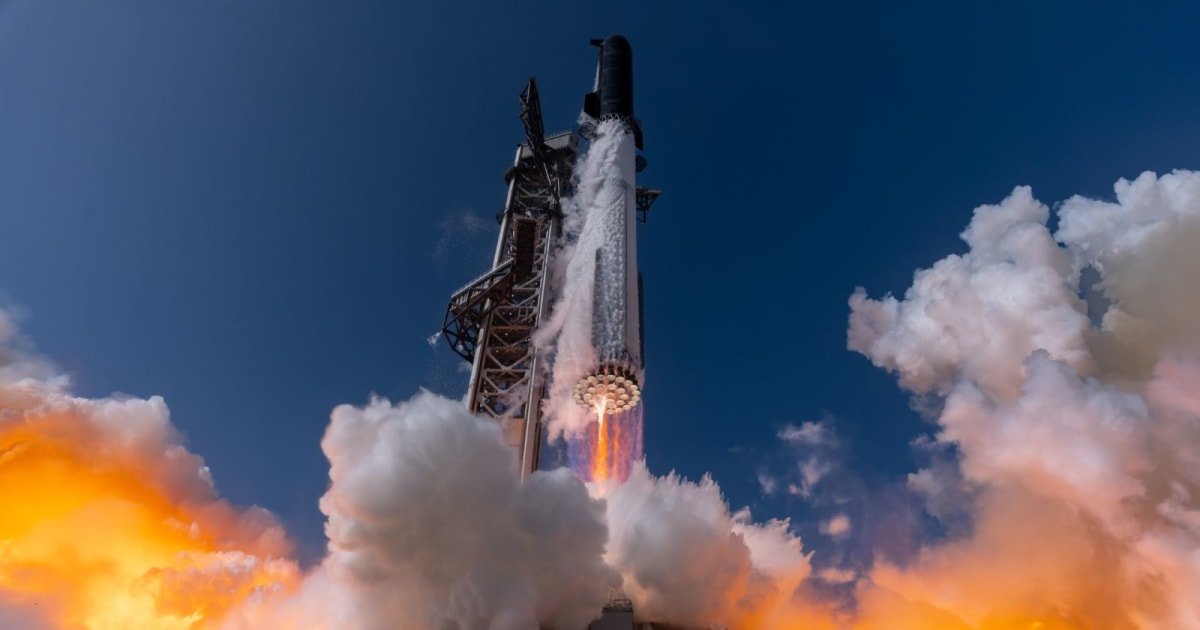
SpaceX has put a new date on the calendar for Starship’s next attempt. The company said on September 17 that it is planning the fourteenth flight of the giant rocket for September 28 at the earliest, with the exact timing still subject to regulatory approval.
The window represents a delay of six days from the originally planned date. Starship’s schedule has never been a fixed one; weather, ground testing, and the approval process have pushed every flight around, and this one is following the same pattern. The company announced the new target in a post on social media, the standard channel for its launch updates.
The mission is different from the ones that came before. This flight is intended to be the first to reach orbit, with the vehicle planned to fly roughly six orbits and deploy a satellite. The previous test flights all ended in the suborbital phase, deliberately or otherwise, and reaching orbit would be a step the program has been building toward since its first test in 2023.
Orbit changes the difficulty of the mission. A vehicle that reaches orbital velocity must survive reentry at far higher speeds and temperatures than a suborbital hop, and Starship’s heat shield, which has been progressively redesigned across the test campaign, will face its first full-scale examination. The satellite deployment adds a further test: the payload door must open and release in the vacuum and cold of orbit.
The delay itself is unremarkable in the context of the program. Starship flights have been approved and rescheduled repeatedly, and the Federal Aviation Administration’s review of each launch license has been a recurring source of scheduling changes. A six-day slip is modest by the standards of a program that has measured some delays in months.
SpaceX has been preparing for this mission for weeks. The company has conducted the usual battery of static fires and ground tests on the booster and the ship, and the previous flight, in which the vehicle reached the edge of space before coming apart during ascent, provided the data that shaped the fixes incorporated into this one. Each flight is a test of hardware as much as a demonstration of progress.
The orbital objective reflects the program’s maturing ambition. The first Starship flights were about learning to fly; this one is about doing work, carrying a payload to orbit and maneuvering the vehicle through multiple laps of the planet. The satellite deployment, if it succeeds, would make Starship a functional launch vehicle rather than a development program.
Elon Musk has said Starship is the vehicle that will carry humans to Mars, and the test campaign is the incremental path toward that goal. But the nearer-term purpose is commercial: a reusable rocket of Starship’s size would cut launch costs enough to reshape the economics of putting payloads, including the thousands of satellites in the Starlink constellation, into orbit.
The program’s progress has been measured in flights. The first test in April 2023 ended in a controlled destruction minutes after launch, and each subsequent flight has pushed further: higher, faster, and closer to the orbital goal. The previous flight carried the vehicle to the edge of space before it came apart during ascent, and the data from that failure shaped the changes incorporated into this one.
The regulatory relationship is a standing feature of the program. Each flight requires a license from the Federal Aviation Administration, and the reviews have at times stretched longer than the company would like. The six-day slip in this case was attributed to the approval process, and SpaceX has learned to announce dates as earliest estimates rather than firm commitments.
The satellite deployment objective ties the flight to a commercial purpose. SpaceX operates the Starlink constellation, the largest in orbit, and Starship is intended to launch the heavier next-generation satellites that the current Falcon rockets cannot carry. A successful deployment on Flight 14 would begin to prove the vehicle’s usefulness for the business that funds SpaceX’s ambitions, not just for the Mars program that drives its founder.
The September 28 date, even if it slips, keeps the program on the cadence it has maintained through the year, with flights spaced closely enough that each one builds on the last. The shift to orbital operations is the threshold the whole campaign has been aimed at, and reaching it would convert Starship from a development program into a launch vehicle doing real work.
The September 28 date is an earliest estimate, and SpaceX was explicit that regulatory approval could push it again. The pattern of the program has been that dates announced are targets, not commitments, and the company has learned to present them that way. What is certain is that the fourteenth flight is close, and that it will attempt something none of the previous thirteen have done.