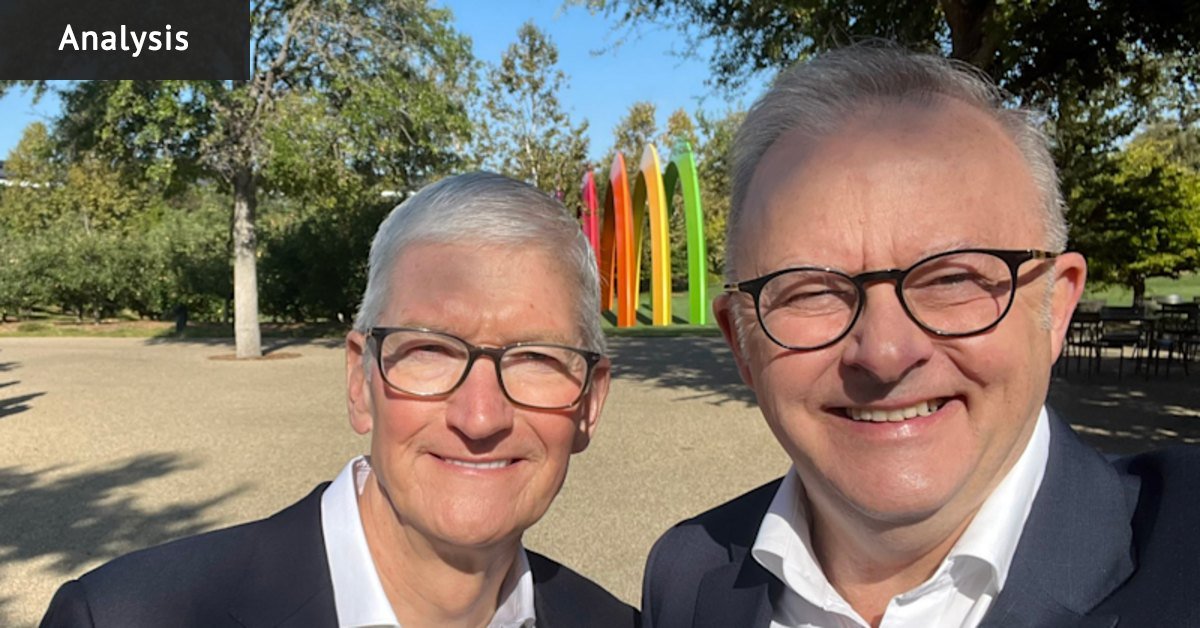
Tim Cook, the executive chairman of Apple, met with Australian Prime Minister Anthony Albanese at Apple Park on September 19, and came away having told the prime minister that Australia’s early moves to control social media are, in Albanese’s telling, “world-leading.” The meeting, reported by Reuters, was Cook’s highest-profile engagement since he handed the chief executive role to John Ternus on September 1 and took the chairman’s title.
The compliment, as relayed by Albanese afterward, was directed at a specific policy. Australia has moved to ban social media for children under sixteen and has pushed the platforms to take responsibility for what appears on them, measures that have drawn criticism from the technology industry and interest from governments elsewhere. Cook’s endorsement, however qualified, gives the Australian approach the backing of the executive of the world’s most valuable company.
Albanese made the most of the moment. He told reporters that “Cook gave us a lot of time this morning,” a detail meant to convey that the meeting was substantive rather than ceremonial, and he paired the social media remarks with a broader argument about artificial intelligence. Australia, he said, wants a global framework for AI, one that keeps “humans always in control of technology,” a formulation that places him in direct opposition to the Trump administration’s posture of resisting additional AI regulation.
The contrast is sharp and Albanese did not soften it. The United States has signaled that it will not pursue new federal AI rules, betting that American companies can out-build their competitors without them. Australia, a small economy with no frontier lab of its own, has chosen the opposite tack, arguing that the technology’s risks are too great to leave to the market and that international coordination is the only workable answer. Cook’s audience with Albanese gave the prime minister a stage on which to make that case next to one of the industry’s most recognizable figures.
Cook’s transition from CEO to executive chairman has been gradual and deliberate. He ran Apple for more than a decade, through the company’s growth into the most valuable in the world, and his move to the chairman’s role was presented as a continuation rather than a retirement. The meeting with a head of government is exactly the kind of engagement a chairman performs, and it signals that Cook intends to keep Apple’s relationships with regulators and world leaders in his own hands.
The social media question is one on which Apple and the platforms diverge. Apple is not a social media company, and its interests in the Australian debate run through the App Store and the devices through which Australians access the platforms. Endorsing the country’s social media controls costs Apple little, because the rules govern companies like Meta and ByteDance rather than Apple itself, and the endorsement lets Cook appear aligned with a government whose good will Apple needs on other fronts.
Apple’s own regulatory exposure in Australia is real. The company has faced pressure there over App Store policies and payment rules, and the Australian government has been among those pressing for greater accountability from the platform gatekeepers. A warm meeting with the prime minister, at which Cook offers a compliment on a policy Apple can afford to praise, is part of the ordinary management of those relationships, a gesture with more value in the relationship than in the substance.
The AI framing was the more consequential part of the visit. Albanese used the meeting to stake out a position that will define Australia’s engagement with the technology industry over the coming years, and to do so in a setting that gave the position international attention. His insistence on human control and a global framework is a direct challenge to the hands-off approach emerging from Washington, and it positions Australia as a counterweight in the debate over who governs AI.
Cook’s role in that debate is constrained by his company’s interests. Apple has built AI into its devices and services and has its own commercial stake in the technology’s spread, and an executive chairman does not endorse a global regulatory framework for a product his company sells without considering the costs. The meeting produced no announcement of Apple’s position on Australian AI rules, and Cook’s remarks, as filtered through the prime minister, were confined to the safer subject of social media.
What the visit accomplished was less a policy change than a positioning. Albanese secured a meeting, a compliment, and a day of attention in which Australia’s approach to technology governance was presented as forward-looking rather than restrictive. Cook secured the continuation of a relationship with a government whose regulatory ambitions will, in some form, reach his company eventually. Both men left with what they came for, and the substance of the argument about AI remains, for now, exactly where it was.