The notice Oracle sent on Wednesday was, on its face, a routine legal step. By Thursday, it had reached into the credit markets, dragged down a Japanese conglomerate’s shares, and put a chill across a trillion-dollar corner of finance.
Oracle’s force majeure notice on Project Jupiter, its 2.45-gigawatt data-center campus in Doña Ana County, New Mexico, was disclosed Wednesday. The notice would let Oracle delay payments to the developer, a unit of Blue Owl Capital, if the campus fails to come online in 2028 as planned.
The fallout arrived the next day. Reuters reported that the move sent a chill through the market for AI infrastructure financing, a segment measured in the trillions of dollars. SoftBank Group’s shares fell in Tokyo on Thursday amid concern that Stargate-linked projects could slip.
The Wall Street Journal reported that a key development partner has exited the project and that it has faced local resistance, with about $18 billion in debt tied to the campus. That construction loan, provided by a group of roughly 20 banks including Santander and Jefferies, is already trading at stressed levels of 89 to 91 cents on the dollar, according to market participants.
Oracle shares fell more than 3.6 percent at one point during Thursday’s session. Oracle Financial Services, listed in India, dropped 4 to 5 percent, while Oracle’s Japanese subsidiary rose 7 percent on a record quarterly result, a split that showed how differently investors read the news across markets.
The notice is rooted in a dispute over fuel. The New Mexico State Land Office denied rights-of-way for a natural gas pipeline supplying the site in March and again in July, and Energy Transfer has rerouted the 17.8-mile line across federal land, pushing its service start back nearly six months to Feb. 1, 2027.
Project Jupiter is a flagship of Stargate, the AI infrastructure program announced at the White House in January 2025 with a pledge of up to $500 billion in U.S. investment, involving OpenAI, SoftBank and Oracle. OpenAI signed a $400 billion agreement with Oracle and SoftBank covering five U.S. data centers, including the New Mexico site.
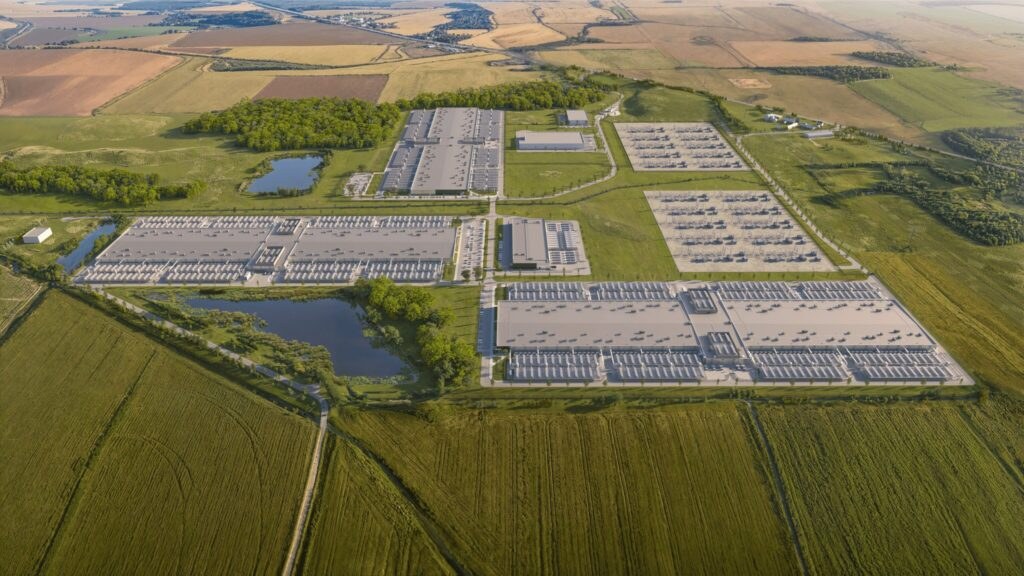
The 1,400-acre campus, designed to draw enough power for roughly 1.8 million homes, has become a symbol of the backlash against the AI data-center boom. Local groups have questioned its water and power demands in an arid region, and legal challenges over water and air-quality permits have slowed its path, turning the site into a political flashpoint ahead of the U.S. midterm elections.
Oracle is not walking away. The company has said it remains committed to the project, and the notice is designed to shift the cost of delay toward the developer rather than end the tenancy. Blue Owl, which holds about $3 billion in equity in the site, has said the notice does not change its funding commitments.
But the credit market’s reaction tells a different story from the companies’ public statements. The $18 billion loan was underwritten against a specific timeline for revenue, and every quarter of delay widens the gap between interest costs and the cash the site is expected to generate.
The episode has drawn attention to the broader financing model behind the AI buildout. Oracle has been the clearest example of a hyperscaler borrowing heavily to fund capacity, with capital spending of $28.5 billion in its latest quarter, negative free cash flow, and plans to raise about $40 billion through debt and equity this fiscal year.
The notice was first reported by Bloomberg on Thursday, and it landed on a financing market already skittish about AI data-center debt. Arranging banks have struggled to syndicate the Project Jupiter loan to other investors, and the discount on the paper reflects lenders demanding higher returns for risk they once priced cheaply.
The legal question the notice raises is untested. Law firms that advise on data-center deals have called force majeure a core risk-allocation tool, warning that how such a clause is read can determine whether a delay stays isolated or cascades through a project’s construction, customer, power and financing documents.
For Oracle, the stakes extend beyond a single site. The company has tied its strategy to delivering data-center capacity on schedule, signing leases with terms that stretch fifteen to nineteen years into the future. A marquee project slipping, even on paper, feeds the question of whether the industry’s spending can be sustained.
SoftBank’s slide showed how tightly the players in the AI buildout are linked. The Japanese group, a Stargate partner and one of the largest backers of AI infrastructure, saw its shares move on news about a single campus in the New Mexico desert, a sign of how few degrees of separation there are across the sector’s financing.
Force majeure clauses have long been a feature of energy and commodities contracts. Their migration into data-center deals, and the market’s swift reaction when one is invoked, shows how much of the AI boom’s financing now rests on assumptions about delivery dates that are slipping.