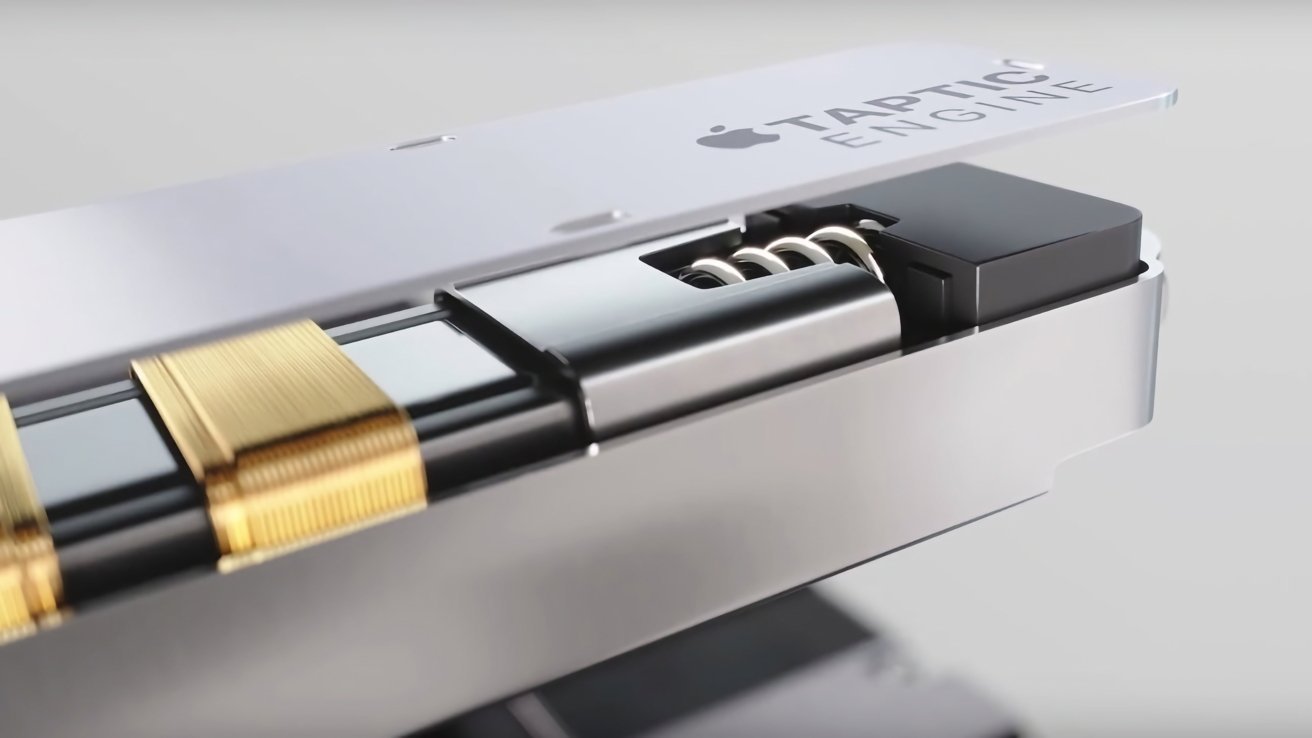
In the fall of 2015, Apple took the physical home button off its new iPhone and replaced it with a sheet of glass. Underneath sat a component the company had built for itself, a small motor tuned to vibrate so precisely that a stationary pane could be made to feel like a button being pressed. Apple called it the Taptic Engine, and a version of it now sits inside every iPhone and every Apple Watch the company has shipped in the decade since.
On September 25, a federal jury in San Diego decided the engine’s lineage belongs to someone else. The panel found that Apple’s Taptic Engine infringes two haptic patents held by Taction Technology, a small San Diego company, and ordered Apple to pay $5,721,961,750, roughly $5.72 billion.
The verdict covered U.S. Patent Nos. 10,659,885 and 10,820,117, which describe tactile transducers that produce bass-frequency vibrations perceptible to touch. The jury concluded that Apple’s use was not willful, a finding that matters when a judge weighs whether to triple damages, and it rejected Apple’s contention that the asserted claims were invalid.
Taction filed the suit in April 2021, arguing that Apple lifted its vibration-feedback design and built it into the iPhone and the Apple Watch without paying for it. Apple answered that the Taptic Engine is fundamentally different from Taction’s technology and that the damages figure had no basis in fact. The company said it would appeal.
The road to the verdict was long and not one-sided. A district judge had earlier granted summary judgment of noninfringement, a ruling the U.S. Court of Appeals for the Federal Circuit vacated in August 2025 and sent back for further proceedings. That remand reopened the case and eventually put it before a jury, which weighed years of technical testimony about how a motor can be tuned to fool a fingertip.
The size of the award reflects the scale of Apple’s product line more than the price of any single device. Apple has sold well over a billion iPhones, and the Taptic Engine runs across the lineup, from the entry model to the Pro, and through every generation of the Apple Watch. Patent damages in such cases are usually calculated as a royalty spread across an enormous base of units, which is how a thumbnail-sized motor becomes a multi-billion-dollar number.
The precise figure, $5,721,961,750, is unusual in its specificity. Verdicts of this magnitude are typically rounded in company disclosures and headlines, but the number written on the form is what Apple has now been ordered to pay, subject to whatever the appeals process does to it.
Apple’s balance sheet can absorb the sum with ease. The company has reported more than $150 billion in cash and marketable securities and generates close to $400 billion in annual revenue. The larger question is whether the award survives appeal, and Apple has a long record of grinding down patent verdicts at the Federal Circuit, where damages figures are often cut or sent back for recalculation.
The company has also shown it will change a product before it will pay. When past disputes over components such as certain watch sensors produced rulings it did not like, Apple redesigned or removed the feature rather than write a check. Whether the Taptic Engine could be replaced without altering how an iPhone feels to the touch is not something Apple has discussed in public.
Analysts said the verdict, if it stands, is a manageable line item for a company of Apple’s size but a transformative one for Taction. Taction has no product line to fall back on; its business is the patent portfolio and the technology behind it. A judgment of this size, upheld even in part, would remake a company that has spent four years litigating against one of the largest corporations in the world.
The case also fits a broader pattern in which Apple is a frequent defendant and a frequent plaintiff in fights over the physical details of its devices, from watch sensors to the look of a screen. The company argues it designs in-house and pays for what it uses; its critics argue it ships first and litigates later.
The verdict also arrives at a moment when haptics, long an afterthought in electronics, have become a selling point. The sensation of a button that is not really there, the subtle knock of a notification, the click of a watch crown that does not move, all of it is engineered, and now a jury has put a dollar figure on part of that engineering.
For the moment, the only certain thing is the number on the form. Apple has said it will appeal, a process that could take years and could end anywhere between the full amount and nothing. What is not in dispute is that the small motor beneath the glass has become one of the most valuable components Apple has ever built, and, in the view of one jury, one it may not have built alone.