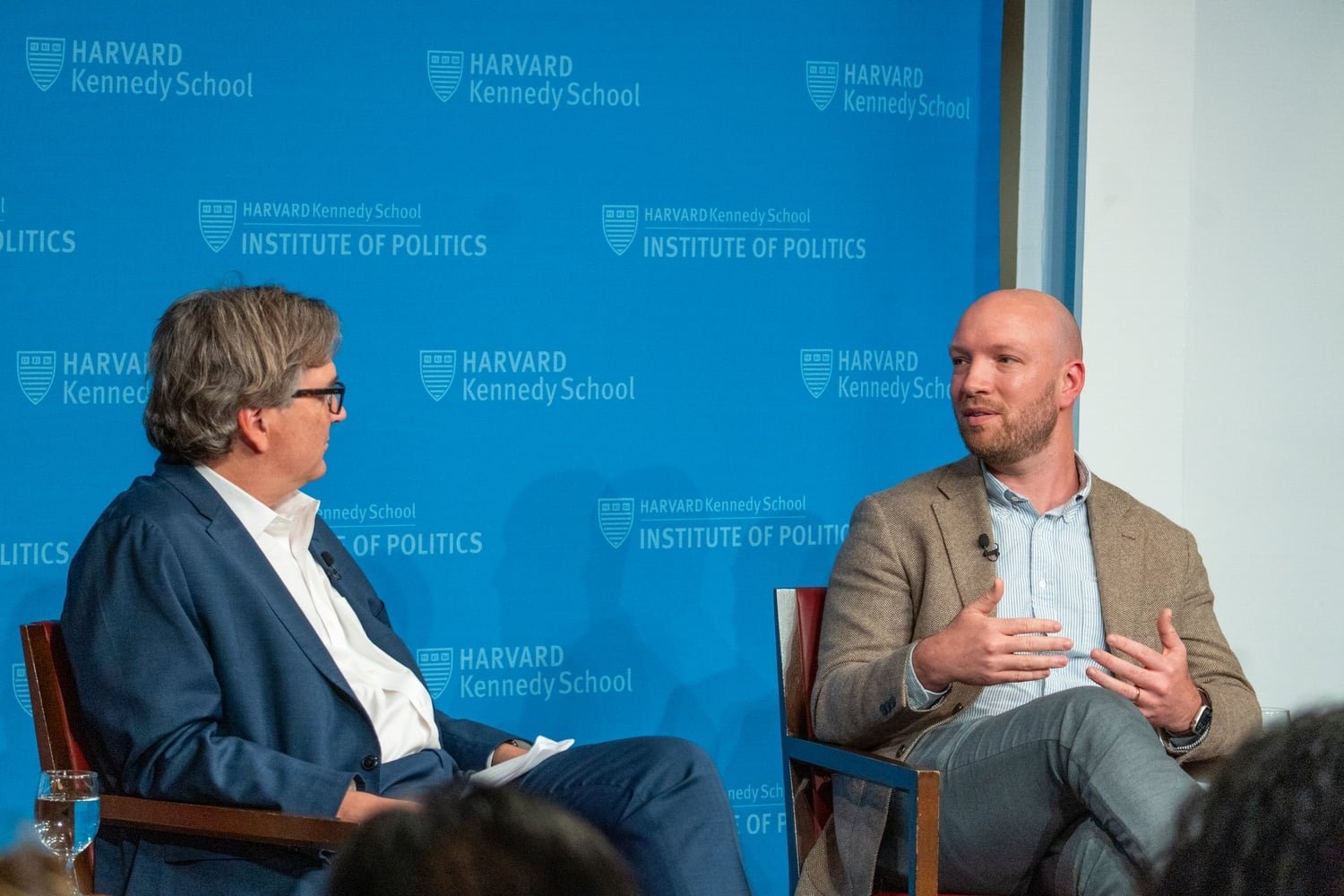
Peter McIlroy has spent his career explaining that new technology shows up in the productivity numbers later than its backers promise. As chief economist at Anthropic, he now has to explain why a tool his own company sells has not yet moved those numbers at all.
In a conversation at Harvard’s Kennedy School this week with Jason Furman, the Harvard economist who chaired the Council of Economic Advisers under President Barack Obama, McIlroy offered an answer. Artificial intelligence, he said, has neither lifted total factor productivity nor produced mass unemployment, and the reason is twofold: the lag in how new technology diffuses through an economy, and the J-curve costs a company absorbs while it rebuilds itself around a new tool.
For now, he argued, the dominant pattern is skill augmentation. People work alongside machines rather than being replaced by them, and the gains appear in how a single worker performs rather than in how the whole firm produces. That is a more modest promise than the one attached to AI in recent years, and McIlroy was careful about how far he would extend it.
The analogy he reached for was old technology rather than new. Electricity, the internal-combustion engine and the computer all took decades to reshape productivity, he noted, because factories had to be redesigned around them. The same lag, he said, is what keeps AI’s gains out of the aggregate data today. The spending shows up on balance sheets; the output has not yet followed.
His own arithmetic cuts two ways. AI, he said, could lift U.S. labor productivity. But the same projections point toward wider income inequality, and in an extreme scenario the share of national income claimed by labor could fall by 15 percentage points. A shift of that size would not merely trim wage growth; it would redraw which parts of the population benefit from a richer economy. The labor share has drifted down for most of this century, and McIlroy’s number suggests AI could push that drift much further.
McIlroy organized the next several years around three developments he called singularities, each aimed at roughly 2030. The first is in software, the point at which systems write and repair themselves without the hand-offs that currently slow them. The second is in the economy, when the productivity gains finally show up in aggregate data rather than in demos. The third borrows from Ronald Coase: the boundary of the firm, the line between what a company does inside and what it buys outside, begins to dissolve as agents find, negotiate and complete work across organizations.
That last one carried the sharpest warning. As agents take over the search and bargaining that used to require people, McIlroy said, the balance of negotiating power tilts toward whoever controls the agents. The transaction costs that once justified keeping work inside a large company shrink, and the structure that has organized firms for a century comes under pressure.
Furman, who has argued for years that automation should push governments to rewrite how they tax and spend, pushed back on the specifics. The two spent part of the session moving through competing future scenarios, the structure of competition in AI, and what education and human capital mean when machines take on more of the work. Neither claimed to know which future wins.
The argument led McIlroy into tax policy. He floated a tax on tokens, the units of computation and text that AI systems consume and emit, as one way to offset the external costs of automation and to adapt the tax base to an economy in which labor claims a smaller slice of output. The idea is raw, and he did not pretend otherwise. What it amounts to, he argued, is a recognition that taxing labor no longer works when labor is no longer what produces the value.
The most striking thing about the exchange was its tone. Both men cautioned against confident forecasts about an economy reshaped by a technology that is barely a few years old. McIlroy’s prescription was not a bold prediction but a discipline: watch the data as it comes in, and revise the story as the numbers move.
For a company preparing to sell AI to the world, that is an unusual posture. Anthropic builds the systems whose economic effects McIlroy is asked to forecast, and his message, that the payoff is real but late, uneven and uncertain, is not the one that typically accompanies a product launch. Analysts said the candor may reflect a bet that restraint will age better than hype once the diffusion lag begins to close.
The question he left open is the one that matters most to the rest of the economy: whether the lag is a delay or a ceiling. If the J-curve bends upward on schedule, the productivity gains arrive and the argument shifts to how they should be shared. If it does not, the industry will have to answer a harder question about what the technology is actually worth, and the tax debate McIlroy opened will no longer sound theoretical.