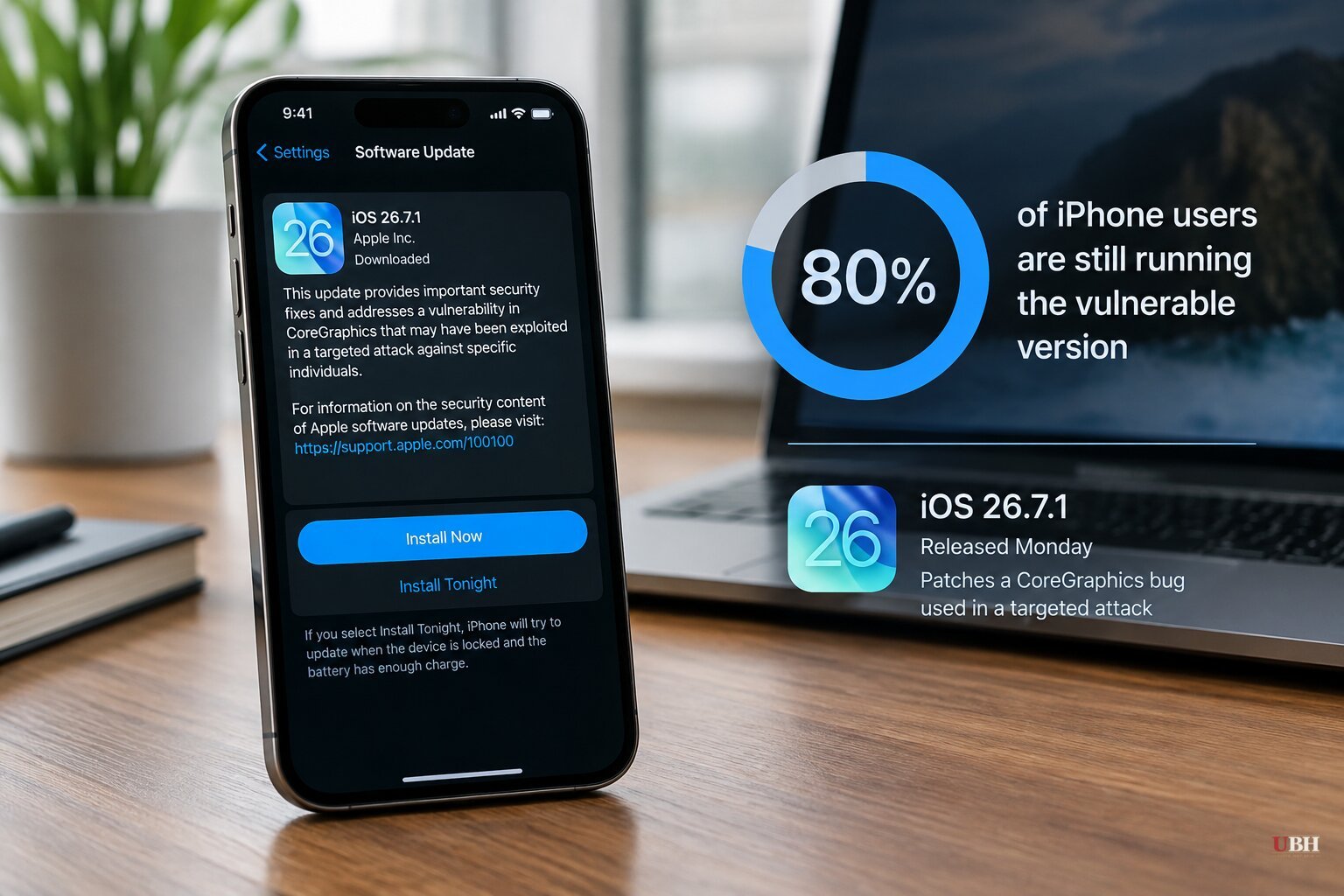
The update landed quietly, the way Apple’s emergency security fixes usually do: a short advisory, a list of affected systems, and a terse warning that a flaw “may have been actively exploited.” This time the flaw was an out-of-bounds write, tracked as CVE-2026-86950, and Apple said that processing a maliciously crafted file could let an attacker run code on a victim’s device.
Apple released the fix on September 28 across four operating systems: iOS 26.7.1, iPadOS 26.7.1, macOS Sequoia 15.8.1 and macOS Tahoe 26.7.1. The company said the vulnerability affects devices running versions earlier than iOS 27 and described the attacks that used it as “extremely sophisticated,” aimed at specific individuals rather than at the broad population of users.
The flaw was reported to Apple by Meta’s product security team, according to Apple’s advisory, which names no victims and no attacker. That combination, exploitation in the wild, a narrow cast of targets, and a vendor declining to say who was hit, is the signature of the commercial spyware trade, security researchers said. Such tools are built by companies that sell them to governments, and they are typically deployed against journalists, activists, dissidents and executives one target at a time.
An out-of-bounds write is a memory-corruption bug. When a program writes past the end of a buffer it has reserved in memory, it can overwrite adjacent data in ways that let an attacker redirect what the program does next. A file that triggers such a flaw can, in the right circumstances, hand an attacker control of the device without the user doing anything more than opening it.
The best-known name in that trade is NSO Group, the Israeli company behind the Pegasus spyware, which for years infected iPhones through precisely this kind of memory-corruption flaw, often without the victim clicking anything at all. Apple and security researchers have spent the past several years trying to make such infections harder, adding hardware and software protections and paying bounties of millions of dollars for the flaws that defeat them. A fresh in-the-wild exploit is evidence that the effort is not finished.
Apple has spent heavily to make these flaws expensive to find. Its security research program pays up to $2 million for reports that defeat specific protections, and the company has layered defenses such as hardware-isolated memory and pointer authentication that force attackers to chain multiple bugs to get anywhere. Each new layer raises the price of an exploit, and the spyware vendors simply charge their customers more.
The customers who pay those prices are usually states. Spyware sold to a government is deployed against a short list of individuals, which is why Apple’s advisory language about “specific individuals” is read so carefully by researchers. It signals that whoever bought the tool had a target list rather than a mass-market campaign, and that the people on that list may have been watched for weeks before the patch arrived.
Apple has treated the patch as urgent, which is what its zero-day fixes signal. A zero-day is a flaw unknown to the vendor until it is already being used against someone, which is why the label carries weight. The company does not fix flaws outside its regular release cycle unless it believes they are being used. When it does, the news is usually that someone, somewhere, has already been compromised, and that the people targeted were chosen deliberately.
Meta’s role is notable because it suggests the exploit chain surfaced through the social network’s own security apparatus. Meta has spent heavily on detecting sophisticated attacks against its users, and its product security team regularly hands findings to Apple and others. That Meta found it first does not mean Meta users were the targets; it means the flaw was worth reporting before it spread further.
Apple has not said who was targeted, when the attacks began, or whether the fix closes every path into the affected devices. That silence is standard, but it leaves the same question hanging that follows every disclosure of this kind: if a spyware-grade tool was pointed at specific people this month, those people may not know it, and the vendor that shipped the patch is not saying.
The quiet framing is deliberate. Naming a country or a vendor would invite diplomatic friction and tip off other targets still under surveillance, so Apple and its peers lean on the same careful wording every time. The effect is that the public learns a weapon exists without ever learning whose hands it is in.
The broader pattern is what worries researchers. Zero-days against Apple software have arrived in a steady rhythm, and each one patched in public is read as evidence that more, unpatched, remain in use in private. The fix closes one door. It says nothing about how many others are open.