Eight months ago, ElevenLabs was worth $11 billion. This week the voice-AI startup told its employees they could sell vested shares at a price that values the company at $22 billion, twice the figure attached to its February funding round.
The money came through a $300 million tender offer led by Wellington Management and T. Rowe Price, according to people familiar with the matter. Both are buy-and-hold institutions of the kind that usually enter late and stay through a public listing, which reads as a wager that ElevenLabs will eventually go public. The company is four years old and has now given its staff a second chance to turn equity into cash, after a $100 million tender last year.
That earlier tender was priced at a $6.6 billion valuation in September 2025. The sequence from $3.3 billion in January 2025 to $6.6 billion in September 2025 to $11 billion in February 2026 to $22 billion now charts one of the steepest private re-ratings of the current AI cycle.
The February round was led by Sequoia Capital and brought in $500 million at the $11 billion mark, more than triple the valuation of a year earlier. The company closed 2025 with more than $330 million in annualized recurring revenue, driven by enterprise customers such as Deutsche Telekom, Square and Revolut, which use its software for customer support, conversational commerce and sales.
The round drew a long list of backers. Andreessen Horowitz and ICONIQ Growth both increased their stakes, and Lightspeed, BOND and Evantic Capital joined as new investors, bringing the company’s total funding to $781 million across five rounds. The company has used the money to expand across more than a dozen cities, from London and Warsaw to Seoul, Singapore and Bengaluru, staffing local teams to sell voice agents to enterprises.
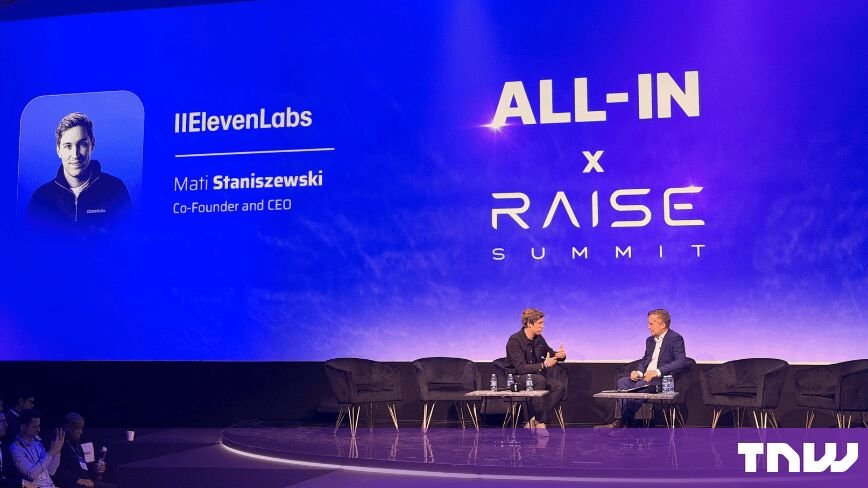
ElevenLabs was founded in 2022 by Mati Staniszewski, a former Palantir employee, and Piotr Dabkowski, a former Google engineer, with a text-to-speech model meant to sound convincingly human. It has since built out three product lines: ElevenAgents, for enterprise voice and chat agents; ElevenCreative, for creators generating and localizing audio; and ElevenAPI, the developer infrastructure that Meta, Epic Games and Salesforce plug into. The company has said its tools reach more than a billion users through those partners.
The tender is not an isolated act of generosity. Across the AI sector, startups have turned to employee tender offers as a retention tool, letting staff lock in gains while the company stays private and defers an initial public offering. The reasoning is blunt: when a rival can double a researcher’s cash compensation overnight, a path to sell vested shares is one of the few tools a company has to keep its core team from walking.
ElevenLabs is not alone in paying this way. OpenAI, Anthropic and SpaceX have run large tender offers to give employees liquidity without a listing, and the practice has spread as private valuations have climbed faster than public markets have absorbed new AI companies. For a firm whose valuation doubled in seven months, a tender at that higher price is cheaper than watching its best people leave.
The bet behind the number is that voice becomes the next interface. As chatbots spread, companies are attaching spoken agents to customer service, sales and call centers, and ElevenLabs has positioned itself as the supplier of the underlying models rather than the agent itself. That is a crowded field, but the company’s argument is that emotional, human-sounding speech is hard to copy, and harder to replace as the models improve.
The timing fits the company’s own stated direction. Its co-founders have talked about building toward an initial public offering, and a tender led by Wellington and T. Rowe Price brings in exactly the investors who anchor a roadshow. The two firms are among the largest asset managers in the world, and their willingness to hold employee shares at a $22 billion price is a signal that someone outside venture capital believes the number.
What the tender does not settle is how long the climb can last. A $22 billion valuation on $330 million of annualized revenue implies a multiple that would have looked extreme even in the most exuberant months of the last cycle. The company argues its addressable market is every business that talks to customers by phone, a category that covers banks, airlines, telecoms and governments, and that voice agents are still in their first innings.
For the employees, the arithmetic is simpler. They can now sell a portion of their shares at a price that did not exist eight months ago, and the buyers are a pair of institutions that plan to be there if the company ever rings a public bell. Whether that day is near or still years off, the tender has turned a paper valuation into something closer to money.