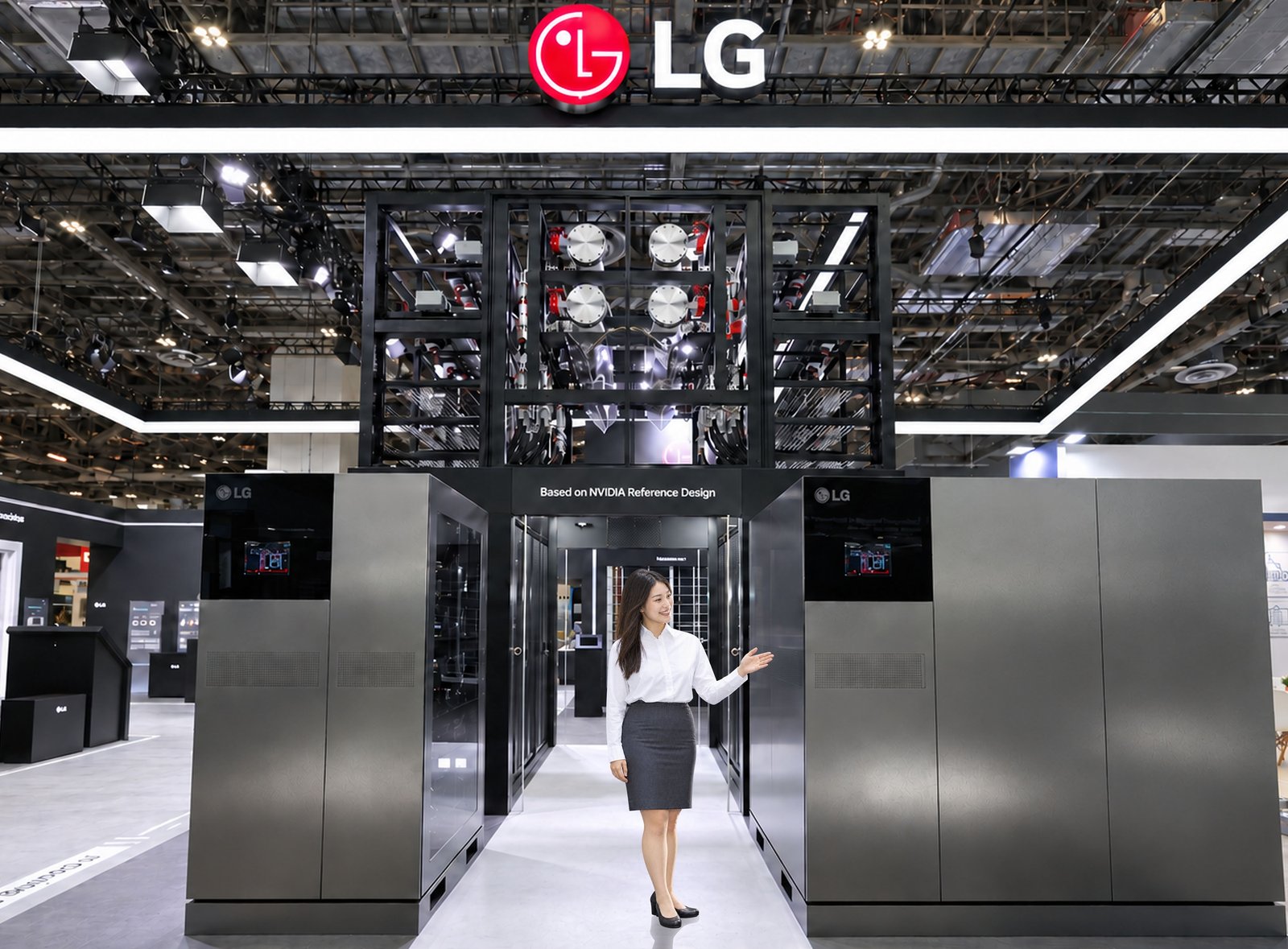
LG Electronics built its name selling televisions and washing machines to households. On Wednesday it placed a bet on a very different customer — the companies racing to build the data centers that run artificial intelligence. The South Korean company said it will build a chiller factory in Virginia and expand two plants at home to supply the equipment that keeps AI servers from overheating.
The announcement, made Oct. 1, adds chiller production at three sites. LG will build a new plant in Windsor, Virginia, that will make air-cooled chillers and is scheduled to begin production in the first half of 2027. It will also expand air-cooled chiller lines at its existing factories in Changwon and Pyeongtaek in South Korea, adding a conveyor-based production system designed for mass output. The company plans to invest a total of 150 billion won, roughly $110 million, across the three facilities.
Chillers are the workhorse of data-center cooling. They produce the large volumes of chilled water that carry heat away from server halls, a job that has grown harder with every generation of AI chips. The air-cooled units LG will build in Virginia reject heat to the surrounding air rather than consuming water, an advantage in regions where utilities are rationing the resource.
The choice of Virginia is not incidental. Northern Virginia is the largest data-center market in the world, home to a dense concentration of facilities operated by the major cloud and AI companies. Making chillers there lets LG supply that market without shipping finished units across an ocean, and positions it next to customers who are adding capacity as fast as power and land can be secured.
The market LG is chasing is expanding on the same curve as AI spending. The global chiller market is projected to reach about $12 billion by 2027, according to industry estimates. The faster-growing segment sits even closer to the silicon: research firm MarketsandMarkets projects the direct-to-chip cooling market will grow from roughly $3.3 billion in 2026 to more than $17 billion by 2032, as racks dense with graphics processors push past what air conditioning alone can remove.
LG’s answer is to sell the entire thermal chain rather than one component of it. Under a strategy the company calls “One LG,” it is bundling chillers and its direct-to-chip cooling products into a single pitch that also reaches into energy and data-center infrastructure, drawing on batteries from LG Energy Solution and the design, construction and operations expertise of LG CNS. The company describes the combined offer as “chip-to-chiller,” spanning cold plates that sit directly on the processor, coolant distribution units, and the chillers that close the loop.
That bundling is the point of the expansion. A data-center operator assembling a cooling system today might otherwise buy cold plates from one vendor, coolant units from a second and chillers from a third, then hope the pieces work together under load. LG is betting that customers building AI infrastructure at speed will pay a premium for a single supplier that can deliver parts built to fit, and that can point to factories on two continents when asked how quickly it can ship.
The company framed the move in the language of a seller trying to catch a wave it expects to last. “We will continue to strengthen our ability to provide a stable supply of cooling solutions, which are core infrastructure for AI data centers, to actively address rapidly growing market demand,” said James Lee, president of LG’s Eco Solution Company. The expansion follows a 2.6-megawatt coolant distribution unit that LG said qualified under Nvidia’s DSX Ready program, part of the same effort to be taken seriously as a data-center supplier rather than a consumer brand.
LG is not alone in the race. Established cooling and power-equipment makers, along with a crop of liquid-cooling specialists, are all building capacity for the same boom. What LG brings is scale and the reach of a conglomerate: the same company can supply the chiller on the roof, the batteries buffering the power, and the network that monitors the building, a full-stack pitch that few rivals can match across both hardware and integration.
The risk sits in the timing. The Virginia factory will not produce a single chiller until 2027, and LG is committing nine figures of capital before the full demand curve has proven itself. If AI infrastructure spending cools, the factories built to feed it will be the first assets to look expensive. For now, though, the arithmetic favors builders. Every major AI lab and cloud provider is signing leases and buying chips faster than the power and cooling to support them can be delivered. A chiller that arrives on schedule, from a plant a few hours’ drive from the data center it will serve, is closer to a commodity in short supply than to a piece of HVAC equipment. That is the position LG is spending $110 million to secure.