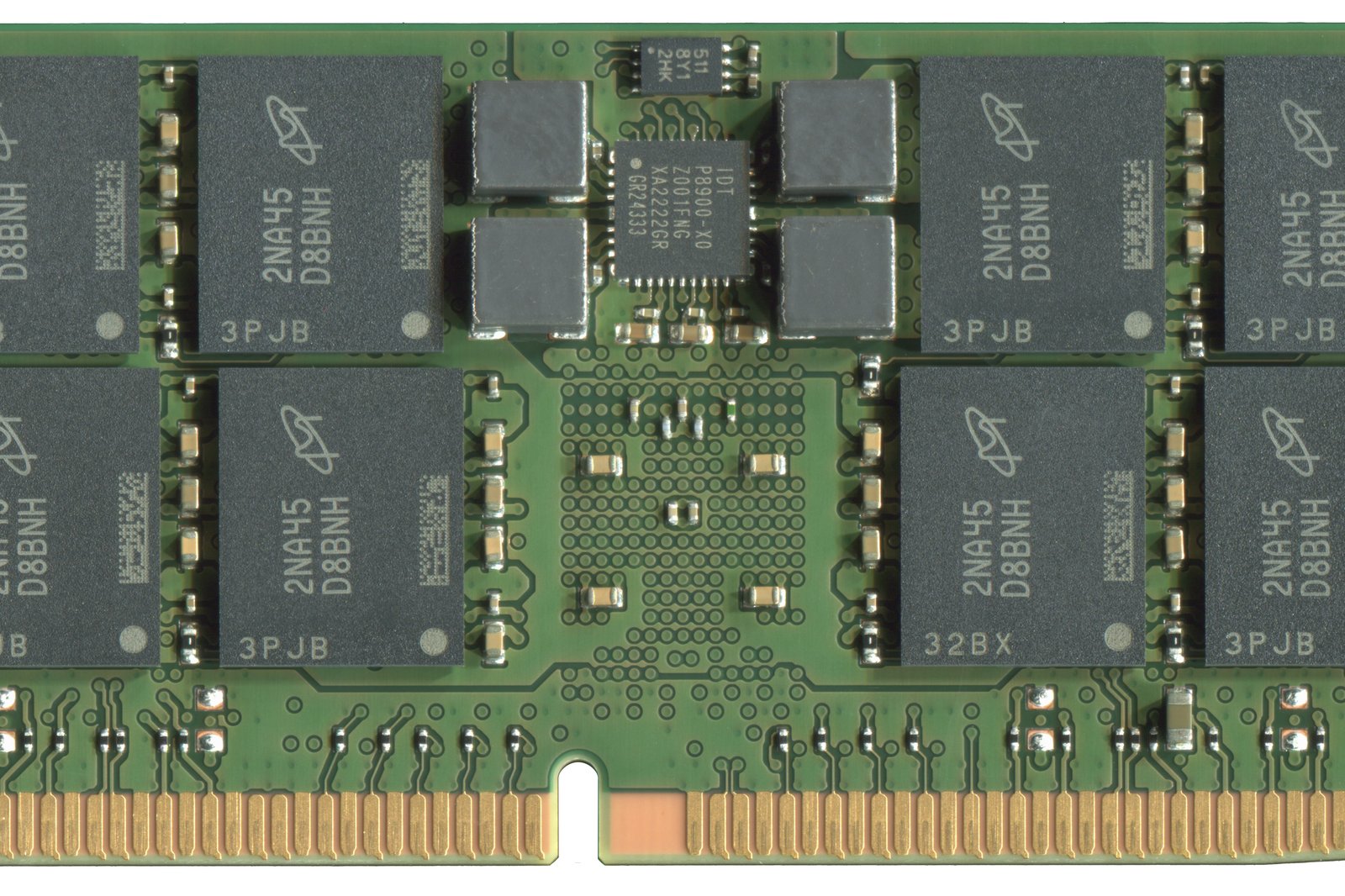
Micron Technology is telling its customers something they do not want to hear: the shortage of memory chips squeezing anyone building an AI data center is going to get worse, and it will stretch into fiscal 2028. In an investor presentation on October 1, the chip maker extended its forecast of tight supply, saying supply would be even tighter by then and that customers had begun locking up capacity with longer-term agreements.
The warning landed a day after Micron delivered the numbers that explain it. On September 30, after markets closed, the company reported revenue of $54.23 billion for its fiscal fourth quarter, up 379% from a year earlier and a record for the company. The surge is the clearest sign yet of how much money is flowing into the memory that sits beside the processors at the center of the AI boom.
The same disclosure carried the cost of meeting all that demand. Micron’s capital-spending guidance weighed on the stock in after-hours trading, a sign that building the capacity to satisfy AI customers is expensive, and that investors are watching how much of the windfall gets plowed back into factories. A record quarter that comes with a bigger bill for new plants is a mixed message, and the market’s reaction suggested it heard the second part clearly.
The shortage has a specific shape. High-bandwidth memory, or HBM, is the premium product at the center of it. HBM stacks memory chips to feed data to AI accelerators, the kind of processors Nvidia and others sell by the truckload to hyperscalers, and it has become one of the tightest corners of the semiconductor supply chain. Micron is one of the big three memory makers, alongside South Korea’s Samsung and SK Hynix, and all three have been racing to add capacity without repeating the industry’s oldest mistake.
The buyers are a small, wealthy club. Nvidia’s latest accelerators pack high-bandwidth memory into the same package as the processor, and every hyperscaler, from the cloud giants to the newest AI labs, is competing for the same allocation. When one of those buyers signs a multiyear deal, it removes supply from everyone else, which is how a shortage at the top of the market quickly becomes a shortage everywhere below it.
Micron’s message also carries a claim about its own position. SK Hynix and Samsung have led the HBM market, and Micron has spent the past several years trying to close that gap, arguing that its later designs leapfrog the incumbents. Extending the supply-tight forecast this far out is, in part, a statement that the company expects to keep selling everything it can make, rather than ceding the premium end of the market to its larger rivals.
That mistake is overbuilding. Memory is a famously cyclical business, and the last downturn is recent enough to remember. When demand softened in 2023, the industry cut output and took losses, and the recovery has been driven almost entirely by AI. What makes this cycle look different, Micron’s message suggests, is that the demand is concentrated among buyers with deep pockets who are willing to pay up and, increasingly, to commit to supply years in advance.
The shift to longer-term agreements is the tell. Memory buyers have historically bought on short horizons, shopping for the best price. The fact that customers are now locking capacity with longer terms, as Micron described it, is the kind of behavior that appears when buyers are more afraid of not having chips than of paying too much for them. It is also the mechanism by which a tight market becomes a predictable one for the suppliers.
Extending the forecast to fiscal 2028 matters because of how far away that is. Micron has just closed fiscal 2026, so the company is now telling investors and customers that it expects the squeeze to persist for roughly two more years. Forecasts that far out are rare in an industry that turns on its own supply decisions, and the company is effectively betting that AI spending will keep rising long enough to absorb all the capacity being built.
The stock’s reaction framed the trade-off the company faces. Higher capital spending is the only way to capture the demand it is describing, but it also commits Micron to factories that will keep costing money if the cycle turns. The after-hours move suggested investors see the upside and the risk at once, and are not yet convinced the spending will pay for itself before the tightness it is meant to serve runs out.
The risk is the mirror image of the opportunity. If AI spending slows, or if the capacity being added across the industry comes online faster than demand grows, the same tightness Micron is promising will turn into a glut, and the long-term agreements that look smart today would become a problem for the buyers who signed them. For now, Micron is signaling that it sees no such slowdown coming. The question the market is asking is how much it will cost to be right.