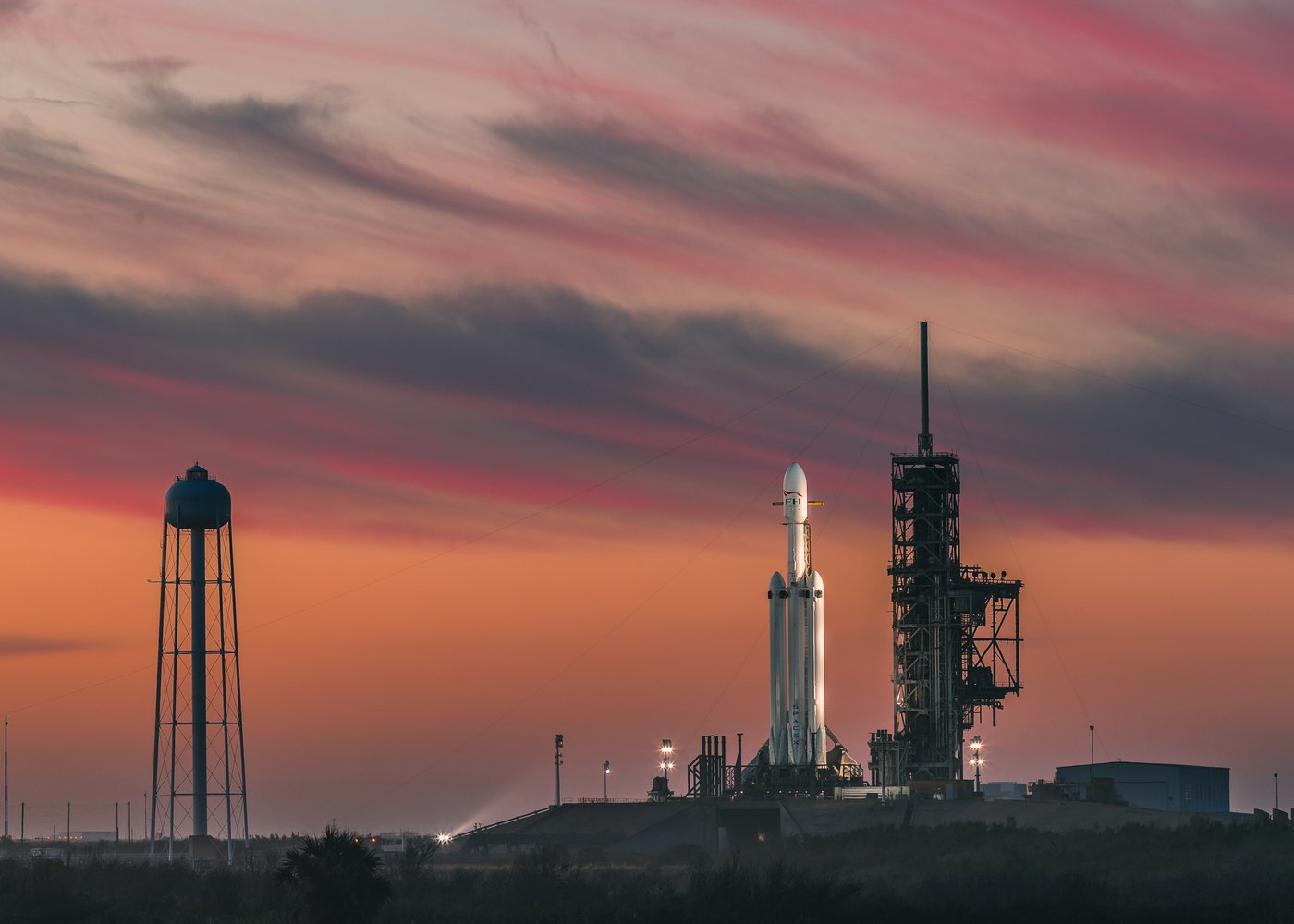
Late on the night of October 1, the most powerful rocket in SpaceX’s operating fleet cleared the tower at Kennedy Space Center’s Pad 39A and carried a classified national-security payload into orbit. The customer was the National Reconnaissance Office, the agency that builds and operates America’s spy satellites, and the launch marked the first time the NRO had put a mission on Falcon Heavy, the triple-booster rocket that has flown only occasionally since its 2018 debut.
The payload, designated NROL-97, went up in darkness, its purpose and destination as classified as such missions almost always are. What was visible was the rocket doing its job. After the first stage separated, the two side boosters fell back toward the Florida coast and touched down at Cape Canaveral’s landing zones, a sequence now so practiced that it barely slows the countdown for the next customer.
The flight was Falcon Heavy’s 14th. The rocket was built to carry the heaviest loads in SpaceX’s inventory, and for much of its life it has been something of a niche vehicle, used for a handful of deep-space and heavy-communications missions while the workhorse Falcon 9 handled the daily traffic. Its debut in February 2018, when it flung a sports car toward Mars as a test payload, was as much a publicity gesture as a demonstration, and the rocket has since settled into a quieter role lifting large satellites and government payloads.
The selection by the NRO signals that the agency, already a steady Falcon 9 customer, is now willing to put larger classified payloads on the bigger rocket. National-security launches have historically been among the most closely held contracts in the business, split between SpaceX and United Launch Alliance, the Boeing-Lockheed Martin joint venture. Adding Falcon Heavy to that rotation, rather than reserving it for occasional heavy missions, suggests the government has grown confident in the rocket’s record.
The night launch was only a third of the company’s output for the day. Earlier, a Falcon 9 lifted off from Vandenberg Space Force Base in California on Transporter-18, a rideshare mission that carried 130 payloads to orbit. And Crew-13 carried four astronauts toward the International Space Station. Three launches, three pads, three orbits, inside a single day.
For most of the space industry, a three-launch day would be an event to be planned around. For SpaceX it is a pace to be maintained. The company has spent years driving down the cost and turnaround time of flight by landing its boosters and flying them again, and the result is a manifest that now behaves less like a list of one-off missions and more like a timetable.
That cadence has become the company’s chief competitive advantage. Rivals can match a single launch. Matching a company that flies several times a week, with boosters that return to be refueled and relaunched, requires more than a rocket: it requires the ground infrastructure, the regulatory approvals and the practiced workforce that SpaceX has assembled over a decade. Most of its competitors are still years from that position.
The volume also changes the economics of the government business. A customer like the NRO once waited for a launch slot as a rare and expensive event; now it can book one the way a passenger books a seat. That shift is part of why the spy agency, among the most conservative buyers in the industry, is willing to fly new payloads on a rocket that has spent years proving itself.
The three flights also ran on different coasts and different vehicles, which is its own kind of stress test. Crew-13 lifted off from Florida, Transporter-18 from California, and Falcon Heavy from the same Cape Canaveral pad that has hosted the company’s most important missions. Coordinating three countdowns in a day demands the kind of operational depth that comes only from repetition, and it is exactly that repetition SpaceX has been accumulating since it began landing boosters in 2015.
The spy mission’s place in the day was not incidental. The NRO buys launches from a small group of providers, and its willingness to use Falcon Heavy for a classified payload rather than wait for the standard Falcon 9 configuration tells the rest of the national-security market that the heavier rocket is now an ordinary option, not a special request.
Behind that decision sits a longer question about what comes next. SpaceX is developing Starship, a far larger rocket intended to replace both Falcon 9 and Falcon Heavy, and the government has already begun planning payloads for it. Until Starship proves itself, Falcon Heavy remains the heaviest option the NRO can call on with confidence, which gives every one of its flights a weight that goes beyond the single satellite on board.
What NROL-97 carried, and what it will do once in orbit, will most likely never be disclosed. The launch itself made one thing plain: a private company flew the nation’s most sensitive hardware into space, landed two of its boosters, and then flew twice more before the day was out.