
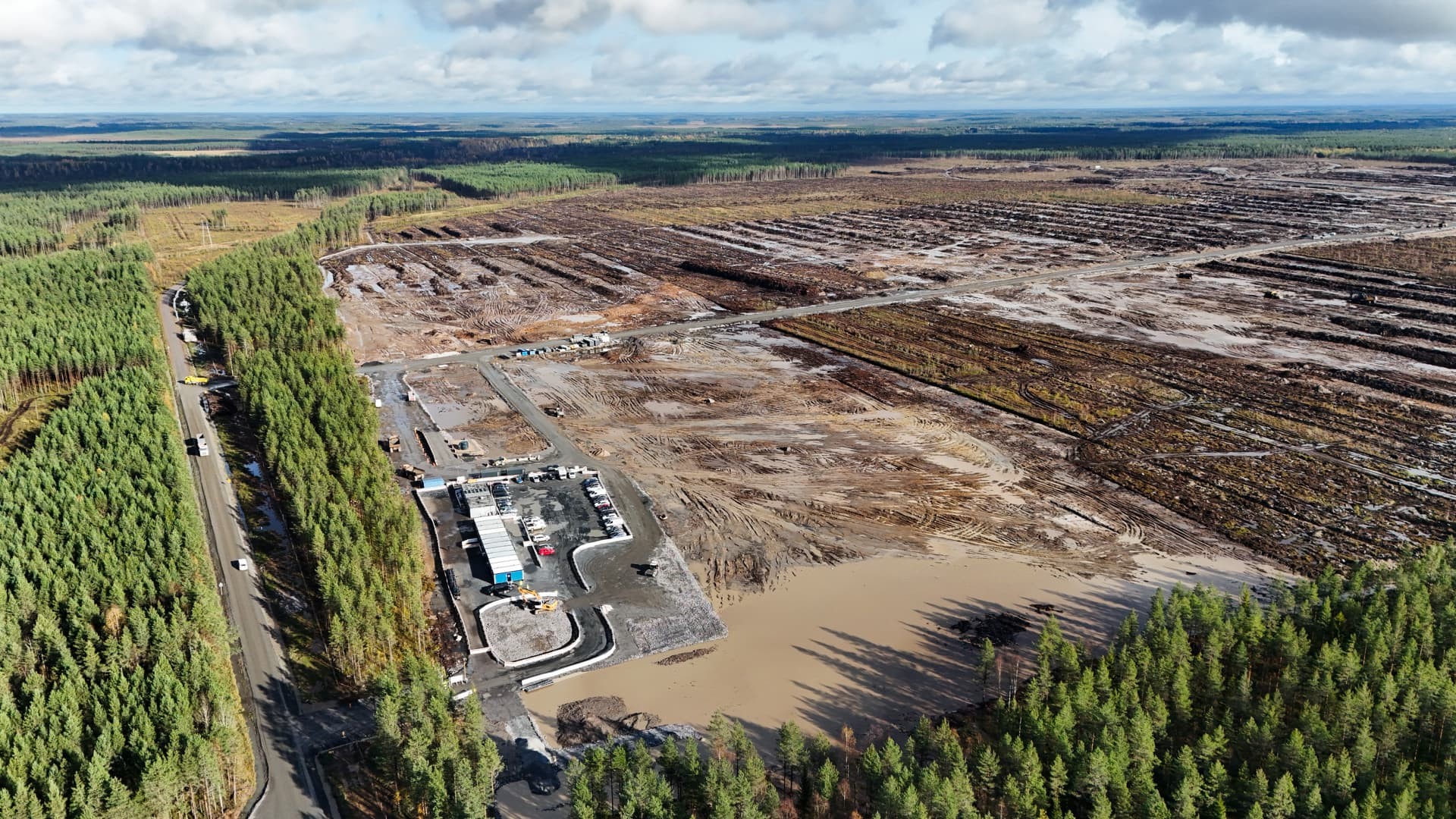
The trees came down in March, before the paperwork was done. Workers began clearing forest at Leppiniemi, outside the northern Finnish town of Muhos, months before the environmental impact assessments that Finnish law requires for projects of this scale had been completed. On Tuesday, the country’s licensing authority had seen enough, and it ordered the work stopped.
The Finnish Licensing and Supervision Agency, known by its initials LVV, directed Tuike Finland Oy, the Google subsidiary running the projects, to suspend all environmentally significant preparation at data center sites in Muhos and Kajaani no later than October 23. The order covers the removal of trees and topsoil, excavation, quarrying, crushing, the moving of soil, ditching and the building of site roads and storage areas.
The timing could hardly be worse for Google. A month earlier the company had committed to invest $15 billion in AI infrastructure in Finland, part of a sprint by American technology giants to secure land and power across Europe. Finland has courted that spending for years, pitching its cool climate, cheap hydroelectric power and stable grid as a natural home for data centers. Google has run a facility at Hamina, on the southern coast, since 2011, built inside a decommissioned paper mill. The northern sites at Muhos and Kajaani, along with a third at Vaala, are the centerpiece of its expansion.
The regulator’s complaint is specific. Tommi Muilu, who heads the LVV’s environmental department, said the measures already carried out would change the environment and cause impacts whose identification and assessment are among the key objectives of the review procedure. The Finnish Association for Nature Conservation said more than 300 hectares of forest had been cleared at the Muhos site while those assessments were still incomplete.
Google has not disputed that it began work early. The company said it acted in good faith under the Forestry Act and ran nature surveys and put in place measures to protect high-value areas. Sondre Ronander, Google’s head of communications for Finland and Norway, said the company was examining the authority’s observations carefully and would act in line with its instructions. The distinction Google draws, between forestry law and the separate rules that govern environmental assessments, is precisely where the regulator disagrees.
For European regulators, the episode lands as the politics of AI infrastructure are shifting. Data centers were long sold as clean, job-creating investments. Now, as hyperscalers line up gigawatts of demand, the friction points are multiplying: access to electricity, competition with households for power, water use, and the environmental cost of clearing land. Finland’s intervention suggests that even in a country eager for the investment, the environmental review is no longer a formality to be completed after the bulldozers arrive.
The stakes are concrete for Google. The LVV has given Tuike until October 14 to respond in writing and confirm whether it will comply, and the environmental impact assessments for both sites are not expected to be finished before the end of the year. That pushes any resumption of work into a period when the northern construction season is already short. If the company does not follow the order, the agency has said it may begin enforcement proceedings that could carry financial penalties.
Minister of Climate and the Environment Sari Multala told Finnish media that all companies operating in Finland, domestic or foreign, must comply with Finnish law, a statement that reads as a warning the government will not smooth the path for a prized investor. The message, delivered politely but firmly, is that Finland wants the data centers and will still apply its rules.
For the broader AI buildout, the case is a marker. The industry’s expansion has moved from a race for capital to a race for land, power and permits, and each of those now carries its own choke point. A company can raise billions and still be stopped by a forestry rule in a municipality most investors could not find on a map. Analysts said the friction is unlikely to slow the sector’s overall trajectory, but it will raise the cost and lengthen the timelines of individual projects, and it hands local authorities and environmental groups a seat at a table they once only watched from outside.
Google’s own posture is telling. It did not fight the order, and it framed the early clearing as an act of good faith under one law rather than a dodge of another. That defensiveness signals how much the company has riding on Finland, where it is betting that a tolerant government and abundant clean power can host the compute that Europe’s AI ambitions demand. With data center demand across the continent now pressing hard against the limits of available electricity and patience, the race is no longer simply about who builds first. It is about who can build without tripping over the rules meant to protect the ground the servers will sit on.



