
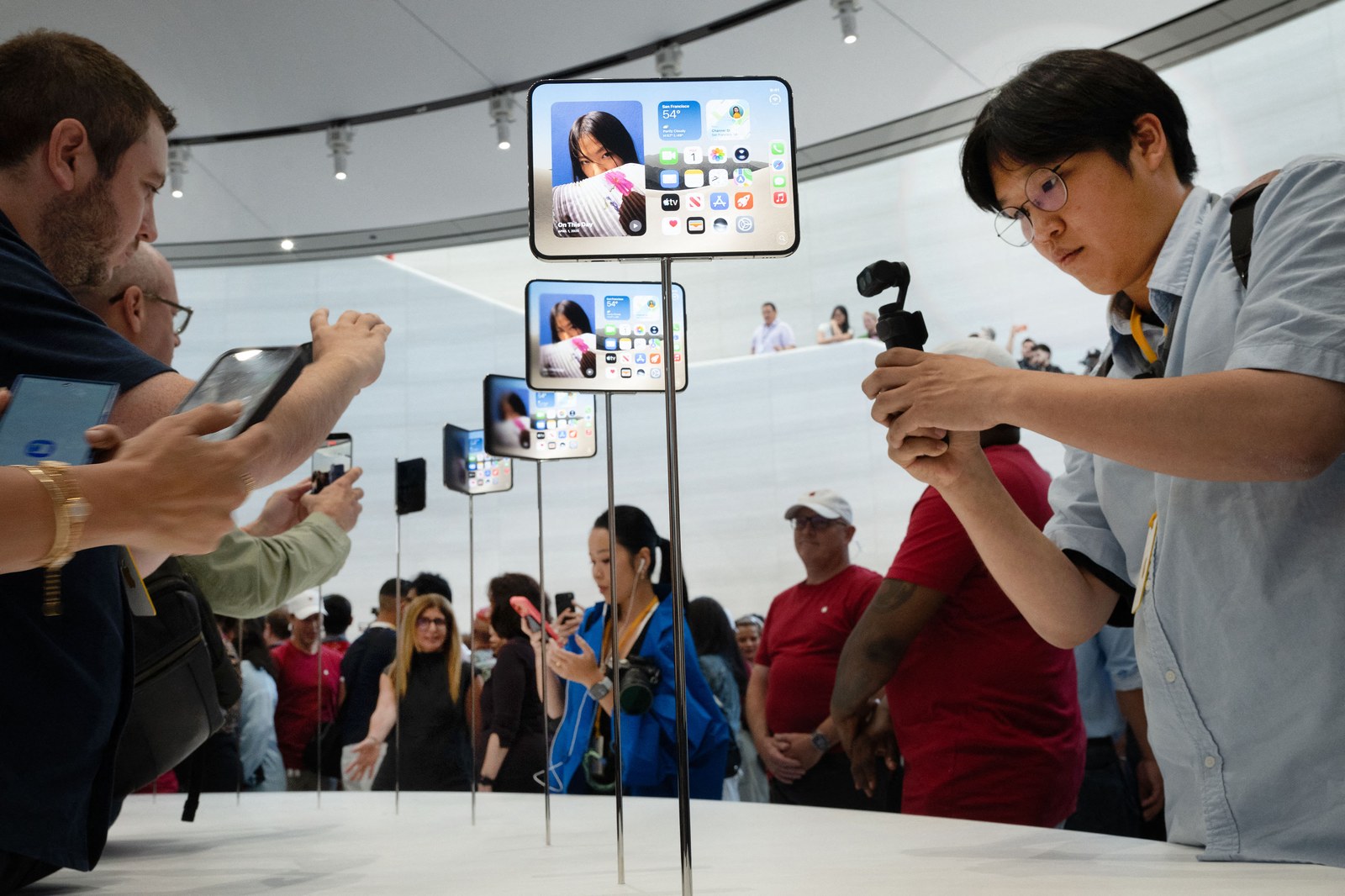
Apple’s first foldable phone does not reach customers until late October, but the company has already drawn the line for the people who make its software. Starting in April 2027, every new app and every update submitted to the App Store must be adapted for the iPhone Duo, or the submission will not pass review.
The rule, published on Apple’s developer site and circulated to app makers worldwide, requires developers to include screenshots of their apps running on both of the device’s displays: the 5.4-inch outer screen and the 7.6-inch inner screen that unfolds into a small tablet.
The requirement is framed as a submission change, but its practical effect is broader. To produce those screenshots, a developer must build an app that actually runs on the foldable hardware. Existing apps that are never updated can keep running as they are; the moment a developer submits an update, the adapted screenshots must be there.
Apple is giving developers a runway of more than half a year. The device launches October 23, and the April 2027 deadline ends a transition period the company has explicitly called a buffer.
The policy covers apps and games, with no category exemptions. The screenshots must show the app on the outer screen and the inner screen separately, sized for each display, and will appear on the App Store product page.
The company is also supplying the tools. Xcode 27.1 adds development support for the iPhone Duo, and a testing tool called Device Hub lets developers run a virtual foldable on a Mac, reproducing the opening and closing of the device and its screen rotation.
Apple has also made clear what the new device asks of existing software. Apps built for a single screen will run on the iPhone Duo through compatibility scaling, but only apps compiled with the iOS 27.1 SDK or later can resize and reflow their layouts across the full inner display. The distinction is the difference between an app that merely runs and one that uses the extra screen.
The requirement lands at a moment when Apple is asking developers to do more work across its platforms, from privacy labels to new compliance demands. Some smaller studios have grumbled that the foldable deadline is another tax on their time. Apple’s answer, in effect, is that a flagship device deserves software that meets it.
Apple’s approach reflects a lesson drawn from the Android side of the market, where foldable phones spent years shipping with apps that stretched awkwardly or ignored the extra screen. By making adaptation a condition of review, Apple is trying to ensure its first foldable does not arrive with a library of software that treats the new hardware as an afterthought.
The deadline is the latest in a series of moves that show how seriously Apple is treating the launch. The company has published design guidance, templates and workshops, and has already begun accepting apps optimized for the iPhone Duo through App Store Connect. Apps built with the new tools will carry a badge on their product page marking them as optimized.
The mandate puts the burden on developers, not on Apple. The company does not have to persuade every major app to adapt on a voluntary schedule; it simply sets a date after which non-adapted submissions are rejected.
For developers, the work is real but bounded. Adaptive layouts and support for multiple displays have been standard practice on other platforms for years, and Apple’s tools do much of the resizing automatically for apps built on recent versions of its frameworks.
The stakes are high on both sides. Apple’s foldable is its most important hardware bet in years, and its first impression depends on whether the most popular apps work well on day one. Developers, for their part, cannot afford to be absent from a screen that will sit in tens of millions of pockets.
That mutual dependence is what makes a hard deadline viable. Apple rarely dictates to its developers this bluntly, but when a new form factor arrives, the alternative – a device that launches with a thin and broken software catalog – is worse for everyone.
The rule also signals how Apple wants the foldable to be judged. If the device is going to justify its premium price, it needs software that uses the extra screen rather than merely tolerating it. Apple has decided it would rather force that outcome than hope for it.
The company has reason to be strict. Foldable rivals on the Android side spent years explaining to users why apps looked broken on their new phones, an apology Apple would rather never have to make.
For the developers who have not yet started, the clock is already running. Six months is enough time to adapt a layout, but only just, and the queue for review has a way of filling up as a deadline approaches. Apple has given them the date, the tools and the instructions. The rest is up to them.



