
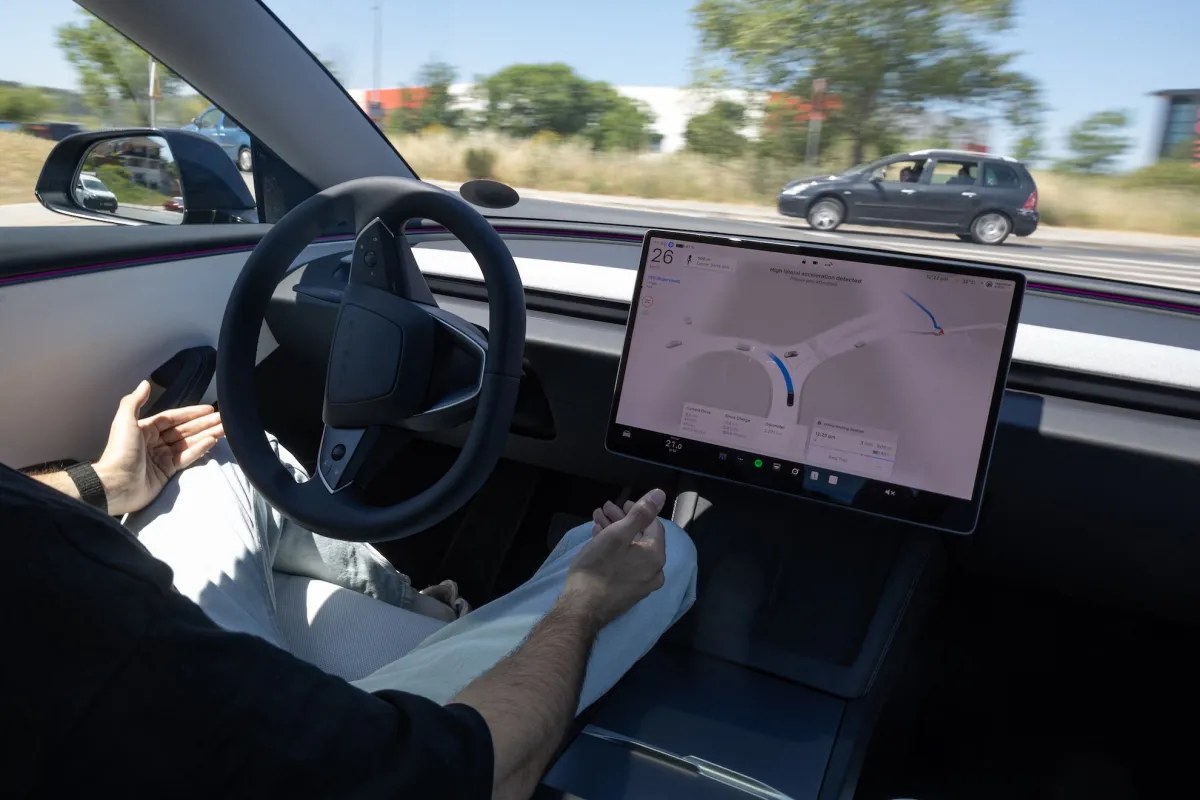
The badge on Tesla’s European website changed this week, and the change was not cosmetic. Where customers had seen “Full Self-Driving (Supervised),” the company now writes “Tesla Assisted Driving.”
The switch, made October 8, replaced the name on Tesla’s European sites, with local-language versions in France, Norway and elsewhere, and the /fsd web address now redirects to a new page in more than ten countries. The old name, Tesla appears to have concluded, promised more than the system delivers.
The change followed talks with Germany’s transport ministry. German officials argued the “Full Self-Driving” label was misleading, because the system does not take over the entire driving task and the driver must stay attentive throughout. Tesla, according to people familiar with the discussions, proposed the renaming itself rather than wait for a ruling.
The name has always carried more weight than the technology beneath it. Musk has used “Full Self-Driving” for years, even as the system remained what regulators call Level 2 automation — an assist that steers, accelerates and brakes but still requires a driver watching the road and ready to intervene at any moment. The “Supervised” qualifier was added only after scrutiny made the gap harder to ignore.
The stakes are regulatory approval in Europe’s largest car market. Germany has signaled it would support letting the system drive up to 10% above posted speed limits, while France and Sweden have opposed that. A vote at the European Union level has slipped from October to December at the earliest.
The renaming is also aimed at Britain, which from January 2027 will restrict the use of phrases such as “autonomous driving” in marketing. Tesla’s European move gets the company in line with that deadline more than a year early, a sign that the company is learning to meet regulators on their terms rather than argue about vocabulary.
The episode shows how far the marketing language around driver assistance has drifted from what the systems actually do. “Full Self-Driving” has always been a contested name. Regulators on both sides of the Atlantic have questioned the gap between the label and the capability, and safety agencies have opened inquiries into crashes in which the system was engaged.
Renaming the product is cheap. The harder question is whether the underlying system can win approval under rules that Europe applies to genuinely automated driving. Tesla has been seeking approval country by country, and the German support for a speed-limit tolerance suggests a compromise is forming, even as French and Swedish objections keep it from being settled.
For Tesla, the stakes go beyond a marketing term. Europe has been a difficult market for the company’s more advanced driver features, and getting a form of the system approved on the continent would give Tesla a selling point that most rivals cannot match. The company has framed assisted driving as central to its future, and Europe is a large slice of that future.
Tesla’s approach now differs from the rest of the industry, which has largely avoided the “self-driving” label for systems that require supervision. Most automakers market their features as “assist” systems precisely to avoid the regulatory and legal exposure that a stronger claim invites. Tesla’s rebrand brings it, at least in Europe, in line with that convention.
The change leaves the company’s position in North America untouched, where the “Full Self-Driving (Supervised)” name remains. That split — one name in the United States, another in Europe — is itself a concession that language which passes in one market can run into trouble in another.
The rebrand is the latest turn in a long argument over what Tesla’s software actually is. Musk has promised full autonomy repeatedly over the past decade, setting timelines that slipped, and the company now charges thousands of dollars for the feature in the United States while regulators elsewhere treat it as an assist. The European Union’s rules, shaped by the United Nations and national authorities, are stricter about what can be marketed as automated, and they were never going to accept a name that claims self-driving for a system that is not. German regulators in particular have pushed automakers toward precise language, and the “Assisted Driving” label is the vocabulary they want. For Tesla, the concession is small compared with what it buys: a chance to win type approval in a region that has been slow to grant it. The company has spent years arguing that its camera-based approach is safer and cheaper than rivals’ sensor stacks, but safety claims do not settle marketing rules.
What matters for drivers is unchanged. The system still requires a human to watch the road and be ready to take over, whatever it is called. Europe simply decided that the name should say so, and Tesla, after months of negotiation, agreed.



