
A quantum computer on its own can hold only so many qubits. The path to bigger machines runs through connecting several of them, the way classical data centers link servers. That connection has always been the slow part. IonQ says it has just made it fast enough to matter.
On Thursday, the College Park, Maryland company announced that its photonic interconnect had reached entanglement rates above 1,000 per second, one kilohertz, between a trapped-ion qubit and a solid-state quantum memory. Entanglement is the quantum link that lets separate systems work as one, and the speed at which it can be created is the bottleneck for any network of quantum processors.
Quantum networking has long been the field’s least-visible frontier. Companies and governments have poured money into the processors themselves, but a single processor is not a computer at useful scale. The interconnect is the part that turns several machines into one, and it has lagged far behind the chips it is meant to join.
Entanglement is the currency of that future. When two qubits are entangled, measuring one fixes the state of the other, which is what lets a computation spread across machines that may sit in different rooms. IonQ, which trades on the New York Stock Exchange under the symbol IONQ, calls itself a full-stack quantum platform and foundry.
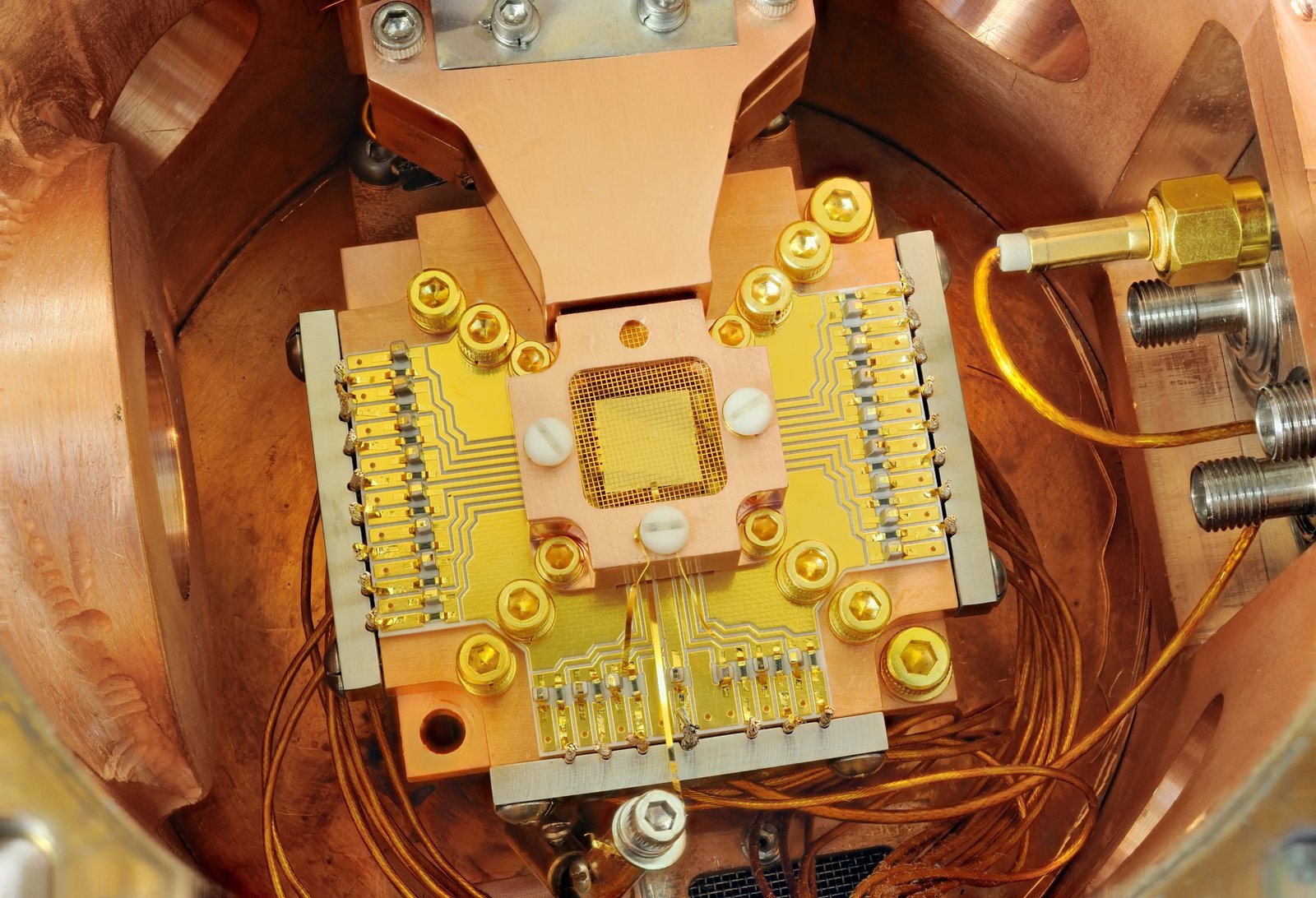
The number is specific: an average of 1.032 kilohertz, or 1,032 entangled Bell pairs every second, with a mean time to success of 969 microseconds. The measured fidelity of the two-node state was 87.9 percent. The demonstration tied a barium-138 ion to a silicon-vacancy qubit embedded in a diamond nanophotonic cavity.
The kilohertz rate matters because it lines up with the roughly one-millisecond cycle time of the fault-tolerant trapped-ion processors IonQ is planning. A network slower than the processor becomes the limiting factor in any cluster. At 969 microseconds per link, the interconnect is no longer the thing holding the system back.
The result is more than four times faster than the previous record for trapped ions, which belonged to a research group at Duke University led by Christopher Monroe, an IonQ co-founder who also collaborated on the paper. IonQ called the link the fastest heralded entanglement rate yet shown between separate quantum nodes on any platform.
The speed came from pairing two technologies with opposite strengths. Trapped ions hold their quantum state longer than almost any other qubit, which makes them reliable but slow to couple to light. Solid-state memories couple to light efficiently but decay quickly. IonQ paired them, using the ion for computation and the diamond memory as a buffer that lets nodes entangle without waiting for simultaneous photon arrivals.
The link is a feat of optical plumbing. A 493.5-nanometer photon emitted by the barium ion is shifted to 737.45 nanometers inside a periodically poled lithium niobate crystal, then pushed through a basis converter that maps its polarization onto early and late time bins. That conversion lets a photon born in an ion match the wavelength a diamond memory can absorb.
Niccolo de Masi, IonQ’s chairman and chief executive, framed the achievement as a step toward networked quantum data centers. The work runs through the company’s participation in a Defense Advanced Research Projects Agency program called High-Speed Quantum Interconnects, or HARQ, which aims at networking fabrics that can tie together different kinds of quantum hardware.
The demonstration is a rate record, not a fidelity record. A figure of 87.9 percent sits well below the high-nineties fidelity that is routine for operations within a single quantum chip. IonQ’s own framing treats the link as a building block toward clustered systems, and the company has said those systems could reach commercial readiness later this decade.
The announcement landed as quantum computing draws fresh money and attention. A day earlier, Nvidia committed $1 billion over five years to U.S. scientific research, naming quantum computing among the fields it would support, alongside healthcare and energy security. Nvidia builds no quantum processors itself; it is assembling the computing stack around them. The signal was enough to pull quantum stocks into view.
IonQ’s practical record gives the announcement substance. The company has sold commercial quantum-networking systems to the University of Maryland and to South Korea’s SDT, and the work is supported in part by Amazon Web Services and Element Six, the diamond-materials supplier. The kilohertz result was produced on real hardware, not simulated.
What the result does not establish is whether interconnected quantum processors can run useful workloads at data-center scale. No peer-reviewed paper accompanied the announcement, and the rate and fidelity rest on IonQ’s own measurements. The next question is whether fidelity can climb while the rate holds, and whether a laboratory link can grow into a multi-node cluster. For a field long defined by promises, 1,032 pairs a second is a number with a unit attached. Whether it compounds into a working machine is the part still to be shown.



