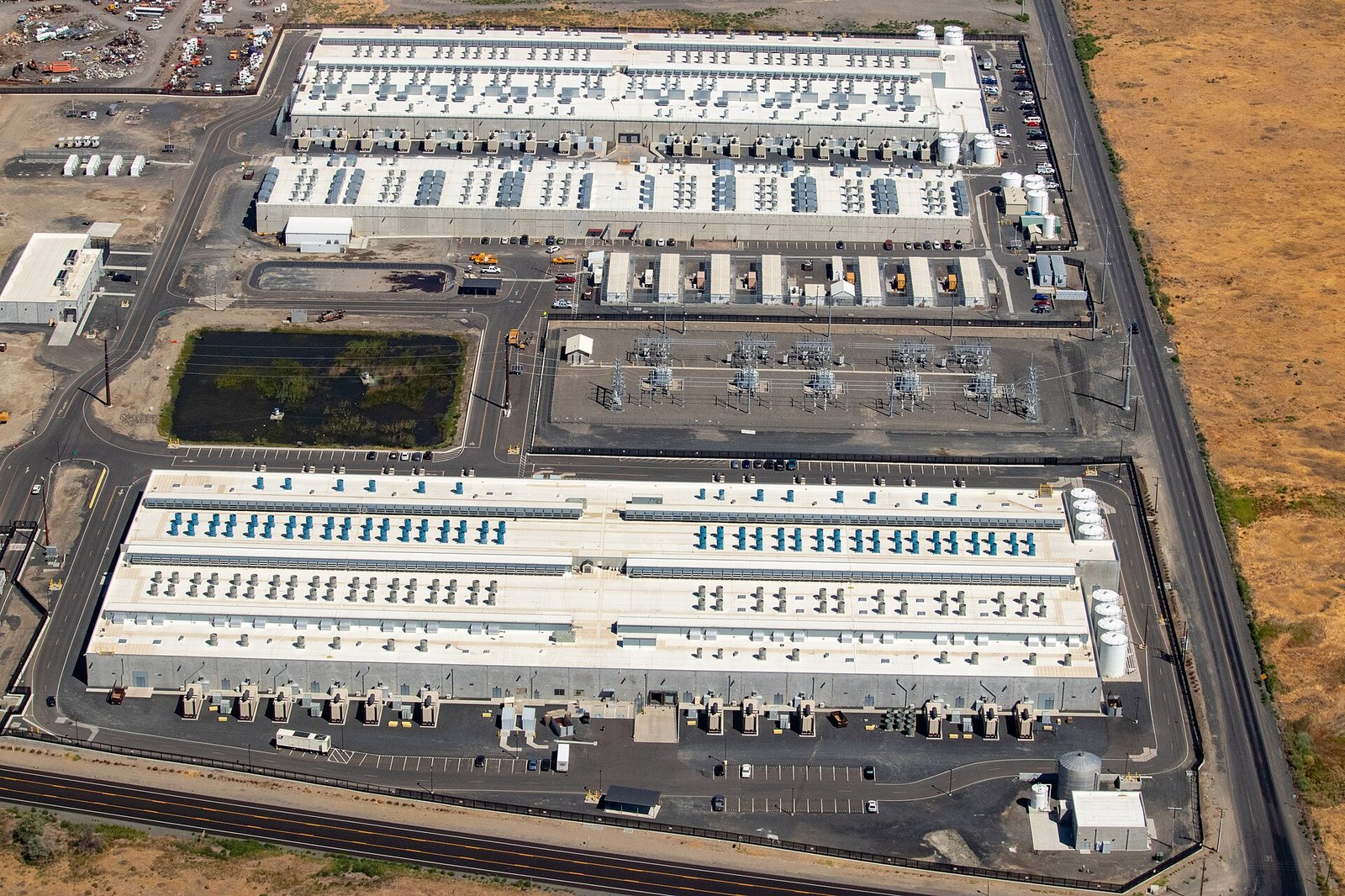
The Homer City Generating Station burned coal for 54 years, and for much of that run it was the largest coal-fired power plant in Pennsylvania. It shut down in mid-2023. On the same ground, Amazon Web Services now plans to build 36 data center buildings across 1,100 acres, drawing power from a new 4.5-gigawatt natural-gas plant rising beside them.
Amazon Data Services, Inc., the company’s development arm, has filed a preliminary land-development plan with Indiana County. The application, reported first by Data Center Dynamics and confirmed in local coverage, carries the name PIT100 Masterplan and spreads across six sites – Bruner, Helen, Green, West, Harvey/Gaston and Rura – in Center and Blacklick townships, roughly 50 miles east of Pittsburgh.
Each building would stand two stories and reach about 70 feet, with roughly 225,000 square feet of floor space. The plan adds offices, storage, electrical substations, security and redundant on-site generation. Construction is scheduled to begin in December 2026 and to run in four phases, the last starting in January 2032, with the entire campus complete by June 2036.
The power supply is the centerpiece of the deal. Homer City Redevelopment is converting the old coal site into a 3,200-acre energy campus anchored by a 4.5-gigawatt combined-cycle plant built around seven GE Vernova turbines, a design that would make it the largest gas-fired plant in the country. Most of that output would feed the data centers directly, while more than one gigawatt would flow back into the regional PJM grid.
The coal plant that once stood there was an institution. It ran from 1969 until mid-2023 and, at its peak, powered a large share of the region’s economy as well as its grid. Its closure followed a long decline in coal generation across the country, and the site sat idle while local officials searched for a use that could match the plant’s scale. The data center campus is the answer they settled on.
EQT has agreed in principle to supply Marcellus shale gas, and Knighthead Capital Management is helping finance the conversion. The arrangement ties one of the country’s most ambitious cloud builds to the region’s most abundant fuel, a pairing that has drawn both enthusiasm and wariness in a state still working through the decline of coal.
The jobs figures sit at the center of the pitch. AWS has said the project would support between 1,500 and 2,000 construction positions, with average annual pay of $80,000 to $100,000. The company has also committed to a community benefits agreement meant to address local effects, a concession to the townships that will host a decade of heavy construction.
The filings describe a footprint larger than the 1,100 acres the buildings would occupy. Amazon proposes to acquire roughly 2,200 acres across the two townships, with the data center structures themselves spread across the six named sites. The rest of the land would hold the substations, roads, security and generation equipment that a campus of this size requires.
The filing arrives as Amazon’s infrastructure spending has become one of the defining facts of the company. Amazon has said it will invest heavily in data centers this year, and its cloud division has been adding capacity across the country to meet demand driven by artificial intelligence. Pennsylvania already hosts a separate Amazon commitment of roughly $20 billion for data centers in the eastern part of the state.
Analysts who track the power-hungry computing industry describe the project as one of the clearest signs yet of how far cloud providers will go to secure electricity. Utilities have warned that demand from data centers is outpacing their ability to build transmission, and companies have responded by contracting for generation directly at the sites where they build. The Homer City campus is among the most explicit examples of that shift, pairing a data center developer with a power-plant developer from the start.
Homer City is different in kind even by those standards. Rather than plugging into an existing grid, it pairs computing directly with dedicated generation, a model that has grown more common as utilities strain to keep up with the load data centers draw. The gas plant’s timetable, with first power targeted for 2027, has been arranged to match the data centers’ own construction schedule. The two projects rise together, one supplying what the other consumes.
That transition carries friction. Data centers draw large amounts of power and water, and communities across the country have objected to proposals that promise jobs while straining local resources. Amazon has faced such resistance elsewhere. Matt Garman, the chief executive of Amazon Web Services, defended the company’s expansion in public this week, arguing that the people who stream video and shop online are the same people who question the facilities that make those services possible.
For Indiana County, the project offers a second life to a piece of land that defined the region’s industrial past. Whether a gas-fired data center campus can deliver the stability the coal plant once provided is the question a decade of construction, and the phases after it, will begin to answer.