
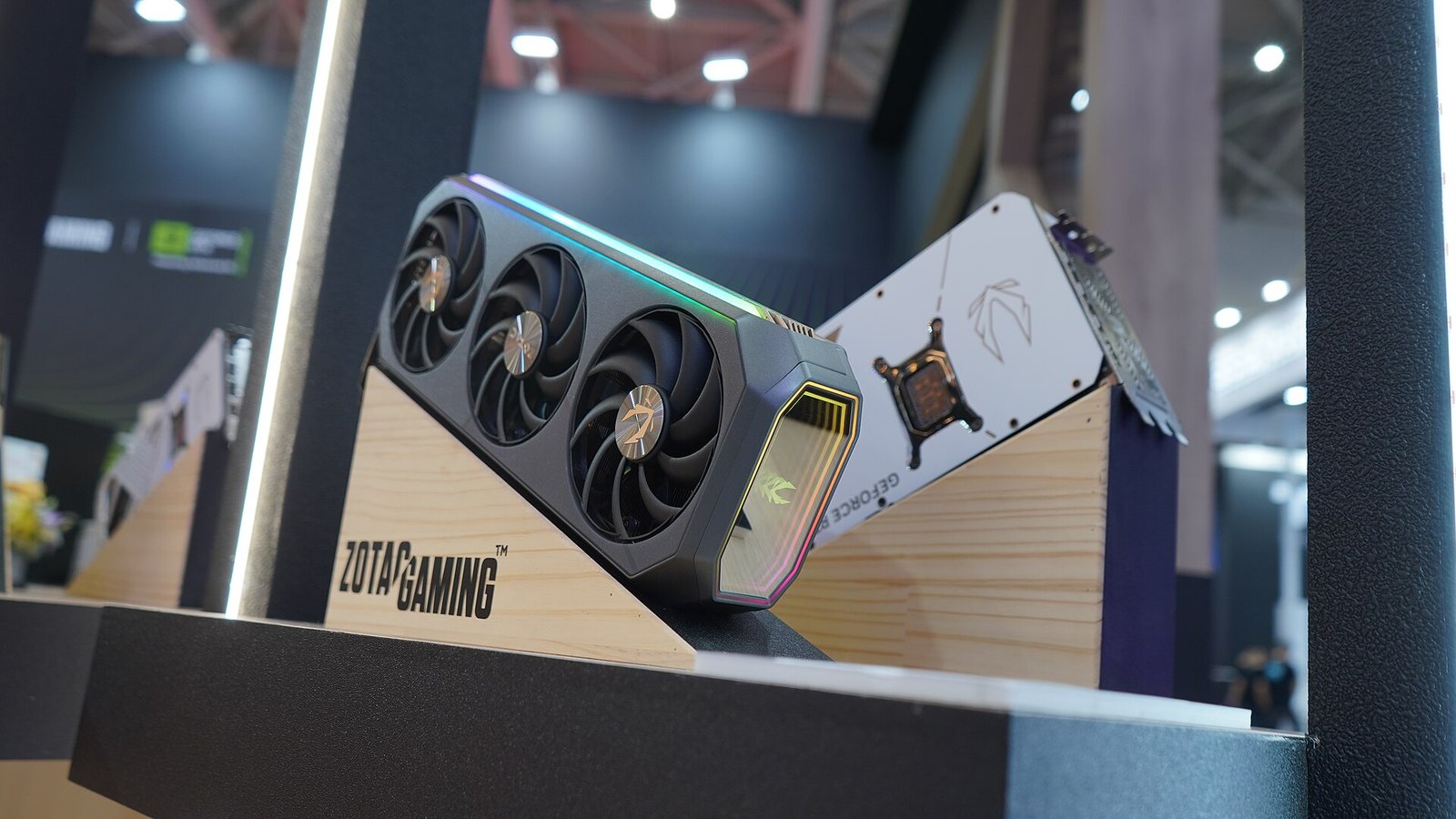
The chip inside Nvidia’s most powerful consumer graphics card may be headed for a quieter, more expensive life. According to a hardware leaker, Nvidia has stopped allocating the GB202 die to the GeForce RTX 5090, and every new GB202 it makes will go to professional workstation cards instead. The claim, posted on October 10, has not been confirmed by Nvidia.
The leaker, who posts as MEGAsizeGPU, wrote on X that there would be “no more GB202 for 5090,” adding that “all future GB202 supplies are RTX Pro exclusive.” GB202 is the largest chip in Nvidia’s Blackwell generation and the silicon that powers the RTX 5090, the flagship of its consumer lineup since early 2025.
If the claim holds, the RTX 5090 would end its production run with no announced replacement, and the top of the consumer stack would fall to lower cards. A second account that tracks graphics-card supply said the 24-gigabyte version of the RTX 5080 would take over the top position. Nvidia has not commented, and has given no end-of-life date or successor model.
The logic is arithmetic. The RTX PRO Blackwell workstation cards built on the same die sell for far more than the consumer card, and Nvidia’s production capacity is finite. When the same silicon can be sold into a professional product at several times the price, the consumer part loses the fight for wafers. The leakers’ claim, if true, is a statement about where the margin sits.
The backdrop is the same one reshaping the entire GPU market: AI demand is crowding out consumer capacity. Nvidia’s data-center business has consumed the bulk of its advanced silicon for years, and every die steered toward a workstation card is a die not steered toward a consumer flagship. The RTX 5090’s rumored exit reads as another small contraction of the consumer side of the business.
The card’s scarcity predates the rumor. In channels, the RTX 5090 has been marked up well beyond its official price, with listings reported between roughly $5,000 and $9,600 as buyers chase a part that has been hard to find since launch. A production stop would turn a scarce card into a collector’s item and would likely push prices higher still on whatever stock remains.
The claim should be weighed carefully. Hardware leakers have a mixed record, and neither Nvidia nor its partners have corroborated the report. A single account’s assertion about supply allocation is a long way from a product discontinuation, and graphics-card roadmaps change without public notice. What is being described is a rumor about supply, not an announced decision.
Still, the claim fits a pattern that has been building. Nvidia has shown little urgency about refreshing the top of its consumer line, and the professional Blackwell cards have been selling into the same AI-driven demand that funds the data-center boom. A shift of GB202 silicon toward those cards would be consistent with where the company has been pointing its capacity for months.
The consumer and professional lines have always competed for the same silicon, but the balance has tilted. Workstation cards once sold in modest volumes to a small audience of studios and engineers. AI has turned that audience into a mass market, and the professional cards now command pricing that a consumer flagship, however inflated on the secondary market, cannot match on the primary one.
The RTX 5090 arrived in early 2025 at an official price of $1,999, carrying 32 gigabytes of memory and a die that Nvidia had steered toward its highest-end consumer card. The professional Blackwell cards built on the same architecture carry far more memory — the RTX PRO 6000 Blackwell ships with 96 gigabytes — and sell for several times the consumer card’s list price, which is precisely the arithmetic the leakers are pointing to.
The shift also reflects how small the consumer business has become in Nvidia’s overall mix. The data-center segment now generates the large majority of the company’s revenue, dwarfing gaming, and the company’s allocation decisions have followed the money for several years. A flagship graphics card that once anchored the brand now competes for silicon with products that fund the rest of the business.
For buyers, the practical question is inventory. The RTX 5090 has been in and out of stock since launch, and a supply halt would mean the cards already in the channel are the last ones, a condition that historically sends secondary-market prices higher rather than lower.
What happens next is genuinely open. If the leakers are right, the question is how long existing RTX 5090 stock lasts and whether a successor arrives before it runs out; if they are wrong, the rumor fades into the noise that surrounds every scarce product. Either way, the episode captures the pressure Nvidia’s most expensive consumer card has lived under since launch: caught between the gamers who want it and a company that may have found a better use for its silicon.



