
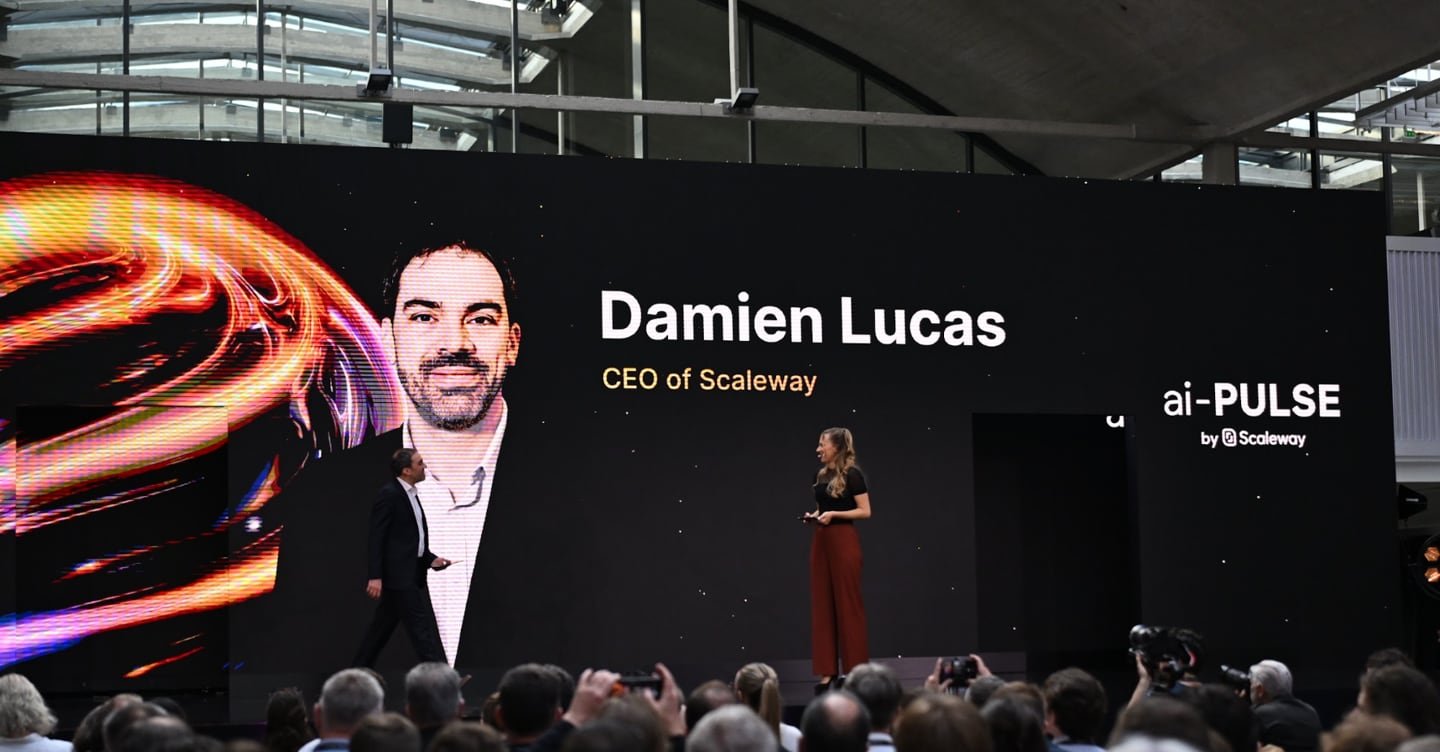
Scaleway, the cloud arm of French telecom group Iliad, said Tuesday that it will build an AI supercomputer in Sweden running AMD Instinct MI355X chips, the first AMD-based machine of its kind in Europe built for commercial customers and the French company’s first deployment outside France.
The announcement came at ai-PULSE 2026, Scaleway’s annual conference in Paris. The system pairs the accelerators with AMD’s open ROCm software stack and will be assembled by the French integrator Bull, which is handling racks, cooling integration and ongoing hardware maintenance. Giga Computing supplies the servers and Motul provides the liquid cooling fluid.
Scaleway used the same event to say it had completed its Milan cloud region, and Lucas told the audience that running a sovereign European cloud on European silicon remains an unmet goal. That is the honest version of the sovereignty argument. Demand for local services is real, the supply of local chips is not, and the practical alternative for a European buyer that does not want to depend on one vendor is a second American one.
The choice of Sweden follows the reasoning behind the country’s existing data center industry. Hydroelectric and nuclear capacity give the site a carbon profile French and German customers can report to their own regulators, and the Nordic grid carries spare headroom the largest continental markets do not. Power, rather than latency, decides where training clusters go.
Scaleway said the machine will be open to startups, AI companies and enterprises across Europe, the part that distinguishes it from the national research clusters that have dominated European high-performance computing. The company’s chief executive, Damien Lucas, said the deployment deepens its work with AMD and brings the Instinct line to European companies at scale. Stephanie Dismore, AMD’s senior vice president for Europe and the Middle East, described it as expanding the compute architectures available to the region.
Sweden was chosen for two reasons given on the record: an electricity supply with low carbon intensity, and a domestic AI industry that wants to run training locally. Tele2’s head of business, Stefan Trampus, said demand from Swedish customers for European cloud and AI services has been rising.
The strategic point is the word AMD. Europe has spent years arguing about compute sovereignty, and Lucas acknowledged from the stage that a sovereign cloud in Europe does not yet run on European chips. Almost every accelerator in the region’s data centers comes from Nvidia. For a buyer who wants a second source, AMD is the only alternative at the top of the market, and the constraint on AMD has never been silicon. It has been the software ecosystem and the reference deployments that convince procurement teams a switch is safe.
That is what a commercial win in Europe is worth. Banks, hospitals and industrial groups do not run benchmarks; they buy architectures someone else has already operated in production. Every reference customer shortens the qualification process for the next one, and MI355X is AMD’s current flagship accelerator for training and inference work.
The same day produced a second AMD announcement that showed how the company is buying that demand. Fermi, the Nasdaq-listed developer of the Matador data center project in Carson County, Texas, disclosed a credit support agreement with AMD covering the first phase of the site, backing a customer lease that spans 222 megawatts of grid capacity. Fermi’s shares rose 13.2% in premarket trading on the news.
Credit support is vendor financing under another name. AMD agrees to stand behind a lease so a developer can raise construction debt and a customer can take capacity, which converts a chip sale into a financing arrangement. Two chief executives warned on the same day that access to capital is becoming the binding constraint on the AI build-out, and a chipmaker underwriting a data center lease is a direct answer to that constraint. It also moves risk onto a balance sheet that reports in accelerators.
AMD’s position in the market is worth stating plainly. Nvidia’s accelerators and its CUDA software stack are the default across the industry, and a rival cannot close that gap with a faster chip alone. What a challenger can do is accumulate evidence: a named operator, a published deployment, a customer who will take a reference call. That is slower work than a benchmark result, and it is the work that decides procurement.
Scaleway’s position is simpler. It sells cloud capacity into a market where European customers increasingly ask where the machine runs and who owns the software stack. ROCm gives it an argument about openness that CUDA does not, and Sweden gives it an argument about power. Neither settles the harder question of whether the software is competitive on the workloads customers actually run, and that will be decided by the first thousand users rather than by the launch.
The pattern across both announcements is the same. A second-place vendor in the accelerator market cannot win on specifications alone at this stage of the cycle. It has to buy the reference, in Europe with a commercial deployment and in Texas with a guarantee. The hardware is the easy part.



