
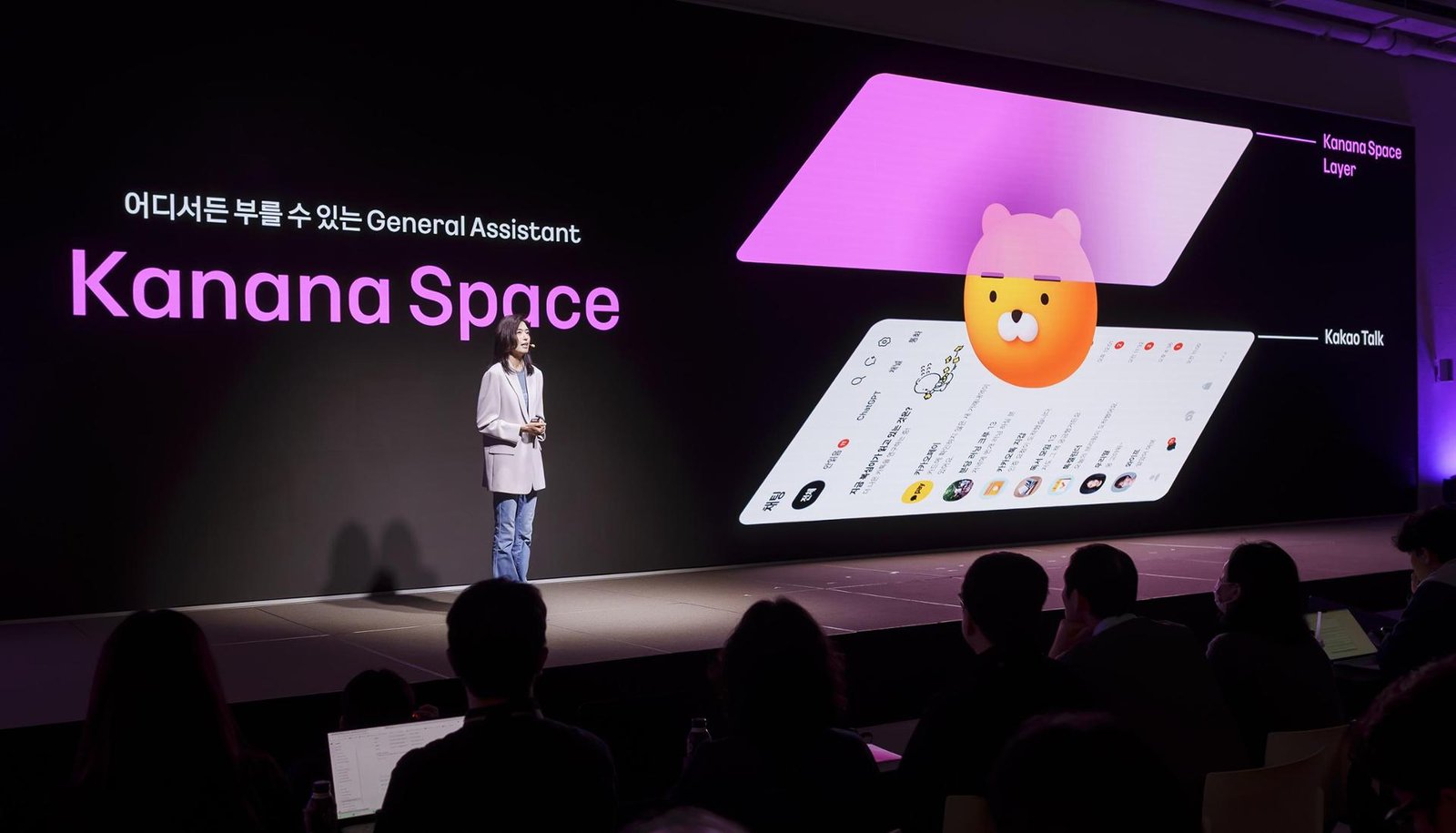
The demonstration began with a gesture rather than an app. Swipe down anywhere with two fingers inside KakaoTalk and an assistant opens on top of the conversation.
Kakao unveiled the service, called Kanana Space, on Tuesday at its annual developers’ conference, held at the company’s AI campus in Yongin, south of Seoul. A closed beta is scheduled for December, after which the assistant will be released inside KakaoTalk, the messenger used by roughly 50 million people in South Korea. It takes voice requests by default and accepts typed ones, and it is built to read the context of a user’s conversations rather than wait to be told what to do.
“The key metric for the quality assessment of generative AI is moving from whether it can put out good answers to whether it can complete requested tasks,” Chief Executive Chung Shin-a said at the event. She framed the change as a shift in interfaces, from a graphic user interface to a language one that understands the context and intent of the speaker.
In a demonstration, the assistant picked out work-related messages, summarized them, drafted a reply and organized unread items, and it adjusted notification settings on request. Given weather data and a record of a user’s workouts, Kakao said, it can suggest what to wear for exercise. The company plans to extend it across shopping, gifting, reservations and money transfers. For actions such as sending a message or moving money, the company said, users will confirm the final step themselves.
The service runs on a layered architecture, and the engineering choice behind it has as much to do with cost as with capability. “Our principle is we provide the best outcomes for all requests but do not use our biggest model for all of the requests,” said Noh Byung-seok, who oversees foundation-model development at Kakao. The hardest problems go to a frontier model, most requests to a flagship model, repetitive and clearly defined tasks to a small language model, and work that can be finished on the handset to an on-device model.
To keep the smaller models competent, Kakao said it used a post-training method called Multi-Teacher On-Policy Distillation, in which several specialist models, each strong in a different area such as conversation, instruction following, reasoning or tool use, teach a single smaller student. The aim is to preserve response quality while cutting the computing needed to serve the assistant at national scale. Kakao also showed Kanvas, an agent that runs on a personal computer and connects to KakaoTalk, and a project it calls Mosaic.
Kakao’s advantage is distribution, and its problem is that the same advantage is what every large technology company now wants. Global assistants from Google and OpenAI are already on the same phones in Korea, and Naver, the country’s other internet group, has its own model efforts. A messenger with half the country’s population inside it is the shortest path to an audience, which is why the assistant is being placed in the chat window rather than in a separate app.
That location is also the risk. Conversations hold the raw material an assistant needs: appointments, names, addresses, deadlines and the difference between a plan and a joke. They hold everything else too. Kakao said messages will be processed on the device and will not be sent out or stored, a design that rests on an on-device model handling the first pass, with servers used when a user asks for a verified answer.
Moving from menus to language changes what the product has to prove. Menus are predictable, and a user learns where things are. A language interface is judged on whether the task finishes, and its failures are quieter: a summary that drops the one detail that mattered, a schedule built on a misread date, a reply drafted in the wrong tone for the recipient. Kakao’s promise to hold important actions for approval limits the damage such mistakes can do. It also limits how much of the assistant’s value a user will ever feel.
Timing matters as much as design. Kakao is bringing the assistant to market after two years of work on its own foundation models, in a country where Samsung ships an assistant on its handsets, Naver runs its own, and the operating systems underneath come from Apple and Google. A messenger that depends on a rival’s app store and a rival’s phone has to earn attention inside a window it does not control.
The closed beta in December is the test. Two questions will decide how quickly Kanana Space spreads. The first is how often it completes a task without correction, which is a measure of the model and of the interface in equal parts. The second is what it costs Kakao to serve tens of millions of users doing it, which is where the small models and the on-device work earn their place. The company’s bet is that in Korea the interface, not the underlying model, is where the market will be won.



