
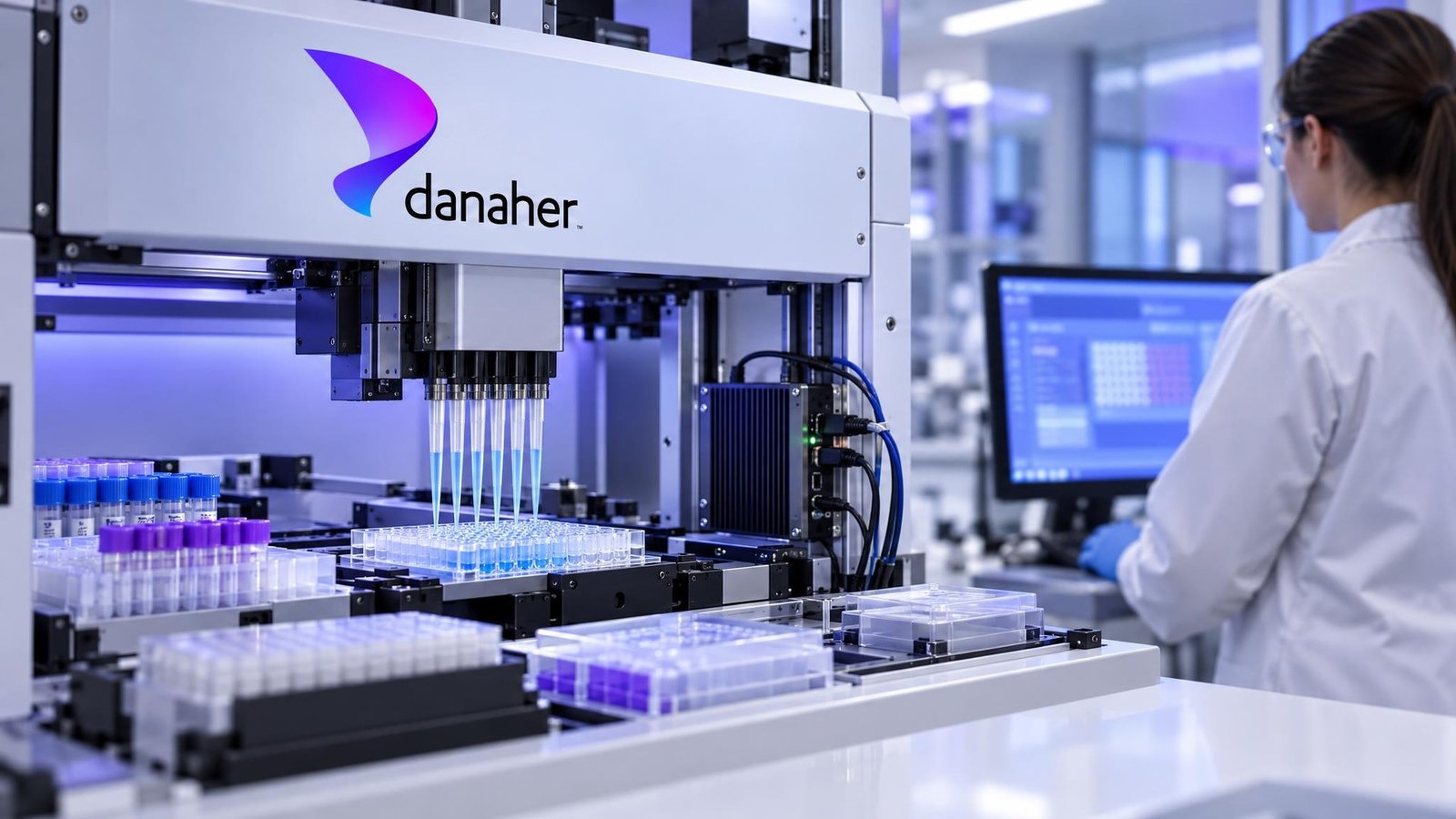
Inside the laboratory Danaher plans to run at Abcam, an experiment will be proposed by a model, built and tested by robots, and read by instruments whose results return to the model that proposed it. The loop is what researchers call design-make-test-learn, and it is the subject of a collaboration Danaher announced Wednesday with Nvidia.
The two companies are working to combine Danaher’s scientific instruments, automation equipment and laboratory workflow software with Nvidia’s accelerated computing. The stated goal is to shorten the distance between a prediction and the experimental evidence that would confirm or kill it, so that results from one round shape the design of the next.
The technical list is specific. Danaher and Nvidia are integrating artificial intelligence into instruments through edge computing devices such as Nvidia’s DGX Spark, accelerated analytics with RAPIDS, real-time inference and foundation models including BioNeMo Open Models. The companies are also exploring Nvidia’s Cosmos world models and Omniverse digital twins for instrument and workflow design. Initial work covers a select group of priority instruments, with expansion across Danaher’s portfolio left as a possibility.
“AI is reshaping how science is conducted,” said Julie Sawyer Montgomery, president and chief executive of Danaher, who took the job in August. Kimberly Powell, Nvidia’s vice president of healthcare, said the two are “bringing accelerated computing and physical AI into the lab,” and that the combination could help researchers “compress years of discovery into months.”
The partnership builds on work Danaher disclosed a week earlier. On Oct. 7, the company said its first AI-powered autonomous lab, based at Abcam, will design custom antibodies and other affinity reagents, build and test each design, and feed every result back into the model. It is expected to operate at scale in early 2027.
Danaher said the laboratory should deliver up to eight times faster discovery of affinity reagents and up to a tenfold increase in annual output, from tens of reagents a year to hundreds as the lab scales. Work is spread across Beckman Coulter Life Sciences, Cytiva, Genedata, Integrated DNA Technologies and Molecular Devices, with robotic orchestration developed with the automation firm Automata. JC Gutierrez-Ramos, Danaher’s chief science officer, said scientists “continue to make the key decisions,” leaving them the problems where judgment matters.
Trade press coverage noted what the release does not contain. No current cycle time at Abcam is given, so the eight-times figure has no baseline to measure against, and nothing is said about which reagents have been validated or how many. Shares rose about 2% before the open on Oct. 7, a modest response to a claim that would, if it holds, change the economics of reagent supply.
The broader pattern explains the caution. Nvidia has spent two years pushing BioNeMo into laboratories as a shared layer for biological models. In January, Eli Lilly and Nvidia committed up to $1 billion to build a continuous-learning discovery laboratory on the same premise of running experiments around the clock. Startups pursuing the approach have been valued at multiples of their revenue, and Nvidia’s partner list includes Eli Lilly and Thermo Fisher Scientific, a direct competitor of Danaher in instruments.
That is the competitive problem in one sentence. The chips and models Danaher is embedding in its instruments are available to its rivals, so an edge in autonomous experimentation cannot come from the processor alone. It has to come from the instruments, the software that schedules them and the experimental data the system generates.
The commercial case is less about selling a laboratory than about what a laboratory sells. Reagents are consumables, which means recurring revenue, and a system that designs and validates them faster can widen a catalog and shorten delivery times for custom orders. Danaher, with about 60,000 employees, has been reshaping itself around that kind of business for years, and it added diagnostics scale in June when it closed the $9.8 billion purchase of Masimo, funded partly with debt. Total borrowings stood at $26.6 billion at the end of June, up from $18.4 billion in December.
Investors get the next hard numbers on Oct. 21, when Danaher reports third-quarter results. Analysts expect revenue of $6.56 billion and earnings of $1.92 a share, according to consensus estimates, a quarter that will show whether its core instrument and diagnostics markets are growing fast enough to justify a science budget of this kind.
Two questions will decide whether the collaboration matters. The first is whether autonomous labs favor the company that owns the instruments or become a commodity layer that any instrument maker can buy. The second is who owns the experimental data. Danaher said the work will preserve customer choice in models, standards and technology providers, a promise that limits how tightly it can bind customers to its own stack.
For now the loop runs on a limited set of instruments, in one company’s lab, on reagents used in research rather than in therapies. The argument that experiments will teach models to design better experiments is easy to make and difficult to audit. The audit will arrive as reagents that either bind to their targets or do not, and no amount of accelerated computing changes what the assay says.



