
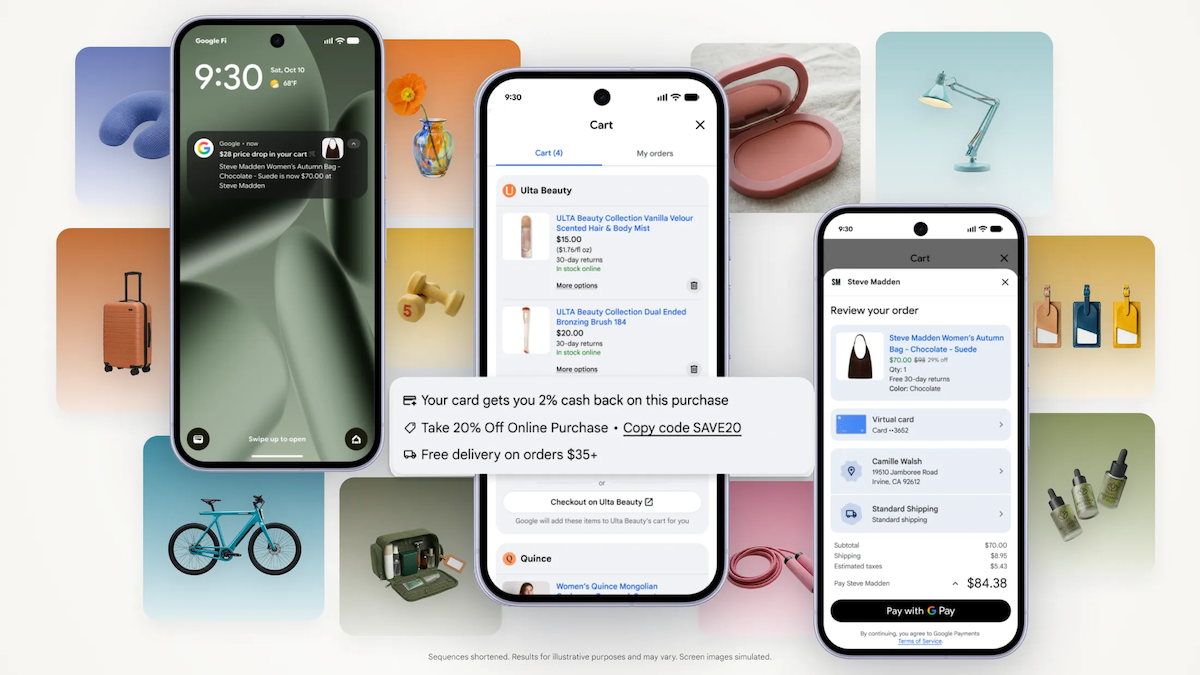
Google began opening its Universal Cart to users in the United States on October 15, a feature that keeps items from different retailers in one place and follows the shopper from search results into the Gemini app. Products chosen in either place land in the same cart, and the contents and their status survive a return visit days later.
The tool does more than collect links. It sends alerts when a price falls or an item comes back in stock, recommends which credit card to use based on the benefits that card carries, and tries discount codes at checkout. Payment runs through the Universal Commerce Protocol, the open standard Google published this year and has been promoting to merchants since.
Google previewed the feature at its developer conference in May and has spent the months since signing retailers and building the plumbing. Universal Cart is available first in the United States, which is where the company’s shopping ads are most developed and where its payment and identity infrastructure reaches the most users.
The strategic target is the moment between wanting something and buying it, which is where the largest advertising businesses in the world are built. A generic search sends a customer to a retailer’s site and the customer may never return to Google. A cart that holds the item keeps the company in the transaction and gives it a reason to send the customer back.
That is why the protocol matters more than the cart. If merchants adopt Google’s standard, they accept a set of rules for how their inventory, prices and loyalty programs are read by outside software. If they refuse, the feature works only with retailers that agree, and the aggregation that makes it useful shrinks.
Retailers are being asked to trade reach for disintermediation, the same bargain they made with marketplaces over the past two decades. The large ones built their own apps and membership programs precisely to avoid that trade, and their reaction will determine how complete the cart is. Google has not said which retailers have signed.
Gemini is the second half of the argument. Google has placed the assistant across search, the browser and its phone software, and a persistent cart gives the assistant something to act on. Comparing prices or checking whether a purchase was already made requires memory of what the user selected, which is exactly what a cart supplies.
Analysts said the cart is the most direct attempt yet by a company whose business was built on sending shoppers away to keep the transaction on its own surfaces. Advertising is the revenue model, though the company has not described how the cart will be monetized. A shopping surface that knows what a user considered, what they paid and what they abandoned is more valuable to advertisers than a page of results, and it is more valuable to Google than a click it does not get paid for.
Competitors are moving into the same space from different directions. Amazon has a cart by default and has added an assistant that can fill it. OpenAI has struck commerce arrangements with retailers and payment networks. Every company with a large consumer audience is trying to become the place where a purchase begins, and each is building the same capability with different assets.
The regulatory question follows the product. Google is subject to scrutiny over whether it favors its own services in search results, and a cart that steers users toward partner retailers raises the same issue in a new form. The company has said the protocol is open to any merchant that meets its requirements.
Merchants face a technical decision alongside the commercial one. Feeding live prices, inventory and shipping terms into another company’s cart requires integrations that a small retailer cannot build alone, which is why the protocol and the commerce platforms that adopt it matter more than the interface shoppers see. Those platforms already sit between merchants and the sites that send them traffic, and each new standard adds a layer that merchants pay for in fees or in margin.
Google has run shopping products before, including an attempt to sell goods directly that it eventually wound down, and it has learned that aggregating retail is easier to announce than to operate. Price and stock data go stale quickly, and a cart that shows a customer an item that is no longer available loses goodwill faster than it earned it.
For shoppers, the immediate benefit is convenience and the immediate cost is concentration. One cart across retailers eliminates the friction of separate accounts and abandoned tabs, and it gives a single company a record of what the customer wanted to buy, which is a more intimate dataset than a history of searches. Google has not detailed what it does with that data.
Early access is limited, and how the feature performs at scale is unknown. Promo code testing and card recommendations depend on integrations that vary by retailer and by issuer, and a cart that works at half the merchants returns the user to the problem it was meant to solve.
The company will measure success in completed purchases and in the retailers it signs, not in press coverage. What it has built is a container for other companies’ goods, which is a familiar position for Google and an uncomfortable one for the companies whose goods are inside it.



