The question put to Korea’s top financial regulator on Monday was procedural, and the answer was not.
At a parliamentary audit of the National Assembly’s political affairs committee, a lawmaker from the ruling party asked whether SK hynix’s plan to list its American subsidiary Solidigm on Nasdaq would amount to a dual listing. Lee Chan-jin, governor of the Financial Supervisory Service, said both the Financial Services Commission and his agency believe it does. He then added the qualification that matters more than the judgment: regulators are waiting for an authoritative legal interpretation of whether the offering would be subject to Korean securities registration rules.
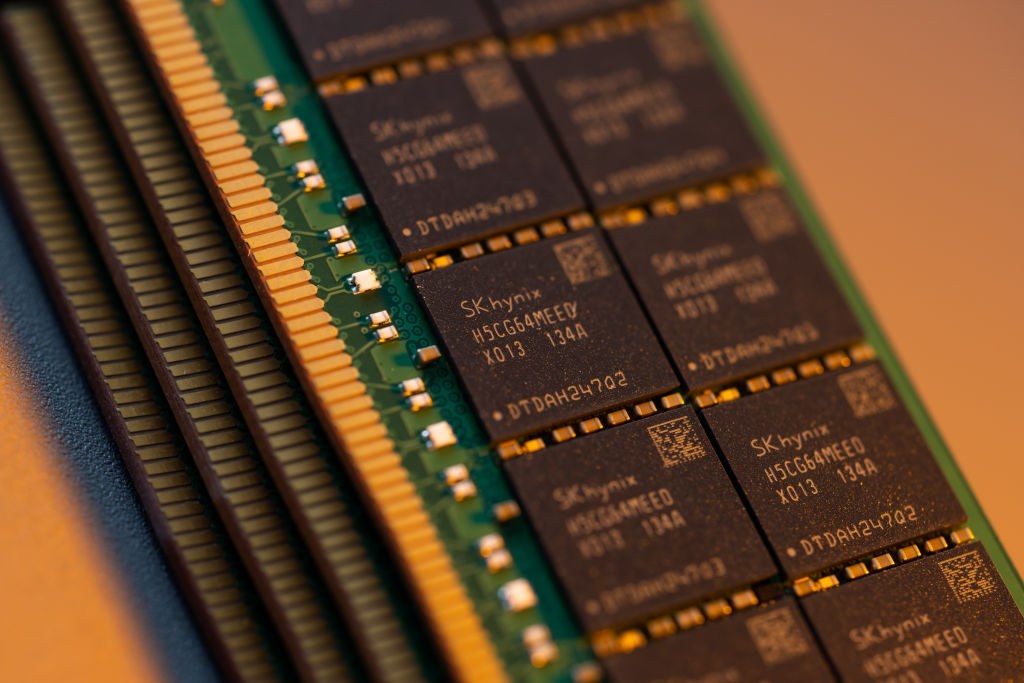
Solidigm is not a side project. It is the business SK hynix assembled from Intel’s NAND flash and solid-state drive operations, bought in two closings for about 9 billion dollars, and it is one of the few suppliers able to make the high-capacity drives that AI servers fill with training data. An offering in New York would give those assets their own currency, their own investor base and their own valuation, denominated in dollars, at a moment when memory pricing is rising.
That is precisely the objection. A shareholder who owns SK hynix owns Solidigm already, indirectly and at whatever multiple the Korean market applies to a memory manufacturer. A separate listing creates a second claim on the same cash flows, priced by a different market, and the parent’s stake becomes a holding rather than the business itself. If the new shares trade at a premium that the parent’s shares do not reflect, the value has not been created so much as relocated, and the people who funded the NAND acquisition do not get to choose whether to follow.
The lawmaker who raised it made a narrower and sharper point, according to Korean press accounts: SK hynix disclosed the risk a subsidiary listing poses to its own share price in American securities filings, and did not give Korean shareholders a comparable explanation. Whatever the legal merits, that is the kind of asymmetry that turns a technical filing question into a political one.
Korea has been here before, repeatedly. The country’s market has spent years absorbing the consequences of chaebol restructuring in which a subsidiary was spun off, listed at a valuation the parent’s shareholders had effectively financed, and then traded at a multiple the parent never received. The pattern became a retail-investor grievance, and the grievance became rules. Regulators have spent the past several years tightening the treatment of spinoffs and subsidiary listings, requiring more disclosure and more protection for minority holders of the parent. Lee’s remarks are the first time that framework has been pointed at an offering that would take place in another jurisdiction entirely.
Which is where the practical problem sits. Under current statutes, Korean regulators do not have the authority to stop a company from listing abroad. They can require registration, and they can make the process expensive and slow. What they cannot do, on the governor’s own account, is forbid it. The pressure available is procedural, and procedure is a slow weapon against a transaction that has already been prepared.
SK hynix’s position has been that a listing would fund the subsidiary and give it access to capital markets that value memory assets at a different rate than Seoul does. That argument is not frivolous. NAND has been the volatile half of the memory business, prone to oversupply and price collapses that a stand-alone company with its own balance sheet can absorb more easily than a division inside a group whose main franchise is DRAM. The industry’s current cycle, driven by AI storage demand, is the best window in years to price such an asset.
The counterargument is about who bears the downside of that flexibility. A spin-off that raises money at a high multiple is a good outcome for the subsidiary and a defensible one for the parent, provided the parent’s holders are compensated for giving up a claim they did not agree to surrender. When the listing happens offshore, the mechanism for that compensation is unclear, and the disclosure obligations that would force the conversation in Seoul do not automatically apply in New York.
There is also a compliance question with a longer tail. If the FSS concludes that the offering requires Korean registration, the timing of the IPO moves into a process the company does not control, and the disclosure that process demands would put the internal economics of Solidigm in front of Korean retail investors before American institutions see them. Companies in this position usually discover that the cleanest path is a settlement: a shareholder-return commitment, a valuation opinion, an independent review, in exchange for regulators declining to test their authority in court.
What the exchange in the National Assembly established is that the regulator has decided to say out loud what it thinks. Lee did not claim a power to block the deal. He said the agency is watching, that it considers the structure to conflict with its rules, and that it is waiting on an interpretation. Each of those statements is a signal to the company about the cost of proceeding without an agreement.
For investors, the relevant date is not the listing. It is the interpretation, because that document will determine whether a Korean company can put its most valuable offshore asset into a foreign vehicle and leave the parent’s shareholders with a minority interest in someone else’s valuation.
SK hynix has not withdrawn anything. Seoul has not blocked anything. The offering is still a plan whose legality is being decided by an opinion nobody has written yet.