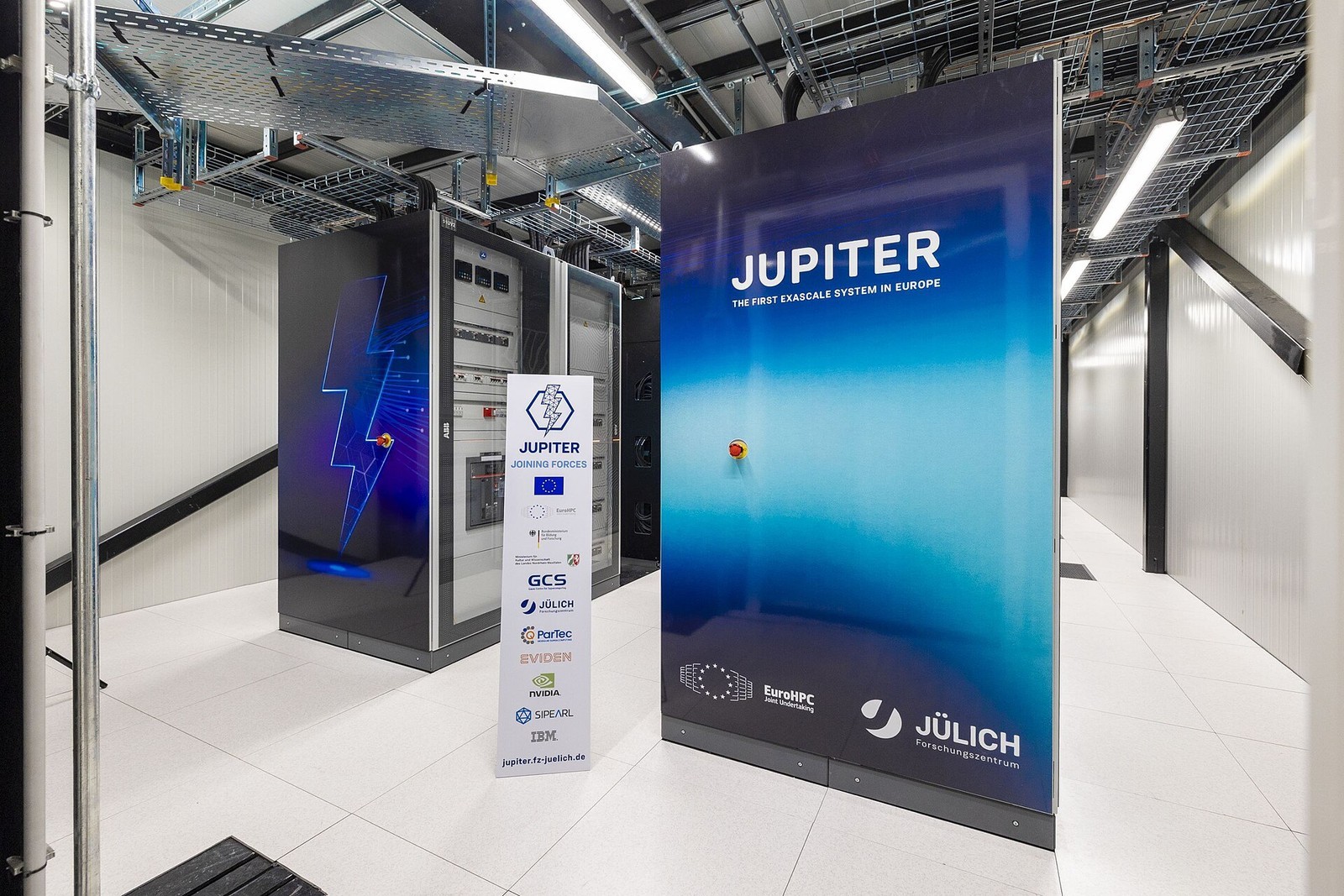
The machine hall at Forschungszentrum Jülich, west of Cologne, holds Europe’s first exascale supercomputer, a system called JUPITER built around 5,884 nodes of Nvidia’s Grace Hopper superchips. On October 19 Nvidia said researchers had used 8,192 of those GPUs to simulate a 104-qubit quantum processor running a fault-tolerant protocol, the largest simulation of its kind the company has published.
The work modeled magic state preparation, one step in a class of error-correction schemes called magic state cultivation. The protocol starts with a small distance-3 color code, checks it for faults, and grows into a distance-7 hybrid code before further rounds and readout. The 104 qubits include both the data qubits and the auxiliary ones used across the sequence.
What makes the simulation unusual is the noise. The model includes coherent phase errors, which accumulate and interfere with one another rather than behaving like random flips, and leakage, in which a superconducting qubit drifts out of the two levels it is supposed to occupy. Selected sites in the circuit were given a third energy level so that the drift could be represented. Simulating that behavior is what turns a circuit diagram into a prediction about a machine that does not exist.
The claim attached to the result is a reduction of about 90 percent in the number of physical qubits needed to reach fault tolerance, compared with earlier approaches. That number matters because the obstacle to useful quantum computing is not the qubit count on the brochure. It is the ratio between physical qubits and the logical ones an algorithm can actually use, and that ratio has been brutal: error rates near one in a thousand imply thousands of physical qubits for each reliable logical one.
Magic states are the expensive part of the problem. Most operations in a quantum error-correcting code belong to a class that can be simulated and corrected cheaply. The operations that give a quantum computer its advantage over a classical one require a state that is difficult to prepare and easy to get wrong, and producing those states consumes a large share of the machine’s resources. Cultivation is a way of distilling them inside a small code and growing the result, and its overhead is one of the open design questions in the field.
“Useful quantum computing will require fantastically complex, fault-tolerant systems, and understanding how they behave at scale is essential to building them,” Jensen Huang, Nvidia’s chief executive, said in the announcement. Kristel Michielsen, who directs the Jülich Supercomputing Centre, said the European investment in JUPITER gave researchers the ability to investigate questions that had been out of reach.
Both statements are accurate and both are promotional. Nvidia sells the classical half of a hybrid machine: the GPUs that calibrate qubits, compile circuits and run the simulations that quantum hardware teams use to design their next chip. If quantum computing becomes useful, the company intends to be the supplier of the computer that sits next to it. If it does not, the company still sells the simulation.
JUPITER itself is a European project with a 500 million euro budget covering acquisition and operation, procured by the EuroHPC Joint Undertaking and built by a consortium led by ParTec and Eviden. Its booster module delivers about one exaflop of double-precision performance on the standard benchmark, with considerably more in the lower precisions that AI and simulation work use. The cluster module runs on Rhea1, the first European-designed high-performance processor, made by SiPearl, alongside AMD chips.
The limits of the result are worth stating. A 104-qubit simulation is not a quantum computer, and the noise model, however detailed, is a model. A machine with a thousand logical qubits would require hundreds of thousands of physical qubits, and no laboratory has built anything close. The value of the exercise is that it lets a hardware team rule out a design before spending four years and a billion dollars fabricating it, which is how the semiconductor industry has always worked.
The competitive picture gives the result its edge. IBM has published a roadmap toward machines with a few hundred logical qubits by the end of the decade, Google has demonstrated error correction below threshold on its superconducting processors, and a group of startups is pursuing trapped ions and neutral atoms on different timelines. All of them depend on classical simulation to validate designs, and all of them are competing for the same scarce engineering talent.
For Jülich, the simulation is a use of the machine that its funders can point to: a European asset producing results that a company in California needed. For the quantum industry, it shows how much of the work still happens on classical hardware, and how far the design tools have run ahead of the fabrication.
The next version of the experiment will carry more qubits and a more complete noise model, and it will run on the same GPUs. The gap between what can be simulated and what can be built is closing slowly, from both directions.