Intel’s Arizona Buildout Reaches the Tooling Stage
In chip manufacturing, the building is the cheap part. A finished cleanroom shell proves a company intends to make semiconductors; the machines that go inside prove it can afford to. Intel crossed that line this week in Arizona.
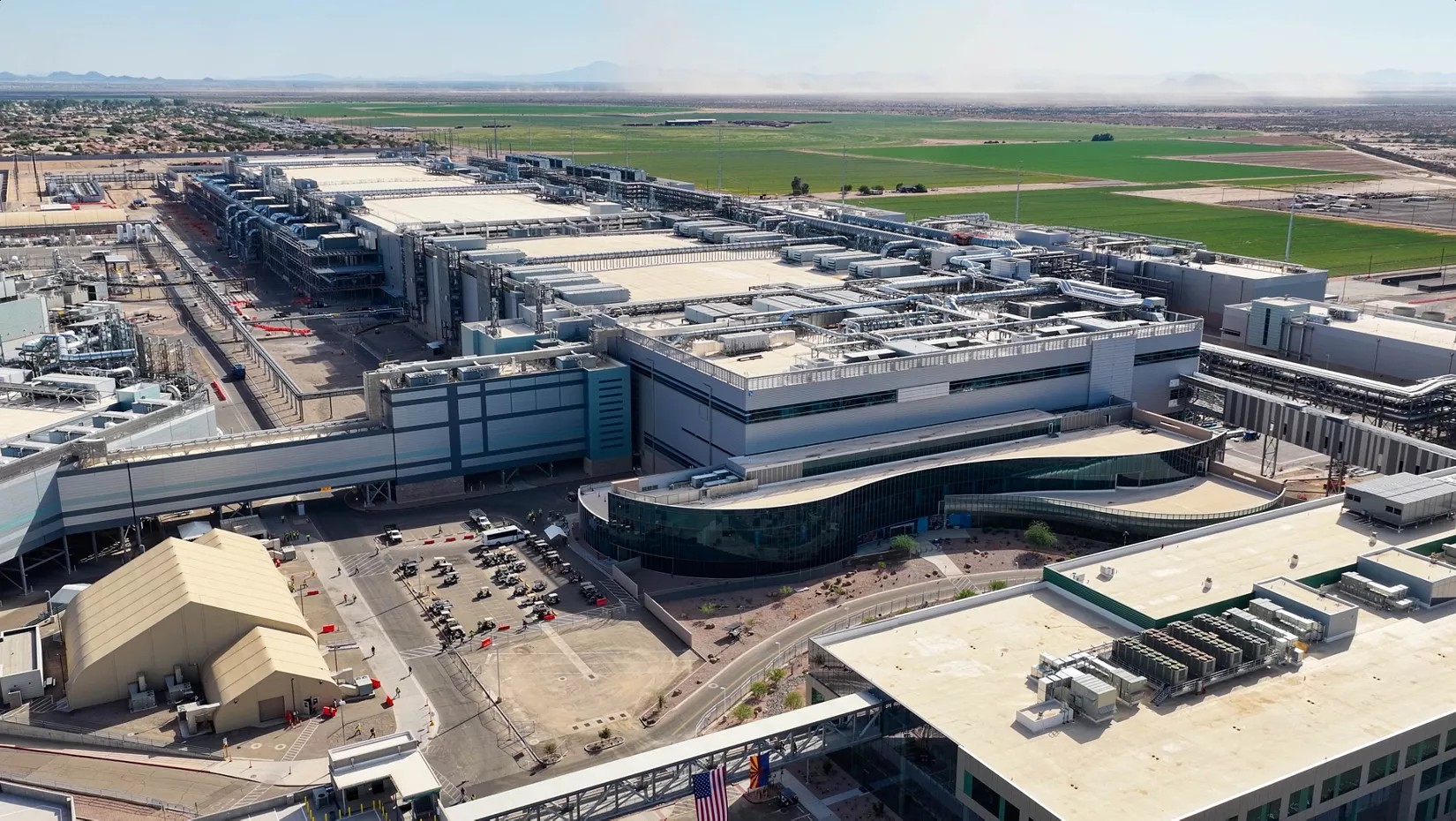
The company said production tools are now being installed at Fab 62, its sixth high-volume factory at the Ocotillo campus in Chandler, Ariz., and that workers had set the first major structural truss at its Ohio One site in New Albany. Intel pointed to recovering demand for CPUs in AI servers as the reason for the pace, according to Digitimes, which reported the moves on Oct. 22. The company did not disclose a new investment figure.
Fab 62 sits beside Fab 52, which began high-volume manufacturing on Intel’s 18A process in October 2025, the first plant anywhere to run a sub-2-nanometer-class node at volume. Intel has said Fab 42, Fab 52 and Fab 62 together represent about $32 billion of investment, with the two newest accounting for roughly $25 billion in tools and infrastructure. Fab 62 is expected to be operational before the end of 2028.
Intel has not said which process the new plant will run. Analysts, including at Piper Sandler, have described it as swing capacity — space that can absorb demand for whichever node needs room, whether 18A, its variant 18A-P, or the next-generation 14A. The company has also not disclosed wafer capacity.
Tool installation is the point at which a fab stops being a construction project. A single high-NA extreme-ultraviolet scanner costs roughly $350 million and arrives in hundreds of crates; a leading-edge fab needs dozens of etchers, deposition reactors, implanters and metrology systems, and the full set can run past $10 billion before a wafer is sold. Intel has confirmed that high-NA lithography will support high-volume manufacturing from 2028.
The Ohio news was more restrained. The $28 billion New Albany project, managed by Bechtel, covers 2.5 million square feet of buildings and about 600,000 square feet of cleanroom. The first truss marks the start of above-ground work after years of foundation pouring and delay. Intel now expects the second module to be complete in 2031 and producing in 2032, at least five years behind the 2025 target it set when the project was announced in 2022.
Money is attached to those dates. Intel has received at least $1.5 billion in CHIPS Act funding earmarked for New Albany. Ohio’s own grants of $300 million per factory were conditioned on construction being finished by the end of 2028, a deadline the site cannot now meet.
A federal clock is running as well. The advanced manufacturing investment credit was raised to 35% under legislation signed in July 2025, but only for facilities whose construction begins before Dec. 31, 2026. Fab 62’s tool work and Ohio’s truss both count as active construction. Any site Intel wants to qualify later would need ground broken within weeks.
The demand argument behind the spending is narrower than it sounds. Intel’s server business spent years ceding share to Advanced Micro Devices, and the AI buildout has so far rewarded makers of accelerators more than makers of general-purpose processors. The case for a CPU recovery rests on inference, where models run continuously and orchestration falls to the host chip, and on the on-premises deployments that cannot be filled with GPUs alone.
Whether that demand arrives on schedule is what the capital spending now bets on. Under Chief Executive Lip-Bu Tan, Intel has said it will not fund 14A volume production without a committed external customer, and the foundry unit has named few. Fortinet became the first publicly identified external customer under Tan, for a security processor built on an older node.
The 18A ramp therefore carries two jobs. It has to supply Intel’s own products, from Panther Lake notebooks upward, and it has to convince outside designers that the process yields well enough to bet a product roadmap on. Fab 62’s tools will be calibrated against both tests, and the cost of failing either one is now embedded in concrete.
Intel’s rivals are building in the same desert. TSMC’s Arizona cluster is aimed at a large share of its sub-2-nanometer capacity, and Samsung has its own Texas plans, though narrower than once advertised. What Intel sells alongside capacity is a domestic supply chain that includes mask-making, which neither competitor operates in the United States at the leading edge.
None of that settles the arithmetic. A fab becomes a fixed cost the day the tools go in, and fixed costs demand volume. Intel has committed the building, the machines and the timetable. It has not yet shown the customers.
Will the equipment now moving into Chandler make chips for Intel’s own catalog or for someone else’s designs — and does $25 billion buy a second act, or merely a longer bill?