Moody’s Raises TSMC to Aa2, Citing AI Demand and Advanced-Node Lead
Moody’s Ratings lifted its issuer rating on Taiwan Semiconductor Manufacturing Co. to Aa2 from Aa3 on Wednesday, moving the world’s largest contract chipmaker two notches below the agency’s top grade. The outlook was revised to stable from positive.
The agency also raised senior unsecured ratings across TSMC’s financing subsidiaries. Aa2 sits in Moody’s high-grade band, one step below Aa1 and three below Aaa, a level few manufacturers of any kind have reached in recent years.
Underneath the decision is arithmetic that has become familiar to anyone tracking the AI buildout. TSMC’s third-quarter revenue rose 51% from a year earlier, and advanced nodes accounted for 79% of wafer revenue. Moody’s expects annual revenue growth of 30% to 45% over the next 12 to 18 months, with earnings before interest, taxes, depreciation and amortization widening toward 75% of sales as optimization across nodes offsets the cost of bringing up 2-nanometer production and new overseas plants.
The balance sheet gives the agency room to be generous. TSMC held roughly 4 trillion New Taiwan dollars in cash and marketable securities at the end of September, a cushion that covers years of capital spending even if demand softens. Shares closed at 2,420 New Taiwan dollars on Wednesday and have gained about 56% this year.
Credit upgrades for a company this large are unusual, and the timing says as much about the buyers as the seller. TSMC’s customers include Nvidia, Apple and Advanced Micro Devices, all of which have committed to capacity years in advance and, in some cases, prepaid for it. That ordering pattern converts what used to be a cyclical foundry business into something closer to a contracted utility, at least for the leading-edge portion of the output.
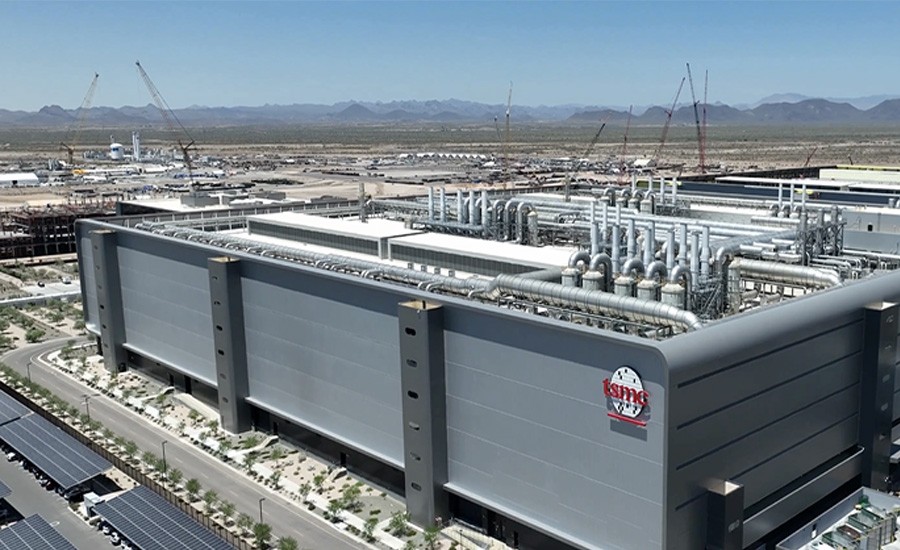
It also changes the cost of money. A higher rating lowers the spread TSMC pays when it borrows to build fabs in Arizona, Kumamoto and Dresden, projects that carry political as well as financial weight. Those plants cost more per wafer to run than the company’s Taiwanese facilities, and the gap is easier to absorb when debt is cheap and margins are near 75%.
Upgrades of this kind have been rare for TSMC, which spent most of the past decade at Aa3 while carrying the capital costs of each new node. The company’s own guidance has emphasized gross margin discipline over volume, a stance that helps a credit story and frustrates customers who want more wafers sooner.
Moody’s framed the upgrade around three things: technical leadership at the most advanced nodes, demand visibility tied to artificial-intelligence orders, and a financial structure sturdy enough to absorb a downturn. The agency’s own projection of 30% to 45% growth assumes AI spending holds, which is the part of the thesis no rating can verify.
The company’s capacity utilization has recovered over the past two years as AI orders arrived, after a stretch in 2023 when the chip industry worked through a post-pandemic inventory glut. Advanced packaging, the step that stitches memory to logic for AI accelerators, has been the tighter constraint for much of that period, and TSMC has been adding capacity there faster than at any point in its history.
For suppliers, the upgrade filters down. Equipment makers and materials vendors in Taiwan, Japan and the Netherlands price their contracts partly off the credit of the customer they are financing, and a stronger TSMC shortens the working capital cycle for the smaller firms that depend on it. For competitors, it widens an advantage that is already hard to close: Samsung Foundry and Intel Foundry both need years of yield improvement before they can bid for the same leading-edge work, and neither enjoys the same borrowing terms.
Analysts said the rating action mostly confirms what the bond market had already priced. TSMC’s spreads have traded tight through the AI cycle, and the equity has been a proxy for the entire supply chain. What the upgrade adds is a public statement from an agency willing to put a high-grade label on an AI-dependent revenue forecast. For portfolio managers who cannot hold paper below a certain threshold, the notch matters more than the spread does.
That is also where the risk sits. A credit rating is a view about the next downturn as much as the next quarter. If AI capital spending plateaus, the 79% concentration in advanced nodes becomes a vulnerability rather than a moat, and overseas fabs with higher unit costs become a drag instead of a hedge. Geopolitics does not appear in the agency’s arithmetic in any explicit way, though every buyer of TSMC paper prices it privately.
Moody’s answer to that is the liquidity position: 4 trillion New Taiwan dollars is enough to keep building through a bad year. Whether the AI order book that justified the upgrade is a structural shift in computing demand or a very large inventory build is the question the next two years of wafer starts will answer.