Spotify Technology SA spent two years telling investors that user growth and profit were no longer a trade-off. On Thursday the streaming company posted the kind of quarter that tests the claim: listeners kept arriving, revenue kept climbing, and earnings still landed a fraction below what analysts had modeled, ending four consecutive quarters of beats.
The Stockholm-based service ended September with 788 million monthly active users, up 1% from the prior quarter, and 306 million paying subscribers, up 2% sequentially and 9% from a year earlier. Both figures edged past the average analyst estimate. Revenue rose 14% at constant currency to EUR 4.97 billion.
Profitability is where the arithmetic tightened. Operating income of EUR 672 million matched the EUR 671.8 million analysts had forecast, but total costs rose as the company funded AI features, podcasting and audiobook expansion, with operating costs approaching EUR 1 billion. Earnings per share came in at $2.79 against a consensus of $2.85.
The miss is small in absolute terms and awkward in timing. Spotify had beaten expectations in each of the previous four quarters, a run that persuaded investors the business had crossed from subsidized growth into durable margin expansion. Shares have been priced for that story rather than for subscriber additions alone.
Revenue, too, came in a shade light: EUR 4.97 billion against a consensus near EUR 4.98 billion, a gap narrow enough to sit inside rounding but wide enough to keep the company from claiming a clean sweep of the quarter’s targets.
What the company is buying with the added expense is engagement. Its AI DJ assembles personalized mixes with spoken commentary, and prompt-based playlists turn a described mood into a queue. Management has argued that better discovery lifts both conversion from the free tier and retention among paying users, which in turn supports the price increases the company has pushed through in recent years.
Competition gives the spending urgency. Generative music tools such as Suno and Udio let anyone produce a passable track from a text prompt, and Spotify has responded by negotiating licensing terms rather than litigating. This week it announced a deal with distributor Believe for an upcoming paid tool for fan-made AI covers and remixes, following agreements with Universal Music Group, Merlin and Kobalt.
Ad-supported listening supplied part of the quarter’s lift. Growth in advertising revenue outpaced the subscription side, though the ad business remains smaller and more cyclical, exposed to whether brands keep spending through the holiday period. Music rights costs, which scale with listening, remain the largest single claim on revenue.
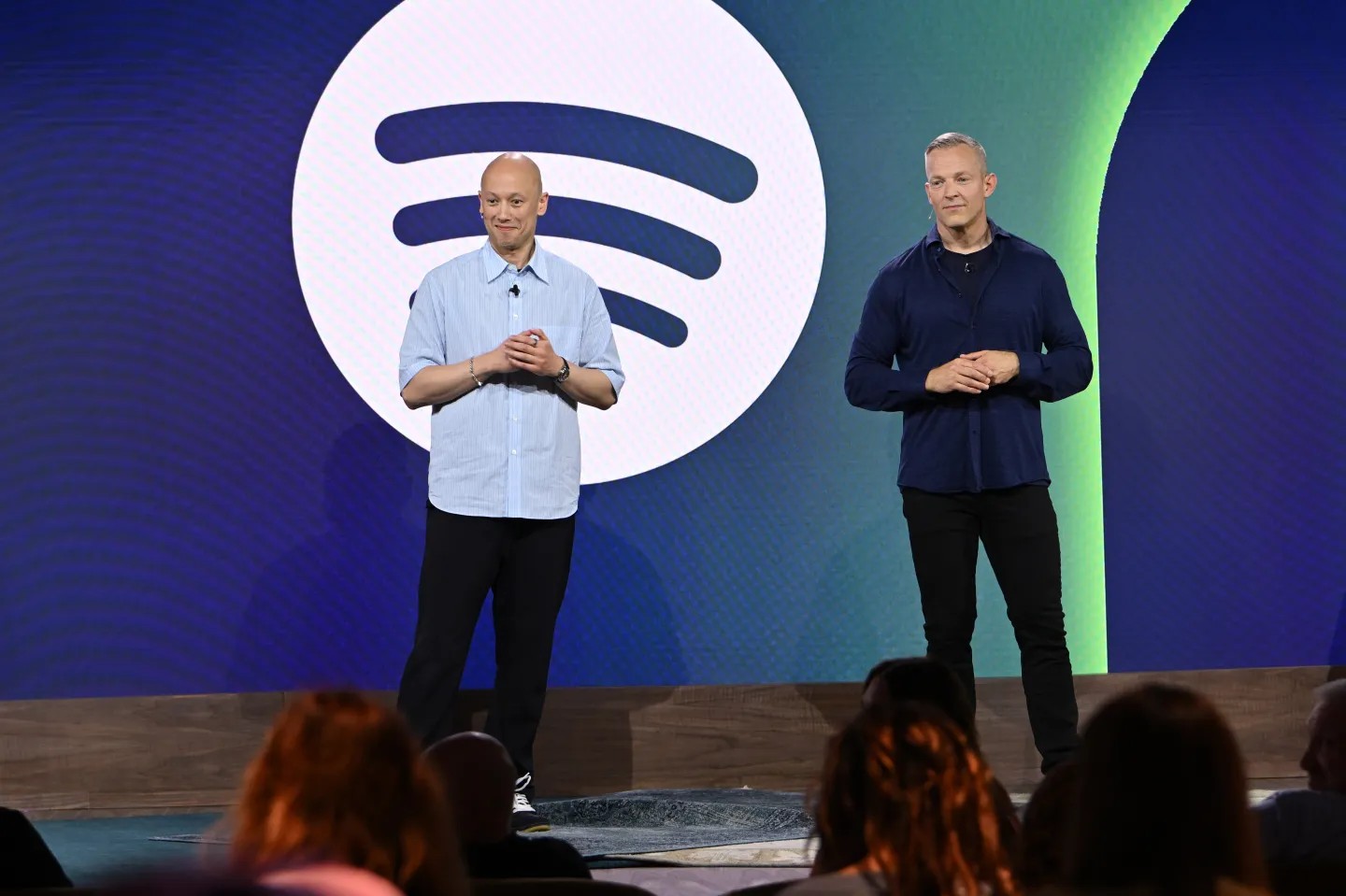
“We’ve built a strong business that keeps compounding, we invest when we see a path for growth, our costs are moderating, and there is more runway ahead,” co-CEO Alex Norstrom said in a statement accompanying the results.
The fourth-quarter outlook leans on that argument. Spotify guided to operating income of EUR 820 million against a consensus of EUR 813.4 million, and to 316 million premium subscribers, above the 314.7 million analysts expected. Its forecast of 818 million monthly active users came in a hair below the 819 million consensus, a reminder that the free tier is maturing in markets where penetration is already high.
The subscriber math explains the strategy. With 788 million listeners and 306 million paying, roughly 39% of the base converts to a paid plan. Each additional point of conversion is worth more than a comparable gain in users, because premium revenue arrives without the content and delivery costs of ad-supported streaming. Price rises do the rest, at the cost of churn risk in markets where a monthly subscription competes with groceries for the same household budget.
Analysts said the quarter’s real test was cost discipline rather than demand. Spotify has spent heavily on podcasting deals, audiobooks and, more recently, machine-learning infrastructure, and investors have grown sensitive to any sign that expenses are outrunning revenue. A single penny of earnings shortfall would matter little on its own; a pattern of them would reopen the question of whether the margin story was a cycle rather than a reset.
The company’s position is unusual among streaming platforms in that it owns no studios, no labels and no networks. It pays for content, packages it and sells attention, which makes gross margin a function of licensing terms and scale rather than of hit production. That structure has produced steady improvement, but it also means the company has little room to absorb a jump in royalty rates or a slowdown in advertising.
The holiday quarter will settle part of the argument, since it bundles the year’s biggest ad spend with the strongest period for gift subscriptions and device activations. A beat there would restore the streak’s logic. A second consecutive miss would suggest the company is paying more for growth than it told investors to expect.
What remains open is whether Spotify can keep converting free listeners at its current rate while absorbing the cost of AI features that, so far, generate engagement rather than revenue of their own.