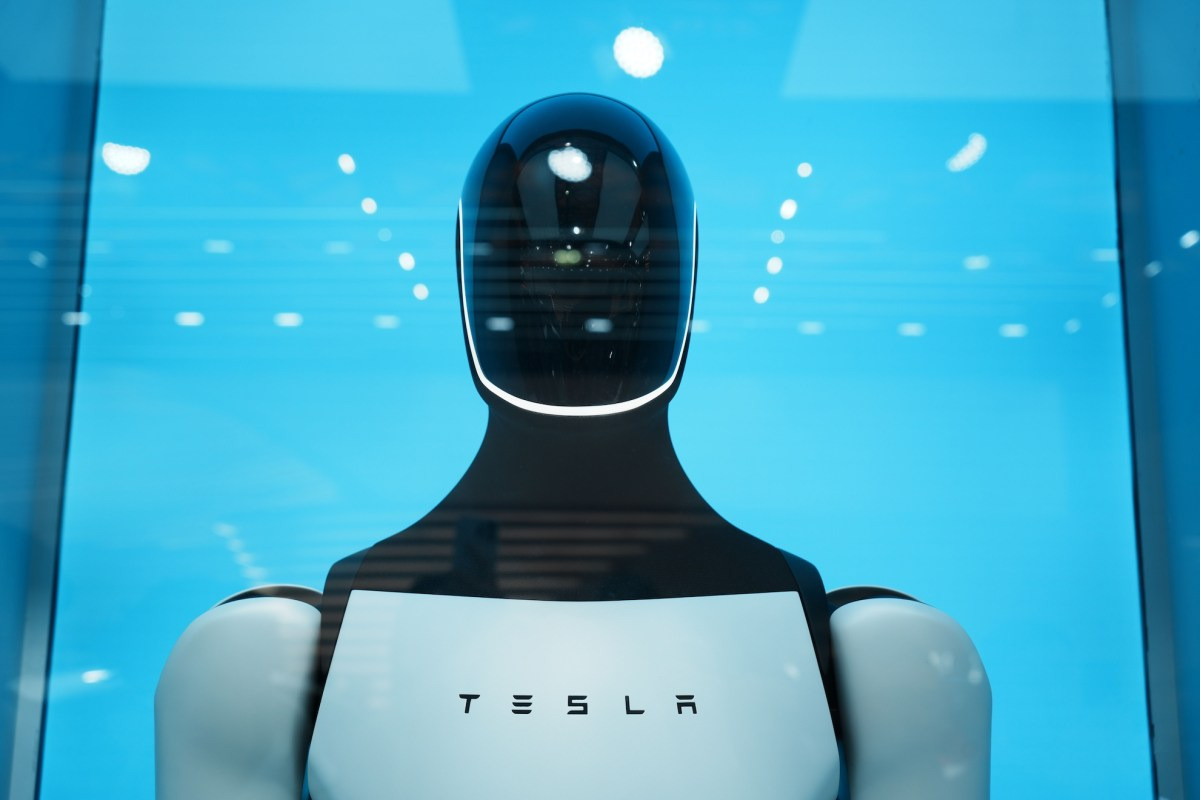
Tesla’s quarterly filing contained a sentence the company had been promising for four years. Optimus, the humanoid robot, has come off the production line at the Fremont factory in California. The first units are production-quality versions rather than prototypes, and the floor space they occupy was freed when part of an existing vehicle line was retired.
The same document, and the earnings call that followed, contained the correction. Elon Musk told analysts that deliveries to outside customers would not begin until around the end of 2027, pushing back a date investors had been treating as near.
The bottlenecks he named were specific: hands, durability, and the AI that lets a robot operate in an unstructured room. Musk has said before that the hand is the hardest engineering problem in the program, because a human hand has more degrees of freedom than most actuators can reproduce, and because a robot that cannot grip cannot do useful work.
Tesla’s long-term target is 20,000 units a week. At that rate the company would build roughly a million robots a year, more than it builds cars, and it would need factories that do not exist. The figure describes a direction of travel rather than a forecast, and Musk has a long record of timelines that slip by years.
What has changed is that the program now has a line, a version and a place in the financial statements. For most of the past four years Optimus was a stage prop and a recruiting tool. A production line at Fremont changes the internal politics: the robot must compete for floor space, capital and engineering attention with the vehicle programs that pay the bills.
The robotaxi report published alongside the earnings shows the contrast. Tesla said its driverless fleet covered 3.1 million miles between January 22 and October 18 with no injuries, and named Las Vegas, Phoenix, Jacksonville and San Antonio as the next cities. Those numbers describe a software business that grows by adding vehicles and geofences. A humanoid robot grows by building machines, one actuator at a time.
That asymmetry explains why Musk put the robot and the taxi in the same call, and why the market treated them differently. The taxi business has revenue, a safety record and a city-by-city rollout. The robot has a line and a customer date three years out.
The competitive field has filled in. Figure has placed robots in BMW’s South Carolina plant. Agility’s Digit has worked in warehouse operations for GXO. Boston Dynamics is commercializing an electric Atlas. Chinese manufacturers including Unitree have pushed prices down sharply, which matters to any customer weighing a robot against a worker’s wage.
Tesla’s argument is that vertical integration wins. It builds its own actuators, designs its own batteries, and has a manufacturing culture that survived a production ramp which nearly ended the company in 2018. Musk has described Optimus as the product that could make Tesla worth an order of magnitude more than its car business.
Investors have heard that claim before, and the stock’s reaction to the call was muted. Analysts who cover the company have started to model the robot as an option rather than a business, assigning it a value in a sum-of-the-parts calculation without a revenue line.
The 2027 delivery date has a practical consequence for buyers. Companies that expected to put humanoid robots into warehouse or factory work in 2026 will go to competitors, and the customers Tesla loses in the first wave may not come back. Industrial buyers tend to standardize on a platform once they have wired it into their own software.
There is also the question of what the first units are for. Tesla said they are production-quality, which in its language means built to the specification it intends to sell, but the company has not said who will operate them or where. The likely answer is inside Tesla’s own factories, doing the repetitive material handling the company has struggled to automate.
That internal deployment is the real test. A robot that works a shift in a Tesla plant produces data, and data is the input the AI needs to become competent. The 20,000-a-week target depends less on the factory than on whether the software can generalize from a controlled cell to a messy floor.
The hand is where that gets decided. A robot that can pick up a part it has never seen and place it without a fixture is a different product from one that repeats a taught motion. A three-year timeline for outside delivery implies Tesla expects to close that gap in-house first.
Suppliers have their own version of the problem. Actuators, harmonic drives and sensors are the constrained components, and the companies that make them are allocating capacity to whichever robot program commits to volume. A customer who says 2027 gets a place in the queue; a customer who says next year gets a purchase order.
For now the progress Tesla can claim is narrower than the headline suggests and larger than the skeptics allow: a humanoid robot in production at an American car plant, in a building where cars are also built, with a customer date that has moved to the right. The next quarterly filing will show whether the line is running or idling.