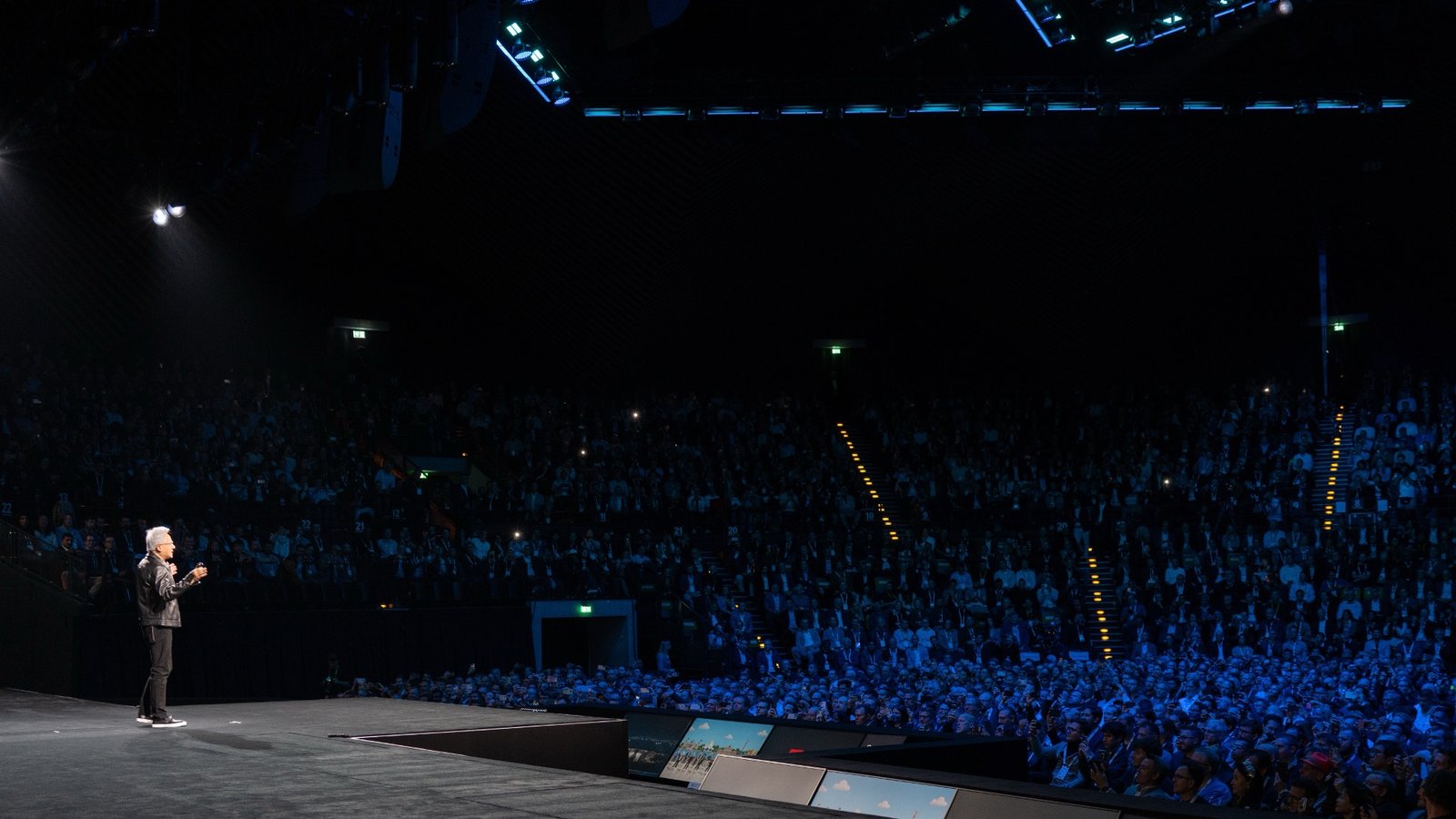
Jensen Huang rarely gives a price without a product attached. At GTC Berlin on Oct. 22, asked how Nvidia intends to charge for software, the chief executive offered a figure that no press release had mentioned and no contract yet reflects. About $2,000 per GPU per year, he said, to run all the software Nvidia provides that puts agents to work on an AI factory. He added that software licensing will become an increasingly large part of the company’s business.
The number traveled quickly because it invites arithmetic. Five million GPUs under paid license at $2,000 each would produce $10 billion a year, and $50 billion over five years if every customer renewed. That scenario was sketched by the analyst newsletter FourWeekMBA, not by Nvidia. The company has not said how many GPUs would fall under the fee, which products the license would cover, when it would take effect, or whether it replaces anything.
Those omissions matter because Nvidia already sells enterprise software. AI Enterprise, the bundle of libraries, inference microservices and support that most large customers run, lists at $4,500 per GPU for a one-year subscription. The $2,000 figure is lower, but Nvidia has not said the two cover the same ground. It would be a mistake to read the remark as a price cut. It could equally be a second, narrower license stacked on top of the first, or an entry price for customers who have so far bought chips and nothing else.
The ambiguity is characteristic. Nvidia’s software business has grown without ever being broken out in its financial statements, which is convenient when the company wants to argue that its margins are defensible and awkward when investors ask what the software actually earns. Huang has spent two years telling audiences that Nvidia is not a chip company. On the BG2Pod podcast he put it plainly: “One of these days, people might not categorize us as a chip company anymore.” He pointed to work in health care, automotive, telecommunications and life sciences, where Nvidia sells a stack rather than a part.
What sits behind the fee is the agent problem. A model that answers questions is cheap to serve. A model that takes actions inside a corporate network, calls tools, reads files and moves money is not, because every action needs identity, permissions, logging and a way to stop it. Nvidia has been building that layer, and bundling it is a way to convert a hardware relationship into a subscription. Customers who rent GPUs by the hour from a cloud provider may find themselves paying Nvidia separately for the software that makes the rental useful.
Whether they accept the charge is a different question. The buyers are a small group of hyperscalers, neoclouds and sovereign AI projects, and all of them negotiate hard. Amazon, Google and Microsoft design their own inference stacks and have every incentive to route around a per-GPU tax. Neoclouds that resell capacity on thin margins would have to pass the fee through, which makes their hourly rates less competitive against the hyperscalers they are trying to undersell. Enterprise customers, meanwhile, have spent a decade learning to distrust per-core and per-socket licensing, and the auditors who enforce those contracts are not fond of ambiguity about what counts as a covered processor.
There is precedent for what happens when an infrastructure vendor reprices software after the hardware is already installed. Broadcom’s overhaul of VMware’s licensing in 2023 and 2024 turned multiyear contracts into bundles priced per core, and the customer reaction was loud enough to become a board-level topic at large enterprises. Nvidia’s position is stronger, because there is no substitute for CUDA at the scale its customers operate. That strength is precisely why a public number is useful: it tests the market’s tolerance before any contract is written.
The $2,000 figure also lands on a specific debate inside the industry about where value accrues. Chips are sold once and depreciate over five or six years. Software is sold every year and renews. A company that can attach a recurring fee to a depreciating asset converts a cyclical business into something closer to an annuity, and the multiple investors pay for annuities is higher. Huang has said the company’s software business will grow faster than hardware for years. A number, even an illustrative one, gives analysts something to model.
Skeptics will note that Nvidia has floated prices before without shipping products to match. The company announced a software subscription for autonomous vehicle fleets, then folded it into other offerings. It has bundled libraries free for a decade because free libraries sell GPUs. Charging separately risks slowing the adoption that made the hardware dominant.
Huang’s phrasing left room for all of it. He described the fee as an example, in the middle of an answer about agents, at a conference whose theme was infrastructure rather than software. The company’s most senior executives have a habit of stating prices before the products exist, and customers have learned to treat those statements as directional.
What is not in doubt is the direction. The margin on a GPU sold into a cluster is fixed at the moment of sale. The margin on software attached to that GPU recurs for as long as the cluster runs, and Nvidia’s installed base is now measured in the millions of units. Whether the number settles at $2,000, $4,500 or somewhere between them, the company has told its customers where the next invoice will come from.